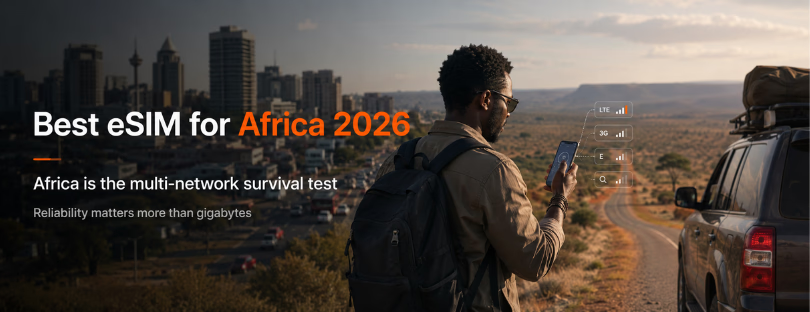
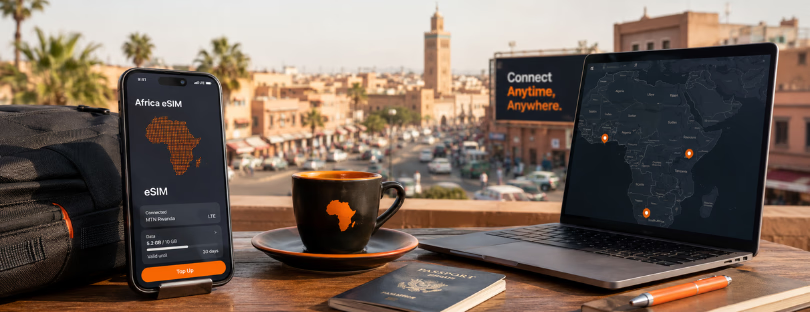
You can land in Nairobi, Cape Town, Lagos, Marrakech, or Accra and get a solid connection in the city, then drive 90 minutes and watch your phone move through a sequence of realities: great LTE, weak LTE, 3G fallback, edge-of-coverage limbo, then back again. In some places, the biggest issue is not speed. It’s attaching at all.
That’s why “Best eSIM for Africa 2026” is not a listicle topic. It’s a reliability topic.
Because Africa exposes resilience weaknesses brutally.
Why Africa is different
Two facts explain most of the traveler experience.
First: mobile broadband coverage is not uniform. ITU’s Africa region stats highlight that by 2024, mobile broadband covered about 86% of Africa’s population, and the coverage gap is worse in rural areas (reported as a higher rural coverage gap).
Second: even where coverage exists, quality and consistency vary sharply by market and by location. Opensignal’s Africa-focused reporting also emphasizes the unevenness of mobile experience across the continent.
So for travelers and remote workers, the “Africa problem” becomes a combination of:
latency spikes that make apps feel unstable even when you have signal
What we tested for Africa 2026
For this region, headline download speed is the least interesting metric.
Our performance focus was:
Attach success rate
Does the eSIM connect quickly after landing, after airplane mode toggles, and when moving between neighborhoods or towns?
Manual vs automatic network switching
When the first partner network is weak, does it recover by itself, or do you need to manually select a network?
Latency spikes
Not average speed. The sudden spikes that break calls, make banking apps time out, and turn remote work into friction.
Stability under a weak signal
Can you still send messages reliably, load maps, and hotspot in marginal coverage areas without constant resets?
These are “travel day” metrics, not lab metrics.
The classic Africa failure mode: “Connected, but not usable.”
In many African markets, the phone can show LTE while behaving like it has no internet.
This usually comes down to one of these:
The eSIM is attached to a partner network with weak backhaul
Congestion is localized (busy areas, events, evenings)
Routing is inefficient because traffic exits through distant hubs
The plan is deprioritized compared to local subscribers
Opensignal’s work on Africa’s mobile network experience highlights how performance can differ sharply across countries and operators, which aligns with what travelers feel: the experience is fragmented.
So Africa forces one uncomfortable truth: coverage maps do not equal reliability.
What “best” means in Africa
In Europe, “best” often means predictable throttling and decent latency.
In Africa, “best” means:
It attaches fast
It finds a usable network and stays there
It switches when the network becomes unusable
It stays stable enough for maps, messaging, calls, and payments
It does not collapse the moment you leave a capital city
That is the bar.
Best eSIMs for Africa 2026
No single provider “wins Africa.” The continent is too diverse.
But some providers consistently fit the Africa survival criteria better than others, depending on your travel style.
Airalo
Airalo is often the most practical “get online quickly” option because it’s built for travel workflows and has broad country coverage. In Africa, that matters because the logistics of arrival are already complex and you do not want to add SIM shop hunting to your first hour.
Where it shines: fast setup, broad availability, solid for everyday traveler needs (maps, messaging, ride-hailing, browsing).
Africa-specific tip: if performance feels off, try manual network selection. In some markets, the difference between “fine” and “frustrating” is simply choosing a better partner network.
Ubigi
Ubigi tends to appeal when you care about predictable product behavior, not just low prices. In Africa, that matters because you want clear policies and fewer surprises when you’re already dealing with variability.
Where it shines: stable “product-like” behavior, better predictability under load, and solid for remote work patterns where you need the connection to feel consistent.
Yesim
Yesim works well for travelers who move frequently and want continuity without reinstalling and reconfiguring every time. In Africa, less friction is not a luxury. It’s reliability.
Where it shines: multi-trip travelers, people combining several countries, and anyone who wants a “connectivity wallet” approach.
Saily
Saily’s angle is a cleaner, security-oriented browsing experience. In markets where stability is uneven, reducing background noise and keeping sessions cleaner can make the experience feel more controlled, especially for work and frequent logins.
Where it shines: security-conscious travelers, people using public networks, and travelers who want a calmer browsing session under variable conditions.
GigSky
GigSky can be a strong choice for travelers who hotspot a lot and prefer clear policy boundaries. In Africa, hotspot use can expose weakness quickly because you’re adding a sustained load.
Where it shines: tethering and “I need my laptop online too” travel.
Holafly
Holafly is primarily a convenience pick: buy days, use data. In Africa, the main caution is that convenience does not automatically equal resilience. If you’re moving outside major cities, you want to validate whether the plan behaves well under weak-signal conditions.
Where it shines: city-based tourism where ease matters most.
How to choose in 60 seconds
If you’re mostly staying in major cities, prioritize operational simplicity and stable everyday performance. Airalo is often the clean default.
If you’re doing remote work: prioritize predictability, stable latency, and hotspot behavior. Ubigi and GigSky-style clarity tends to fit that mindset.
If you’re hopping countries: prioritize continuity and attach recovery. Yesim-style “one wallet” logic reduces friction.
If you’re security-sensitive, Saily-style “cleaner sessions” can reduce pain when networks are inconsistent.
Africa’s deeper trend: infrastructure is catching up, but slowly
A key reason Africa feels inconsistent is that data hosting and routing are still evolving. Reuters reported that Africa has a very small share of global data center capacity and highlighted major investment efforts to expand regional data centers, which can improve latency and reduce reliance on distant routing over time.
That matters because local hosting and better regional infrastructure can reduce latency spikes and improve consistency, especially for apps that rely on quick back-and-forth responses.
At the same time, ITU Africa stats show the region still has meaningful coverage gaps, especially outside urban zones.
So Africa in 2026 is a region in transition: rapidly growing demand, improving infrastructure, but still uneven day-to-day travel reliability.
Conclusion
Africa does not reward optimistic buying.
It rewards resilience.
The market is moving in the right direction, with more investment in digital infrastructure and data centers that can improve routing and latency over time. But the lived traveler experience still reflects what the ITU and measurement firms keep documenting: coverage and quality remain uneven, and rural continuity is the hardest problem.
So here is the real conclusion for “Best eSIM for Africa 2026.”
Stop shopping for gigabytes first.
Shop for survival characteristics:
high attach success rate
strong partner network options
reliable manual switching when auto fails
stable enough latency for work and payments
performance that degrades gracefully under weak signal
Airalo is often the most practical baseline. Ubigi is the “predictable product” choice. Yesim is the continuity play for frequent movers. Saily is the calmer, security-minded workflow. GigSky is useful if the hotspot is non-negotiable.
And if you treat Africa like a resilience test instead of a speed contest, you will make better choices, have fewer bad surprises, and spend less time staring at “LTE” while nothing loads.
Driven by wanderlust and a passion for tech, Sandra is the creative force behind Alertify. Love for exploration and discovery is what sparked the idea for Alertify, a product that likely combines Sandra’s technological expertise with the desire to simplify or enhance travel experiences in some way.