Nepal Telecom Launches Online Prepaid eSIM Sales
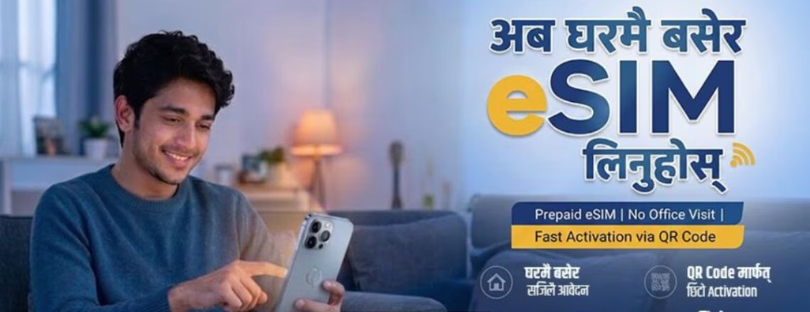
Nepal Telecom has taken a useful step in Nepal’s mobile market by allowing customers to buy a new Ntc prepaid eSIM online, without visiting a company counter or service office.
The new option is available through Nepal Telecom’s official digital services portal, where users can choose “Get New Prepaid eSIM”, register with email, select an available prepaid number, complete the required SIM registration form, pay digitally and receive an eSIM QR code for activation. The official portal already shows the new prepaid eSIM option alongside “Physical SIM to eSIM”, confirming that the platform now supports both new prepaid eSIM purchases and conversion from a physical SIM.
For customers, this sounds simple. But for the telecom market, it is more meaningful than just another online form. It moves SIM acquisition closer to the way modern mobile service should work: digital, faster, and less dependent on paperwork, queues and physical distribution.
How it works
The process starts at Nepal Telecom’s eSIM portal. A customer selects “Get New Prepaid eSIM”, registers an account, verifies the account through OTP, then logs in with the newly created credentials.
From there, the user can choose an available prepaid mobile number. That detail matters, because number selection has often been one of the small but annoying parts of buying a new SIM. Instead of depending on what is available at a counter, customers can now browse available numbers directly through the portal.
After choosing the number, the user fills out the SIM registration form and completes payment through supported digital payment methods. Once payment and registration are completed, the user receives an eSIM QR code. Scanning that QR code on a compatible smartphone downloads and activates the eSIM profile.
Nepal Telecom’s help page also reminds users to check device compatibility before applying. For physical SIM to eSIM conversion, the portal notes that customers must have a minimum balance of Rs. 50, as Rs. 50 is charged for the eSIM change.
Why this matters
This is not Nepal Telecom’s first eSIM move. NTC eSIM services have been available in Nepal since 2022, but the early model was still strongly tied to counters and manual processes. Local telecom coverage has reported that Nepal Telecom first launched eSIM distribution in September 2022, initially with very limited availability before expanding access more widely.
The difference now is convenience. A new prepaid user no longer needs to treat eSIM as something that still requires a physical-world process. For many customers, especially urban users, students, remote workers, business travellers and frequent device switchers, this removes friction from the first step of mobile onboarding.
It also fits a wider trend. Operators around the world are slowly learning that eSIM is not only a replacement for plastic SIM cards. It is a customer experience layer. Apple describes eSIM as an industry-standard digital SIM built into the iPhone, allowing users to activate mobile plans digitally without a physical SIM card. That simple shift changes expectations. Once customers know a mobile plan can be activated digitally, standing in line for a SIM card starts to feel outdated.

The practical benefits
The obvious advantage is speed. Customers can get a new prepaid number and activate it from home, provided their phone supports eSIM.
There is also less hassle. No plastic SIM, no store visit, no waiting for a physical card, and no need to swap tiny pieces of hardware between devices.
Dual SIM flexibility is another strong use case. Many compatible phones allow users to combine one physical SIM and one eSIM, or in some cases use multiple eSIM profiles. That makes eSIM useful for people who want to separate personal and work numbers, or keep one local line active while using another plan for travel or business.
Security is also part of the story. A physical SIM can be removed from a lost or stolen phone. An eSIM is embedded in the device and generally harder to misuse in the same way, although customers still need proper account security, device locks and careful handling of QR codes.
The digital KYC angle may become just as important. When registration, verification and customer data updates move online, operators can reduce manual errors and improve compliance. Nepal Telecom’s portal also points users toward online KYC registration and updates, which suggests a broader move toward self-service account management.
Final take
Nepal Telecom’s online prepaid eSIM launch is not flashy, but it is the kind of upgrade that quietly changes user expectations.
Compared with global travel eSIM players like Airalo, Nomad eSIM or Holafly, Nepal Telecom is not selling a borderless travel product. It is doing something different: digitising the local operator relationship. That matters. Travel eSIM brands made users comfortable with buying connectivity online in minutes. Now, national operators need to make their own onboarding feel just as easy.
For Nepal, this is a smart step. The real test will be reliability: smooth verification, fast QR delivery, clear instructions, device compatibility guidance and responsive support when activation fails. If those pieces work well, online eSIM purchase can become more than a convenience feature. It can become the new default for prepaid mobile access.