What Is LPA in eSIM and Why It Matters
Most people think an eSIM is activated when they scan a QR code. That is understandable. The QR code is visible at a moment. It feels like the whole story.
But behind that small scan sits a much more important layer: the Local Profile Assistant, usually shortened to LPA.
In plain English, the LPA is the software on an eSIM-enabled device that helps download, install, activate, disable and manage eSIM profiles. Telna describes it as the part of the device experience that connects the user, the eSIM chip and the remote server where the operator profile is stored. It handles profile discovery, secure download, management and activation. Without it, the “instant eSIM” experience would not feel instant at all.
That may sound like backend plumbing. In reality, it is becoming one of the quiet power points in the eSIM market.
Why LPA matters
The eSIM industry likes to talk about coverage, price, destinations and data bundles. Those things matter, of course. But the real customer experience starts earlier.
Can the user install the eSIM easily?
Does the phone recognize the profile?
Does the QR code work?
Can the device communicate with the SM-DP+ server?
Can the traveller switch between profiles without confusion?
This is where the LPA sits.
In the GSMA consumer eSIM architecture, the LPA runs on the user equipment, such as a phone, modem or connected device, and interfaces with the SM-DP+ and the eUICC. Its job includes downloading eSIM profiles, enabling or disabling them, deleting profiles and sending relevant notifications back to the provisioning platform.
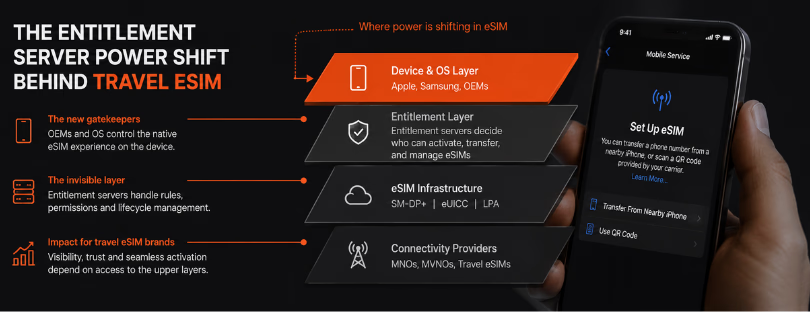
READ MORE: The Entitlement Server Power Shift Behind Travel eSIM
The SM-DP+ is the remote system that prepares, stores, and delivers the operator profile. Google’s Android documentation notes that the LPA and the eSIM OS on the eUICC must support GSMA Remote SIM Provisioning, and that SM-DP+ and SM-DS servers should match the relevant RSP version.
So when a traveller buys an eSIM for Japan, Spain or the United States, they are not just buying “data”. They are relying on a chain of systems that must work cleanly together: the provider’s platform, the SM-DP+, the device operating system, the eUICC and the LPA.
One weak link and the customer blames the eSIM brand.
The hidden front door
The interesting part is that the LPA is local. It lives close to the device experience. That makes it strategically different from many other parts of the eSIM stack.
For years, travel eSIM providers competed on who had better rates, more countries, a nicer app or faster support. But as eSIM becomes more device-native, the activation layer becomes more important. Apple and Android users increasingly expect cellular setup to feel like a normal phone setting, not a telecom project.
Apple, for example, supports several eSIM activation methods, including QR code setup, eSIM Carrier Activation and eSIM Quick Transfer. With Carrier Activation, the carrier can assign an eSIM digitally, while Quick Transfer lets users move a number from one iPhone to another without contacting the carrier, depending on carrier support.
That changes the psychology of the market. The best eSIM experience may not be the one with the prettiest checkout page. It may be the one that disappears most elegantly into the device flow.
This is why LPA should matter to consumer eSIM providers, MVNOs, telecom enablers and travel tech platforms. It is not just a technical component. It influences who controls the activation moment.
QR codes are not the future
The QR code has been useful because it gave the eSIM market a simple bridge from physical SIM behaviour to digital provisioning. Buy plan, scan code, install profile. Simple enough.
But QR activation is also clunky. It breaks easily for less technical users. It often requires another screen. It creates support tickets when the user scans too early, deletes the profile, loses the code, switches devices or misunderstands the setup flow.
For travel eSIM brands, this is not a small problem. Their customer is often installing the eSIM while packing, at the airport, after landing, or while stressed about roaming charges. That is exactly the wrong moment for technical friction.
READ MORE: Who Controls eSIM? The Entitlement Battle Begins
The industry is already moving toward smoother activation: in-app provisioning, carrier activation, device discovery, enterprise MDM deployment and deeper operating system integration. Apple’s deployment guidance, for example, refers to using a carrier’s eSIM server hostname when installing eSIMs through device management services, while Apple’s support documentation shows how mainstream eSIM activation has become inside the iPhone setup flow.
This is where the LPA becomes more than a background function. It becomes part of the customer journey.
Consumer eSIM versus IoT eSIM
There is another reason this topic matters: the eSIM market is no longer only about smartphones.
In consumer eSIM, the LPA is usually tied to the user interface and device operating system. The user chooses a plan, scans a QR code or follows a device activation flow, and the device pulls the profile.
In IoT, the situation is different. Devices may have no screen, no user and limited network access. GSMA’s IoT eSIM architecture introduces the IoT Profile Assistant, or IPA, to help provision eUICCs in IoT devices. GSMA describes the IPA as enabling the eUICC in an IoT device to be provisioned by the SM-DP+, either as a standalone component or inside the eUICC.
That distinction matters because travel eSIM providers, enterprise mobility platforms and IoT connectivity players are solving different activation problems.
READ MORE: Provisioning Is Becoming the Boring Part of eSIM
Airalo, Holafly, Nomad eSIM, and similar consumer brands need a smooth retail installation experience. Enterprise eSIM players need fleet control, visibility, and policy management. IoT connectivity companies need remote provisioning that works without a human holding a phone.
The LPA is part of the consumer world. The IPA is part of the newer IoT provisioning story. But both point to the same trend: eSIM competition is moving deeper into orchestration.
What this means for eSIM providers
For eSIM providers, LPA is not something to ignore because it “belongs to the device”. Quite the opposite.
A provider may not control the LPA directly, especially on Apple or Android devices, but it must design its activation experience around how the LPA behaves. That means better instructions, cleaner provisioning flows, fewer unnecessary steps, smarter app logic and support teams that understand where activation actually fails.
It also means providers need stronger technical relationships across the ecosystem. The SM-DP+ provider, app experience, operating system rules, device compatibility and customer support process all influence the same moment.
This is where companies like Telna, Kigen, 1GLOBAL, G+D, IDEMIA, Thales and other eSIM infrastructure players become important. They are not only “backend suppliers”. They help determine whether eSIM feels like a smooth digital service or a fragile telecom workaround.
Travel eSIM brands often market themselves like consumer apps. But under the surface, they still depend on telecom-grade provisioning architecture. The better brands will understand both sides.
Conclusion
The Local Profile Assistant is not a headline-friendly term. It will not sell many travel eSIM plans on its own. No traveller is going to say, “I bought this eSIM because the LPA flow was excellent.”
But they will feel it.
They will feel it when the eSIM installs without drama. They will feel it when the profile appears exactly where expected. They will feel it when the plan activates at the right moment, on the right device, without a support chat.
That is why LPA matters. It sits at the point where telecom infrastructure becomes user experience.
The next phase of eSIM competition will not be only about cheaper gigabytes or wider destination lists. Those are becoming easier to copy. The harder advantage is activation quality, device integration, profile lifecycle management and the ability to make connectivity feel native.
For Alertify readers, this is the bigger takeaway: the eSIM market is moving from selling digital SIM cards to controlling digital connectivity flows. LPA is one of the small, technical pieces that reveals that shift very clearly. The companies that understand this layer will build better products. The companies that ignore it will keep wondering why “simple eSIM activation” still generates so many support tickets.