Optima Mobile Adds eSIM and Anti-Spam Protection in Italy
Italian MVNO Optima Mobile is adding a new anti-spam feature to its MyOptima app, a small product update that says quite a lot about where mobile services are heading.
The operator, which runs as an MVNO under Optima Italia and uses Vodafone’s network through Effortel, has introduced Antispam, a free feature designed to help users identify unwanted or potentially fraudulent calls. Optima Mobile operates on 2G and 4G across Italy and has also supported 5G since May 2025 for enabled plans or through a dedicated option.
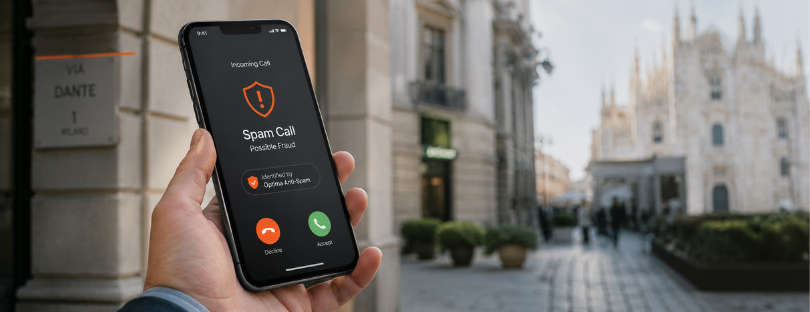
The feature is available inside the MyOptima app for iOS and Android. Users need to install or update the app, then enable the function through their smartphone settings. Once active, Antispam helps recognise suspicious calls, giving customers more control before they answer.
Why this matters now
Telephone spam has moved from being an irritation to a trust problem. Optima says people in Italy receive an estimated 1.5 to 2 spam calls per day, or around 650 unwanted contacts per year. That number feels believable to anyone who has ignored yet another “unknown” mobile number during work, dinner, or a train ride.
Marco Taliani, CEO of Optima HUB, framed the launch as a practical safety move:
“With Antispam, we want to offer our customers a practical tool to defend themselves against an increasingly widespread phenomenon, improving the security and quality of their everyday user experience.”
That is the right language. This is not just about blocking annoying calls. It is about making the mobile experience feel usable again. The phone number has become a weak point in the digital identity chain, especially when fraudsters use spoofing, fake call centres, or international routing tricks to make calls look local and legitimate.
Italy’s wider anti-spam push
Optima’s move lands at a moment when Italy is tightening the regulatory and technical response to unwanted calls.
The public Registro Pubblico delle Opposizioni already allows citizens to object to the use of fixed and mobile numbers for advertising and market research, while operators must consult the register before running phone campaigns.
READ MORE: CMLink Italy offering a year of unlimited data for €160
But the register alone has not solved the problem. Illegal or aggressive callers often operate outside clean consent frameworks. That is why AGCOM has also moved toward stronger technical measures against spoofing. Wired Italia reported that Italy’s anti-spoofing filter was designed to target calls arriving from abroad while pretending to use Italian fixed or mobile numbers.
More recently, AGCOM approved new rules introducing three-digit caller identifiers for legal businesses and call centres, making it easier for users to understand the nature of a call before answering. The measure is meant to improve transparency, although it is not a complete cure because illegal callers can still try to bypass compliant numbering systems.

eSIM arrives too
Optima Mobile also announced that eSIM is now available across all mobile offers, at the same price as a traditional SIM. That makes the update more than a security announcement. It is part of a broader digitalisation of the MVNO experience: app-based control, faster activation, less dependence on physical SIM delivery, and easier multi-number use on compatible devices.
Umberto d’Oriano, Marketing Director at Optima Italia, said:
“The introduction of eSIM represents an important step toward an increasingly flexible, digital, and sustainable offering, in line with users’ evolving needs.”
For an MVNO, this matters. Italy’s budget and virtual operator market is crowded, and price alone is not enough forever. Features like eSIM, anti-spam tools, app-based account management, and cleaner onboarding are becoming part of the value proposition.
The bigger market signal
Optima is not alone in this direction. TIM has introduced TIM Stop Spam, a free feature in the MyTIM app that lets customers block unwanted calls from abroad, except for saved contacts and authorised foreign countries. Vodafone has also been investing in anti-fraud call protection at the group level, including its Global CLI Trust platform, which it says has already blocked more than 300 million non-compliant and spam calls across the UK, Ireland, and Romania.
The interesting part is that Optima is bringing this kind of protection into the MVNO layer. Smaller operators usually compete on price, bundles, and simplicity. But security features are now becoming a way to compete on confidence.
Conclusion
Optima Mobile’s Antispam launch is not a huge technological revolution by itself. But it is a smart sign of the market shifting.
In Italy, the fight against spam calls is no longer limited to regulators, smartphone makers, or major network operators. It is moving into the everyday customer experience, including MVNO apps. That is important because users do not care where the protection comes from. They just want the phone to stop feeling like an open door for fraud.
For Optima, pairing Antispam with eSIM is a sensible move. It makes the brand look less like a simple low-cost mobile offer and more like a digital mobile service with practical protections built around real user pain. Compared with bigger players such as TIM and Vodafone, Optima obviously does not control the same network-level machinery. But it can still win on usability, clarity, and making security visible inside the customer journey.
That may be the bigger lesson for MVNOs: the next layer of competition is not just gigabytes, minutes, and monthly price. It is trust. And in a market where spam calls have become part of daily life, trust is starting to look like a mobile feature.