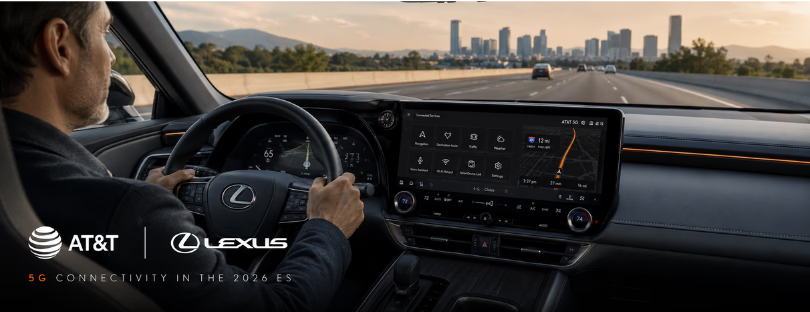
AT&T and Lexus are moving connected cars one step closer to becoming connected devices on wheels. The two companies are bringing AT&T 5G network connectivity into the Lexus lineup, with the redesigned 2026 Lexus ES becoming the first model to receive the upgraded experience.
At first glance, this sounds like another routine automotive connectivity announcement. It is not. What Lexus is really doing here is preparing its cabin software for a world where drivers expect the car screen to behave less like an old infotainment unit and more like a polished, always-connected digital environment.
The upgraded system supports the latest generation of Lexus Interface, the brand’s multimedia platform. According to Lexus, the update brings faster system responsiveness, an intuitive home screen, stronger Voice Assistant performance, improved navigation and broader entertainment options. AT&T’s 5G connectivity is the network layer underneath all of that, helping the car handle richer services with lower friction.
Why 5G matters in the cabin
For years, connected-car features were sold around emergency assistance, basic navigation updates and Wi-Fi hotspots. Useful, yes, but rarely exciting. The shift now is different. Carmakers are using connectivity to make the whole in-car experience more dynamic.
In the 2026 Lexus ES, the most visible changes are inside the Lexus Interface system. The home screen becomes more customizable. Voice Assistant responses are designed to feel quicker. Navigation is more deeply integrated. Entertainment services become easier to access. These are small upgrades individually, but together they change how premium buyers judge the car.
That matters because luxury vehicles are no longer competing only on leather, silence and acceleration. They are also competing on screen speed, software logic, voice accuracy and how naturally the car fits into a digital lifestyle.
One especially useful update is the new embedded Voice Assistant. Lexus says it enables faster responses to “Hey Lexus” prompts and other conversational commands, allowing drivers to manage audio, climate, trip information and vehicle settings more easily. This is exactly where 5G starts to become practical rather than decorative. Nobody wants a premium car that responds like a tired smart speaker from 2016.
Navigation moves closer to the driver
Another notable change is the arrival of full-screen native navigation inside the digital gauge cluster. For the first time in Lexus Interface, maps and turn-by-turn directions can appear directly behind the steering wheel.
That may sound like a design detail, but it is actually important. Navigation is one of the few digital services in a car that should not distract the driver. Moving key route information into the instrument cluster makes the experience cleaner and more natural, especially on longer trips or in unfamiliar cities.
The redesigned 2026 Lexus ES also comes at an interesting moment for the brand. The new ES generation includes hybrid and electric versions, signalling that Lexus is not only updating the cabin but also repositioning one of its core sedans for a more electrified and software-heavy era.
AT&T’s connected-car play
AT&T is not new to automotive connectivity. The company has worked with carmakers for years through AT&T Connected Car, and it says passengers can connect up to five Wi-Fi-capable devices at 5G speeds where service is available. For families, business travellers or anyone using the car as a mobile workspace, that is no longer a bonus feature. It is becoming expected.
The Lexus move follows a similar AT&T announcement with Toyota in October 2025, where AT&T 5G was positioned as the connectivity layer for Toyota Connected Services, including navigation, remote services, vehicle maintenance and over-the-air software updates.
That Toyota connection matters because Lexus is not an isolated experiment. It looks more like a group-level connectivity strategy: start with high-volume Toyota models, extend the experience into Lexus, and gradually build a more consistent connected-car platform across brands.
Toyota Connected has also described the next-generation Toyota multimedia experience as launching with the 2026 RAV4, including customizable widgets, faster “Hey Toyota” voice responses, enhanced entertainment and integrated streaming options. Lexus is clearly moving in the same direction, but with a more premium cabin execution.
The wider connected-car race
Lexus and AT&T are not alone here. The entire car industry is moving toward software-defined vehicles, where connectivity, cloud services and over-the-air updates shape the ownership experience long after the car leaves the showroom.
BMW, Mercedes-Benz, General Motors, Hyundai, Tesla and others have all pushed deeper into connected services, native infotainment, subscription features, app-based controls and digital cockpit experiences. Some brands lean heavily into proprietary ecosystems. Others rely more visibly on Apple CarPlay, Android Auto, Google built-in or telecom partnerships.
The Lexus approach sits somewhere in the middle. It is not trying to turn the ES into a rolling smartphone, at least not publicly. Instead, it is making the core Lexus Interface faster, more useful and better connected while keeping the brand’s premium, controlled environment intact.
That is a smart move. Many drivers like Apple CarPlay and Android Auto, but automakers do not want to surrender the entire cabin experience to Apple or Google. The future battleground is not simply “who has the biggest screen.” It is who controls the interface, the data layer, the services and the customer relationship inside the vehicle.
Final take
The AT&T and Lexus announcement is not just about faster Wi-Fi in a luxury sedan. It is about the next phase of automotive connectivity, where the network becomes part of the product experience itself.
For Lexus, 5G gives the redesigned ES a more modern digital foundation. For AT&T, it strengthens its role as a connectivity partner to major automotive groups. For the wider market, it confirms a trend already visible across premium mobility: cars are becoming subscription-ready, service-led, software-updatable environments.
The interesting part is that Lexus is not shouting about futuristic gimmicks. It is focusing on the things drivers actually notice: faster screens, better voice control, cleaner navigation and reliable passenger connectivity. That may not sound dramatic, but in connected vehicles, the winners will not be the brands with the loudest tech claims. They will be the ones that make the car feel quietly smarter every time you get in.
Driven by wanderlust and a passion for tech, Sandra is the creative force behind Alertify. Love for exploration and discovery is what sparked the idea for Alertify, a product that likely combines Sandra’s technological expertise with the desire to simplify or enhance travel experiences in some way.