Telenor Connexion Targets Global IoT Growth
Telenor Connexion is entering a new phase, and this one looks less like a quiet internal restructuring and more like a serious bet on the next decade of managed IoT.
Telenor has entered into a partnership with Verdane to establish a joint ownership structure around Telenor Connexion, valuing the company at SEK 7.5 billion. Under the agreement, Telenor remains a long-term strategic owner, while Verdane brings growth capital and scaling experience to a business already sitting in a strong global position.
This is not just another telecom transaction. It says something bigger about where IoT connectivity is heading. The old idea that IoT is mainly about selling SIM cards into machines is fading. The market now wants managed connectivity, lifecycle control, global coverage, device intelligence, cost visibility, and a partner that can keep complex deployments running for years.
Telenor Connexion has spent 25 years building exactly that kind of position.
From SIMs to Managed Infrastructure
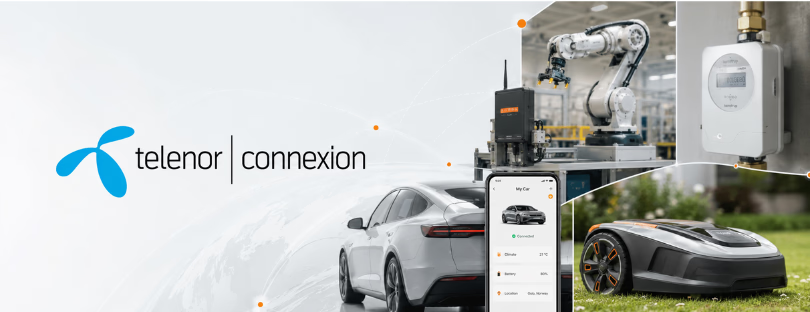
Today, Telenor Connexion is described as a top ten global managed IoT player outside China, with 31 million IoT SIM cards in operation and deliveries to more than 200 countries. Its connected footprint reaches across sectors that rarely make headlines but quietly define modern infrastructure: cars, water pumps, robotic lawn mowers, industrial equipment, and other connected assets that need reliable, always-on connectivity.
That last point matters. Consumer telecom is usually measured in subscribers, ARPU, churn, and handset cycles. IoT is different. A connected car, utility meter, payment terminal, or industrial device may stay in the field for years. The challenge is not only activation. It is management, uptime, compliance, roaming behaviour, troubleshooting, and commercial predictability.
This is why managed IoT is becoming one of the more interesting corners of telecom. It is less glamorous than consumer eSIM, but arguably more defensible. Once a large enterprise embeds a connectivity provider into its devices, supply chain, and operational stack, switching is not simple.
The Verdane Signal
The Verdane partnership gives Telenor Connexion a different kind of platform for growth. Verdane says the goal is to build a global IoT leader, while Telenor says the structure gives the business access to long-term growth capital in a more capital-efficient way.
Benedicte Schilbred Fasmer, President & CEO of Telenor, put it clearly:
“We have bold ambitions in managed IoT, and with Verdane as a partner we gain additional power to realise them in a much more capital-efficient manner. At the same time, this transaction clearly demonstrates Telenor’s ability to create value. With this structure in place, we are well-positioned for the next phase. Telenor will remain a long-term, strategic owner, and we will continue to put the full industrial strength of the Group behind Telenor Connexion. Together with Verdane, we will scale the business more rapidly in a diligent way.”
That is corporate language, yes, but the strategic meaning is fairly sharp. Telenor is not walking away from IoT. It is trying to make the asset grow faster without carrying the full weight of the expansion alone.
In January 2026, Telenor also consolidated its Nordic IoT operations under one brand structure, with Telenor Connexion as the specialised IoT unit operating under Telenor IoT as the portfolio brand. That kind of brand cleanup usually comes before a more aggressive commercial phase. Fewer internal labels, clearer market message, easier partner conversations.

Why IoT Is Moving Up the Stack
The managed IoT market is expected to grow at double-digit rates toward 2030, according to Telenor and Verdane’s announcement. But the interesting part is not only growth. It is what kind of growth?
Enterprises no longer want a simple connectivity contract and a dashboard full of SIMs. They want a managed layer that can support thousands or millions of devices across borders. That includes roaming agreements, eSIM and remote provisioning, security, analytics, billing logic, local compliance, and increasingly, AI-driven monitoring.
This puts companies like Telenor Connexion in a very different competitive set from traditional mobile operators selling enterprise mobile plans. It also places them alongside global IoT connectivity specialists such as 1NCE, floLIVE, Eseye, KORE, Wireless Logic, Soracom, and major operator-backed platforms from Vodafone, Deutsche Telekom, Orange, and Telefónica.
The difference is in positioning. Some players compete heavily on simplified global pricing. Some compete on cloud-native architecture. Some sell into developers and startups. Others focus on automotive, logistics, manufacturing, utilities, or healthcare. Telenor Connexion’s strength is that it already has deep, large-enterprise credibility and a long operating history. That is not easy to copy.
A More Serious IoT Market
There is a quiet parallel here with travel eSIM. In consumer eSIM, many providers still look similar from the outside: destination, gigabytes, price, checkout. But underneath, the real differentiation is in orchestration, network access, lifecycle management, customer support, and commercial control.
IoT has reached that stage earlier. Nobody seriously buys managed IoT just because the SIM activates. They buy it because the provider can keep connected products alive across markets, networks, regulations, and device generations.
That is where Telenor Connexion has an advantage. It does not need to convince the market that connected devices are coming. The market already knows. The harder question is which providers can manage that complexity at a global scale.
Conclusion
This Telenor and Verdane move is not simply about adding capital to an IoT unit. It is a signal that managed IoT is becoming infrastructure, not an add-on telecom service.
The winners in this market will not be the companies with the loudest “global SIM” message. They will be the ones that can combine coverage, control, operational reliability, enterprise trust, and long-term product lifecycle support. That is why Telenor Connexion is interesting. It sits between classic telecom strength and specialist IoT execution.
Compared with cloud-native challengers like floLIVE or Soracom, Telenor Connexion has the weight of a major telecom group behind it. Compared with broader operator IoT platforms, it now has a more focused ownership structure and growth partner. Compared with low-cost connectivity-first players, it can credibly sell managed complexity, not just access.
And that is the real trend. IoT connectivity is becoming less about the SIM and more about who controls the invisible operating layer behind millions of connected things. Telenor Connexion now has a stronger structure to compete for that layer. For a market moving toward AI-enabled devices, smarter infrastructure, connected mobility, and industrial automation, that could matter a lot.