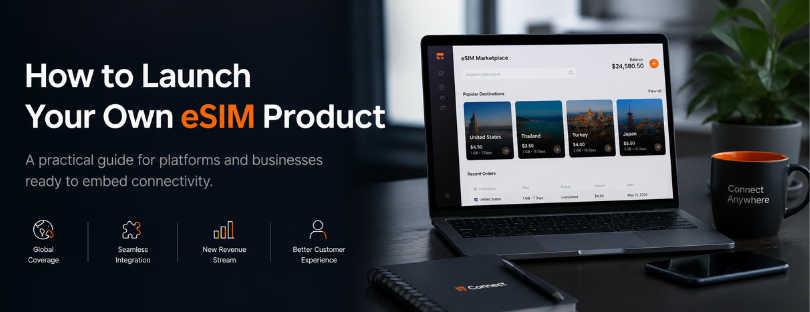
How to Launch Your Own eSIM Product?
There’s a quiet but very real shift happening across travel, fintech, and digital platforms. Connectivity is no longer a standalone product. It’s becoming a feature.
Airlines are experimenting with it at booking. Banks are embedding it next to cards. Travel apps are starting to treat it like insurance or luggage add-ons. And yet, most companies still approach eSIM like it’s a telecom project.
It’s not.
Launching your own eSlM product today is much closer to launching a payment feature or a subscription layer than building a telco. The infrastructure is already abstracted. The real question is whether you understand where it fits in your product, your funnel, and your customer behavior.
Because the companies getting this right aren’t the ones with the best data plans. They’re the ones who understand timing, distribution, and user intent.
What “launching an eSIM product” actually means
Let’s clear something up early. You’re not becoming a telecom operator.
You’re layering connectivity into your existing product or customer journey. That could mean:
Common entry points
- Offering eSIM at checkout for flights or hotels
- Embedding it inside a banking app for travelers
- Adding it as a post-booking upsell
- Bundling it into premium subscriptions
- Integrating it into loyalty programs
Technically, you’re connecting to an eSIM infrastructure provider through an API. Commercially, you’re creating a new revenue stream. Strategically, you’re reducing friction for your users while capturing value that used to go elsewhere.
The gap is not technical anymore. It’s conceptual.
Most companies still think: “Do we need this?”
The smarter ones ask: “Why are we not already monetizing this?”
The infrastructure is already solved
Five years ago, launching eSIM meant dealing with telecom complexity. Today, that layer is mostly invisible.
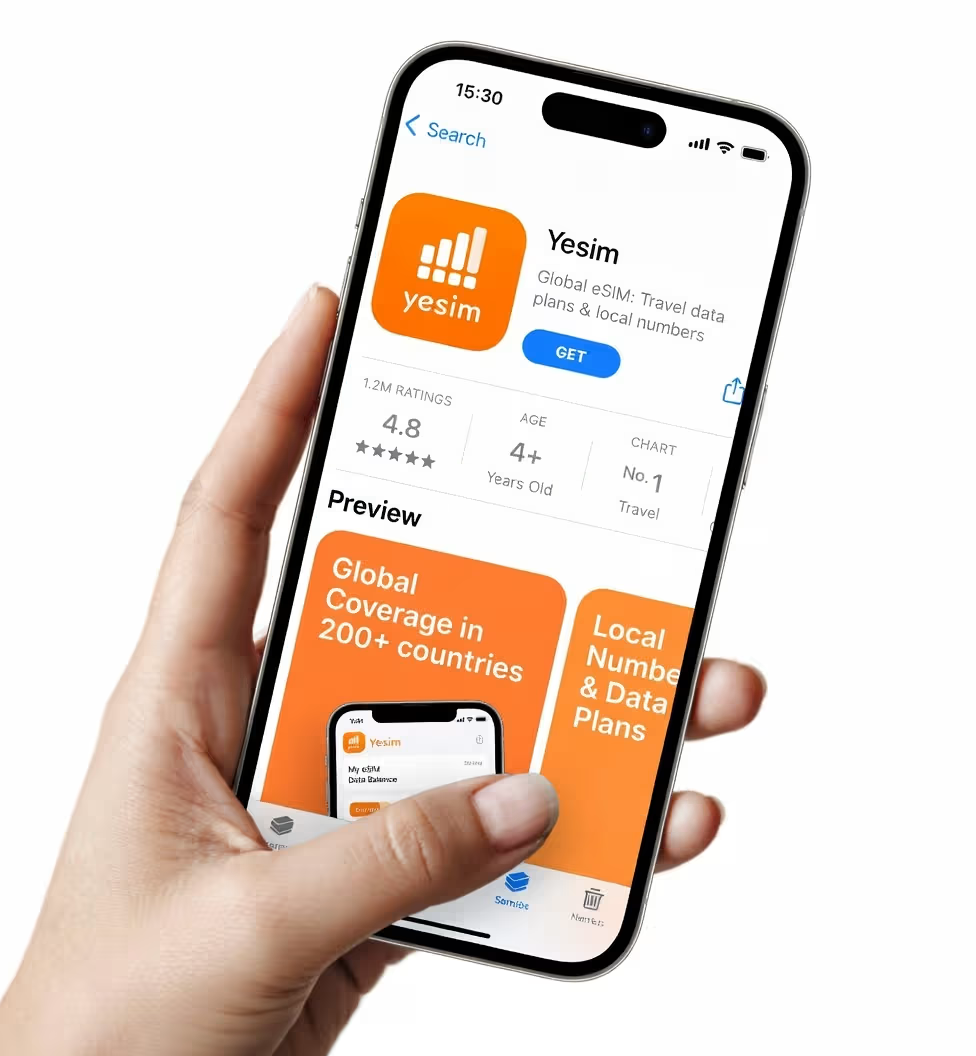
Providers like Yesim offer partner APIs that handle everything behind the scenes. Provisioning, coverage, billing logic, and network relationships. You don’t build telecom infrastructure. You plug into it.
Their Yesim Partner API, for example, is designed for exactly this use case. Platforms can integrate global connectivity into their own product environment, fully branded or embedded, without needing telecom expertise internally.
What matters more is how you position it.
Because two companies can use the same API and get completely different results. One turns it into a hidden menu item. The other builds a meaningful revenue stream.
 Where most launches go wrong
 Where most launches go wrong
This is where things get interesting. And slightly uncomfortable.
The majority of failed eSIM launches don’t fail because of pricing or coverage. They fail because they’re treated like a feature instead of a product moment.
Here’s what that looks like in practice:
Typical mistakes
- Hiding eSIM in settings or secondary menus
- Treating it as a “nice-to-have” instead of a core use case
- No clear timing for when users actually need connectivity
- Generic messaging that sounds like telecom marketing
- No connection to existing customer behavior
You see it all the time. A beautifully designed app, strong user base, great retention… and then an eSIM offer buried three clicks deep with zero context.
It’s not a visibility issue. It’s a product thinking issue.
Connectivity only works when it appears exactly at the moment of need. Before a trip. At the airport. When roaming anxiety kicks in. That’s where conversion happens.
The real opportunity: existing customers
Here’s the part that most calculators oversimplify.
You don’t need millions of users to make eSIM work. You need the right percentage of your existing users at the right moment.
Let’s say you run a travel platform with 500,000 active users. If even 3–5% of them convert on connectivity during travel moments, you’ve already created a meaningful revenue stream.
READ MORE: Yesim B2B Strategy: API vs Enterprise Play
But more importantly, you’ve improved the experience.
No SIM card search. No airport kiosks. No “why is my data not working?” panic.
That’s the real value layer. Revenue is a byproduct.
And this is where companies underestimate the opportunity. They look at telecom as a separate category, instead of an extension of user experience.
Designing the product, not just integrating it
Once the infrastructure is in place, the real work begins. And it’s not technical.
It’s product design.
What actually drives adoption
- Clear entry points (booking, pre-trip emails, app notifications)
- Simple language, not telecom jargon
- Transparent pricing without surprises
- Smart bundling with existing offers
- Context-aware recommendations
Think about how insurance is sold in travel. It’s not hidden. It’s contextual. It appears at the exact moment when risk becomes real.
Connectivity works the same way.
The companies that treat eSIM like a core product moment see traction. The ones that treat it like an add-on see… nothing.
Who is already doing this well?
If you look at the market, a pattern is starting to emerge.
Fintech players are embedding connectivity as part of their travel proposition. Travel platforms are experimenting with pre-booking upsells. Even some loyalty ecosystems are testing bundled connectivity perks.
What they have in common is not scale. It’s positioning.
They’re not selling “data plans.” They’re selling continuity.
Stay connected without thinking about it. That’s the pitch.
And it works because it aligns with how users actually behave. People don’t want to compare gigabytes. They want their apps to work when they land.
The economics behind it
Let’s be honest. This only works if the economics make sense.
The good news is, they usually do.
Margins on eSIM products vary depending on the model, but the real advantage is that you’re monetizing an existing user journey. No acquisition cost. No additional onboarding.
It’s one of the rare cases where you can layer revenue onto something your users are already doing.
And when done right, it doesn’t feel like monetization. It feels like service.
That distinction matters more than most companies realize.
Why now, not later
There’s also a timing element here.
eSIM adoption is accelerating globally. Device compatibility is no longer a niche issue. Apple, Samsung, Google, they’ve all normalized it. In some markets, physical SIMs are already becoming secondary.
At the same time, distribution is shifting.
READ MORE: Yesim Partner Solutions Are Positioning the Company as a Serious Contender in the Telecom-as-a-Service Space
Connectivity is moving closer to platforms. Away from standalone providers. Closer to where decisions are made.
That creates a window.
Not a permanent one. But a real one.
Conclusion: this is no longer a telecom play
If you still think launching an eSIM product is about telecom, you’re already behind.
This is a distribution play. A product design play. A timing play.
Look at how eSIM players built awareness through direct-to-consumer channels. Or how newer infrastructure-driven models are enabling banks and travel platforms to own the relationship instead of outsourcing it. Even large-scale enablers are repositioning themselves as embedded telecom layers rather than providers.
The direction is clear.
Connectivity is moving into the product layer.
And the companies that win here won’t be the ones with the cheapest plans or the widest coverage maps. They’ll be the ones who understand when and why users need connectivity and make it effortless.
That’s where partners like Yesim become interesting. Not because they “offer eSIM,” but because they allow you to focus on everything that actually matters. Positioning, timing, experience.
The telecom part is already solved.
The question is whether your product strategy is.