The First 30 Minutes After Landing Are Travel’s Biggest Tech Opportunity
Travel brands still spend a strange amount of energy polishing the booking moment. The homepage, the fare calendar, the hotel photos, the “only two rooms left” message, and the loyalty upsell. All important, yes. But ask any traveller when the trip actually starts to feel stressful and the answer is rarely “when I clicked pay.” travel connectivity after landing
It is the first 30 minutes after landing.
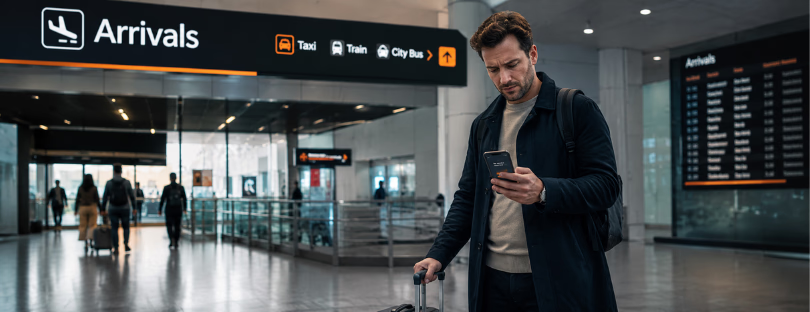
That tiny window between the aircraft door and the destination is where the customer suddenly becomes very human. Tired. Slightly disoriented. Maybe hungry. Maybe with a child, a suitcase, a dying phone battery and a driver who is allegedly “outside,” though outside has six exits and three lanes of honking cars.
This is the arrival anxiety moment. And most travel brands are still underestimating it.
The irony is that travel companies know how much people rely on phones. SITA’s 2024 Passenger IT Insights found that 90% of passengers use technology for bookings and that travellers rely heavily on mobile devices during airport dwell time and onboard. IATA’s 2025 passenger survey also shows how strongly the journey is moving into the smartphone, with 78% of passengers wanting to use a phone that combines wallet, passport and loyalty functions to book, pay and navigate airport processes.
But once the traveller lands, the experience often breaks into pieces.
The messy moment nobody owns
Arrival is not one problem. It is a bundle of small frictions arriving at the same time.
No data connection. Airport Wi-Fi that wants a phone number before it lets you connect. Ride-hailing apps that fail because the card gets flagged. A hotel address was copied in the wrong alphabet. Local transport signs that make perfect sense only if you already live there. A passport control queue that eats the transfer buffer. A hotel app that works beautifully until the guest needs a human.
Individually, these are minor. Together, they are the moment when customer confidence drops.
READ MORE: Banks That Ignore eSIM Will Depend on Someone Else’s Network
This is why arrival anxiety is commercially interesting. It is not just an emotional problem. It is a revenue problem, a loyalty problem and increasingly a distribution problem.
The customer is most open to help when uncertainty is highest. That help could be an eSIM, airport transfer, local payment guidance, a hotel check-in shortcut, luggage tracking, metro ticketing, translation support or a simple “here is exactly what happens after you land” message sent at the right time.
Not a generic destination guide. Not another “top 10 things to do.” Real utility.
Your customers will buy connectivity. The question is: from you, or from someone else?
We help airlines, banks, and travel platforms turn that demand into a built-in product — not a missed opportunity.
Connectivity is the first domino
For Alertify readers, the obvious starting point is connectivity. Without mobile data, every other layer of the arrival experience becomes more fragile.
A traveller without data cannot confirm a pickup point, contact the hotel, check a map, translate a sign, open a mobile wallet backup, receive a security code or solve a booking issue quickly. This is why eSIM is no longer just a cheaper roaming alternative. In the arrival window, it becomes travel infrastructure.
Airlines, OTAs, hotels, banks and travel apps should look at eSIM less as an ancillary product and more as an arrival stabilizer. The value is not only “save money on roaming.” The value is: land connected, avoid panic, move faster.
That is a much stronger commercial story.
And it explains why travel brands are starting to experiment with embedded services. If an airline can sell bags, seats and insurance, why not arrival connectivity? If a hotel sends pre-arrival emails, why not include a verified connectivity option, local transport advice and payment reminders? If a bank already knows the customer is abroad, why not bundle travel payment support and data access inside the same travel mode?
The companies that understand this will not sell “extras.” They will sell calm.
Payments are part of the same anxiety
Arrival friction is not only about maps and messaging. It is also about money.
Phocuswright has pointed out that travel still lags in payment innovation, even as local payment methods, mobile wallets, cross-border payments and embedded payments reshape consumer expectations. The same analysis notes that hotels are often slowed by fragmented processes and legacy technology, while OTAs are more advanced in offering multiple forms of payment.
READ MORE: Why Travel eSIMs Break at Enterprise Scale?
That matters after landing. A traveller may have booked with one card, need a deposit with another, use Apple Pay at home, face cash-only transport locally and then discover the hotel wants a physical card at check-in.
Again, not dramatic on paper. Very dramatic at 11:40 p.m. in a foreign city.
This is where fintechs, travel wallets and telecom-enabled travel services can become more relevant. The arrival layer needs payment confidence as much as connectivity. The best products will not ask travellers to think about rails, wallets, roaming, authentication and FX fees. They will quietly make the first hour easier.
Hotels may be closest to the opportunity
Hotels often talk about personalization, but many still treat arrival as an administrative sequence: confirm booking, collect ID, take payment, explain breakfast.
The smarter opportunity is to own the emotional transition from “I have landed” to “I am okay.”
That could mean earlier room readiness updates, better airport-to-property guidance, WhatsApp support, digital key options, local SIM or eSIM recommendations, transport integrations and clearer instructions for late arrivals. Not every hotel needs a giant app. In fact, many hotel apps are overbuilt. What guests need is confidence.
Booking.com’s 2025 travel predictions highlighted demand for technology that reduces travel anxiety, especially tools that provide updated information, delay reports and calmer navigation through airports and hotels. That signal is important because it shows anxiety reduction is becoming a product expectation, not just a nice service detail.
The connected trip is still unfinished
Amadeus has framed the smartphone as the “epicenter” of modern travel, with mobile expected to become the main mode of travel booking by 2026 and hotel booking already strongly mobile-led in its research. It also notes the bigger industry goal: a connected trip that removes friction across the journey.
That sounds right. But the connected trip will not be won by whoever has the most beautiful booking flow. It will be won by whoever solves the ugly in-between moments.
READ MORE: Why eSIM Customers Never Come Back After Their First Trip
The transfer. The SIM. The payment. The address. The check-in. The local context. The “what now?” moment.
Airlines have the customer before landing. Airports have a physical touchpoint. Hotels have a destination relationship. OTAs have the itinerary. Banks have the payment layer. eSIM providers have the connectivity layer. The opportunity is obvious, but fragmented ownership keeps slowing it down.
Conclusion about travel connectivity after landing
Travel has spent years optimizing inspiration and booking. The next competitive edge is reassurance.
The first 30 minutes after landing are when the traveller decides whether a brand merely sold them something or actually helped them travel. That is a different standard.
Airlines, hotels, OTAs, fintechs and eSIM providers are all circling the same space from different angles. The winners will be those who stop treating arrival services as add-ons and start packaging them as a practical layer of the journey. Data, payments, transport, translation and check-in are not separate problems to the traveller. They are one feeling: “Can I handle this place?”
The brands that answer that question fastest will own more than a transaction. They will earn trust at the exact moment it matters most.