Why Travel eSIMs Break at Enterprise Scale?
Travel eSIMs have done a good job solving one very specific problem: helping individual travellers avoid expensive roaming and awkward airport SlM card counters.
For a weekend in Lisbon, a trade show in Dubai, or a few days in New York, that model is simple enough. Choose a country, buy a data plan, install the eSIM, and get online when you land. The buyer is the user. The user manages the app. The user handles the problem if something goes wrong.
Enterprise mobility does not work like that.
Once a company starts managing connectivity for travelling employees, consultants, field teams, executives, remote workers, tablets, laptops, or operational devices, the question changes completely. It is no longer “can this person get data abroad?” It becomes “can the business see it, control it, procure it properly, support it, secure it, and report on it?”
That is where many travel-first eSIM models start to feel thin.
Visibility is the first gap
Consumer travel eSIMs usually show the traveller what they bought and how much data they have left. That is useful, but it is not enterprise visibility.
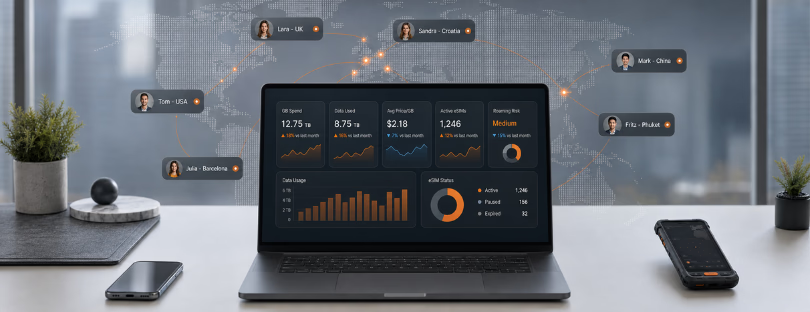
An IT team needs to know who is connected, where they are connected, which network is active, whether usage is normal, whether costs are rising, and whether a user is about to hit a limit. Finance needs reporting. HR or travel risk teams may need confidence that workers in unfamiliar locations have reliable mobile access.
READ MORE: Why Enterprise eSIM Management Is Moving Beyond SIMs
This is where enterprise-focused providers begin to separate from travel-first products. SureSIM, for example, positions its platform around real-time visibility, cost control and global workforce connectivity, including live connection information such as country, network, usage, cost-to-date and SIM status. Its SureSIM Global offer covers 200+ destinations and access to 450+ local carrier networks.
But SureSIM is not the only company trying to answer the visibility problem. Holafly Connect also promotes a centralized dashboard for business travel connectivity, while Airalo for Business has moved beyond pure consumer purchase flows with tools for teams and corporate users.
The difference is not whether a dashboard exists. It is how deep the control model goes.
The procurement problem
Travel eSIM buying is fragmented by design. Individual plans, individual destinations, individual receipts, individual troubleshooting.
That works for consumers. It becomes messy for business.
Procurement teams do not want dozens of employees expensing different travel eSIMs every month. Finance does not want to reconcile scattered receipts and currencies. IT does not want to support five different apps. Legal and compliance teams do not want a shadow mobile data stack that sits outside policy.
This is why managed mobility has become a broader sourcing issue, not just a connectivity issue. Gartner’s 2025 Market Guide for Managed Mobility Services says sourcing mobile services cost-effectively across geographies can improve productivity and user satisfaction, but is complex. It also notes that sourcing leaders should combine technical, commercial and operational needs when choosing providers.
READ MORE: The IT Channel’s Next eSIM Opportunity Is Enterprise Mobility
That one point explains why enterprise eSIM is not just “travel eSIM with invoices.” The provider has to support the buying model of the company, not only the travel behaviour of the employee.
Vodafone Business and Orange Business traditionally approach this from the enterprise telecom side, with contracts, account management and broader mobility services. 1GLOBAL sits closer to the full-stack eSIM and telco enablement side, with infrastructure and enterprise capabilities that can support more controlled deployments. Travel-first brands, meanwhile, tend to start from convenience and then add team features later.
None of these models is automatically better. They simply solve different problems.
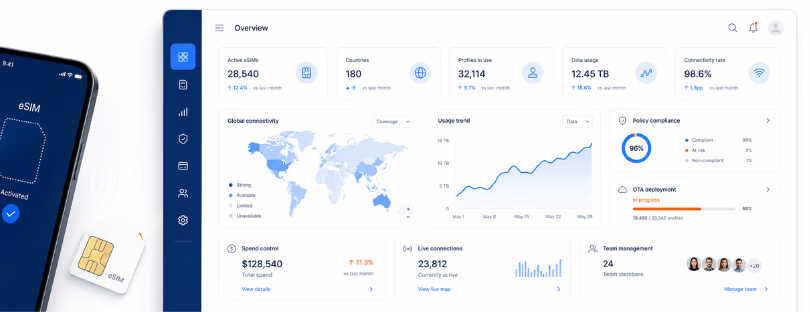
Team dashboards are not the same as governance
It would be unfair to say travel-first business products have no enterprise functionality. They do.
Airalo for Business and Holafly Connect both recognise that companies want team access, centralised buying and easier management. Holafly’s business pages, for example, explicitly promote a single dashboard for teams and business travel cost control.
But there is still a meaningful distinction between a team dashboard and enterprise governance.
A team dashboard helps a company buy and distribute plans. Governance asks harder questions. Can access be restricted by profile? Can usage rules change by destination? Can hard caps stop overspend automatically? Can IT see per-connection behaviour quickly enough to intervene? Can the organisation support users without relying on consumer-style app support?
This is where enterprise-specific platforms try to move the conversation from “buy data for staff” to “manage mobile data as an operational layer.” SureSIM’s category fit is strongest here, particularly for IT, finance and HR teams that need visibility, cost control and policy-led usage rather than only simple travel bundles.
Support matters more at scale
A consumer can tolerate a failed activation, a delayed chat response or a refund request. A company often cannot.
If a salesperson cannot open CRM at a client site, if a field worker loses data while travelling between countries, or if a manager lands before a major meeting and has no connection, the cost is not just the price of the plan. It is lost productivity, frustration, operational delay and sometimes safety risk.
This is where managed service expectations become important. Enterprise buyers increasingly want escalation paths, reporting, support ownership, and a supplier that understands business-critical mobility.
READ MORE: Enterprise eSIM Is Becoming a Corporate Standard — Here’s Why
GigSky, Airalo, Holafly, 1GLOBAL, Vodafone Business and SureSIM all sit somewhere in this broader market, but they do not all enter from the same direction. GigSky and Airalo are well-known in the travel eSIM. Holafly has pushed strongly into unlimited-style travel connectivity and business travel plans. Vodafone Business brings enterprise telecom depth. 1GLOBAL brings full-stack telecom and eSIM infrastructure. SureSIM’s angle is more focused on managed enterprise eSIM control for the global workforce and device connectivity.
That makes the buying decision less about brand recognition and more about the operating model.
The real enterprise eSIM test
Travel eSIMs break at enterprise scale because they were never really designed for enterprise scale.
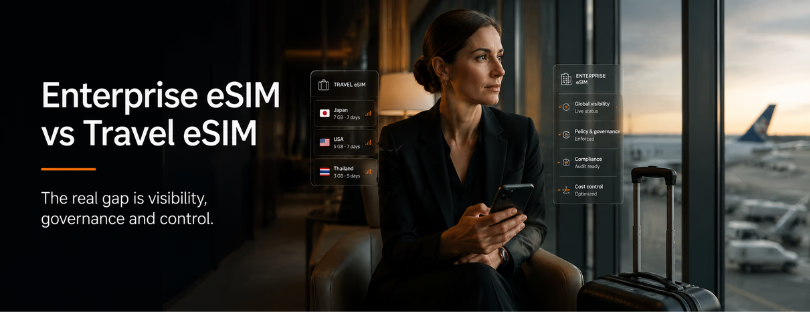
They were designed for individual travellers who want quick, affordable data abroad. That remains valuable. But enterprise mobility introduces different requirements: visibility, governance, procurement, support, reporting, security and cost accountability.
The next phase of this market will not be decided only by coverage maps or low prices. Most serious providers can talk about global reach now. The harder question is who can make connectivity manageable when the buyer is not one traveller, but an organisation.
For some companies, a travel-first business product from Airalo or Holafly may be enough. For others, a traditional enterprise telecom route through Vodafone Business or Orange Business may make more sense. For platforms, fintechs or embedded connectivity models, 1GLOBAL may be closer to the infrastructure conversation. For companies that want global workforce eSIM control without turning the whole thing into a traditional telco project, SureSIM belongs in the shortlist.
That is the credible way to frame the category. Not “travel eSIMs are bad.” They are not. They solved the first problem. Enterprise eSIM has to solve the second one. enterprise esim solution