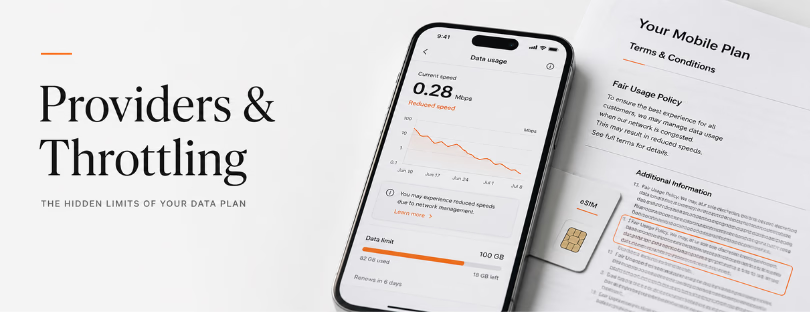
What eSIM Providers Don’t Tell You About Throttling
“Unlimited” has become one of the most abused words in travel connectivity. You see it everywhere now. Unlimited eSlM for Europe. Unlimited data in Japan. Unlimited global plan. Unlimited travel internet. It sounds simple, almost comforting. Buy once, stop thinking, stay connected.
But in the eSIM market, unlimited rarely means what normal people think it means.
It usually means one of three things: unlimited at full speed for a limited amount of daily data, unlimited at reduced speed after a threshold, or unlimited access subject to a fair-use policy buried in the plan details. The data may technically keep working. The experience, however, may not.
That difference matters. For a traveler, throttling is not an abstract telecom term. It is the moment Google Maps freezes outside a train station. It is the video call that turns into a slideshow. It is the hotel check-in app that spins while the receptionist waits. It is “connected” on paper, but useless in practice.
What throttling really means
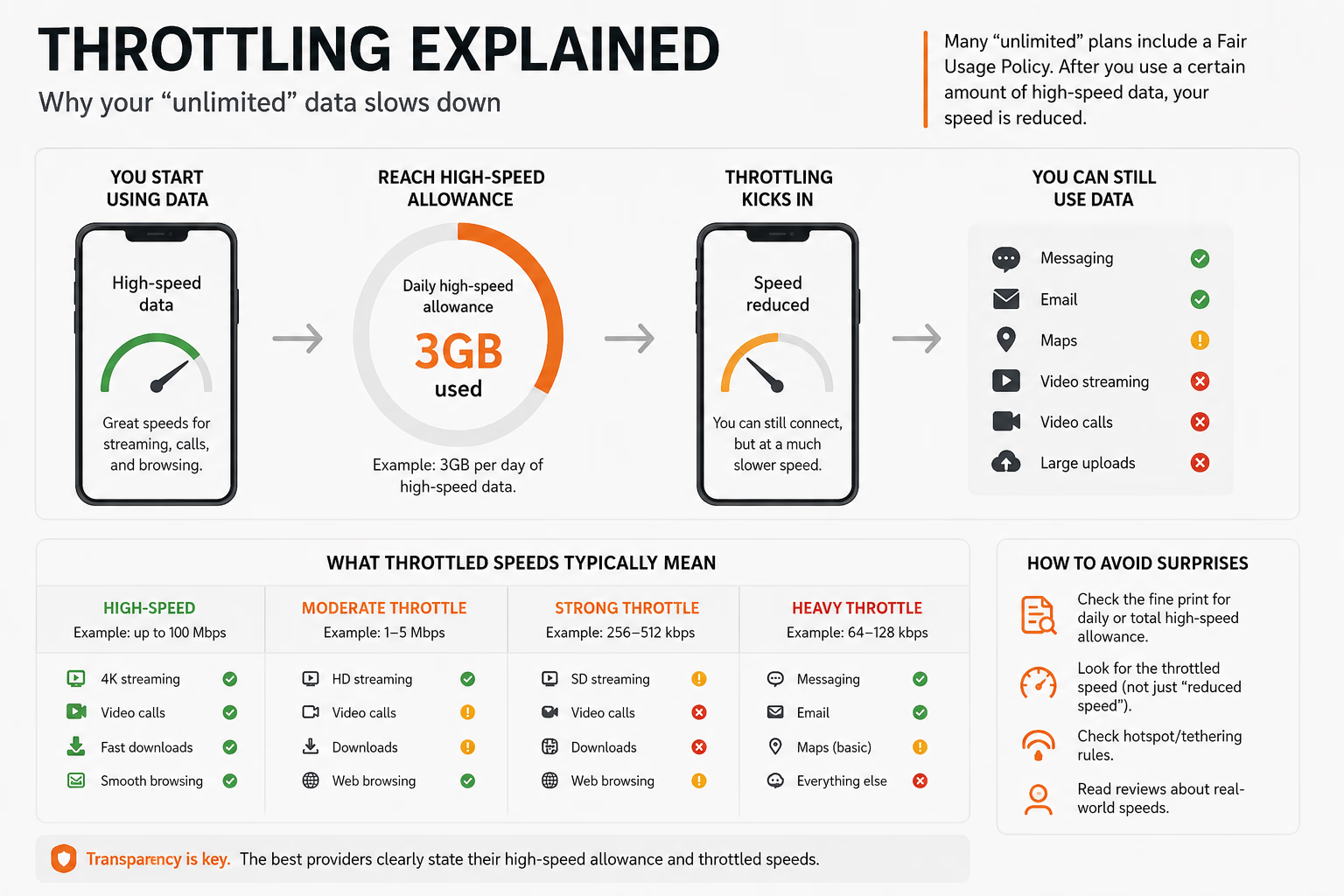
Throttling is when your provider deliberately reduces your data speed after certain conditions are met. Most commonly, that happens after you use a set amount of high-speed data within a day, week, or billing period.
A plan might advertise unlimited data, but the small print may say something like “high-speed data up to 2GB per day, then reduced speed.” Another plan may not clearly state the number at all, using softer language such as “subject to fair usage” or “network management may apply.”
READ MORE: What Fair Usage Policy (FUP) Really Means for eSIM Users (And Why You Should Care)
This is not always malicious. Mobile networks are shared infrastructure. If everyone used unlimited high-speed data without limits, especially on roaming agreements, costs and congestion would spiral. Regulators also recognise fair usage as a legitimate concept. In the EU, operators are allowed to apply fair use policies to roaming, and wholesale roaming data caps still shape the economics behind what providers can offer. For 2025, the EU wholesale data cap is €1.30 per GB plus VAT, falling to €1 per GB from 2027.
So yes, fair usage can be reasonable.
The problem is not throttling itself. The problem is how quietly it is sold.
The speed nobody advertises
Most providers are happy to shout about coverage, destinations, 5G, app activation, and “no roaming fees.” Few explain what happens after heavy use.
And that is where travelers get caught.
A provider may say “unlimited,” but after a few gigabytes, the speed may drop to a level suitable only for messaging and basic browsing. You might still be able to send WhatsApp texts. You probably will not enjoy hotspotting your laptop, uploading videos, joining a Zoom call, or watching Netflix.
This is why two unlimited eSIMs can look identical in a comparison table but behave completely differently in real life.
READ MORE: No Throttle eSIM vs Unlimited Plans: The Truth
One provider may throttle after 1GB per day. Another after 3GB. Another may offer a higher allowance but route traffic through a distant core network, adding latency. Another might depend on a local operator’s roaming priority, which can vary depending on congestion and commercial agreements.
The result? Same phone. Same city. Same local network name on the screen. Very different experience.
Why travel eSIMs are especially exposed
Travel eSIM providers often sit between the customer and the underlying mobile network. Some have deeper infrastructure, stronger operator relationships, better routing, and more control over traffic. Others are mainly distribution layers reselling access through aggregators.
That is not automatically bad. Many reseller-style providers offer good value and perfectly decent service for normal travel use. But when it comes to throttling, routing, and speed consistency, the difference becomes visible.
A full-stack or infrastructure-heavy player can often manage quality more directly. A lighter marketplace-style provider may depend more heavily on the terms it receives from upstream partners. In practice, that can mean less control over fair usage thresholds, less visibility into network performance, and more vague wording in the customer-facing offer.
This is also why the eSIM category is getting more serious. GSMA Intelligence noted in 2026 that travel eSIM is shifting roaming and the user experience, while GSMA also reported that eSIM smartphone penetration is moving from forecast to mass-market reality. In other words, this is no longer a niche travel hack. It is becoming mainstream mobile behaviour.
And when a market goes mainstream, vague promises become harder to defend.

Fair use is not the enemy
Let’s be fair to providers. Unlimited high-speed roaming is expensive to deliver.
A traveler using 500MB per day for maps, messaging, browsing, and tickets is a very different customer from someone hotspotting a laptop for eight hours, streaming video, uploading content, and running cloud backups. Providers need commercial protection against extreme usage. Local networks need capacity management. Regulators understand this, too. Ofcom, for example, frames net neutrality around user control while still monitoring traffic management practices and compliance with open internet rules.
READ MORE: Unlimited eSIM Without Throttling: Truth & Reality
So the mature position is not “all throttling is bad.”
The mature position is: tell people clearly.
Say how much high-speed data is included. Say what happens after the threshold. Say whether speed reduction is daily, total-plan-based, or network-dependent. Say whether hotspot use is treated differently. Say whether 5G availability means guaranteed 5G speeds, because it usually does not.
That kind of transparency would not scare good customers away. It would build trust.
What travelers should check
Before buying an eSIM, especially an unlimited one, look beyond the headline.
High-speed allowance
Check whether the plan includes a specific daily or total high-speed data limit. If the provider does not state it clearly, assume there may be one.
Reduced speed
Look for the throttled speed. “Reduced speed” is not enough. There is a big difference between usable slow data and barely functional data.
Hotspot rules
Some unlimited plans restrict tethering or treat hotspot usage differently. This matters for business travelers, remote workers, and families sharing data.
Network and routing
A strong local network can still perform poorly if routing is inefficient or roaming priority is weak—reviews and provider transparency help.
Use case fit
If you only need maps, messaging, ride-hailing, and searches, a capped plan may be smarter. For calls, meetings, uploads, or hotspotting, read the fair usage terms carefully.
Conclusion
The eSIM market is entering its honesty phase.
For years, providers competed on three easy claims: more countries, lower prices, and unlimited data. That worked while most buyers were casual users and the category was still young. But as travel eSIM adoption grows, the winners will not be the ones shouting “unlimited” the loudest. They will be the ones explaining performance most clearly.
Airalo, Holafly, Nomad eSIM, Ubigi, GigSky, Orange Travel, Yesim, Fairplay, and dozens of others are not selling the same thing, even when their plan cards look similar. Some are better for light travelers. Some are better for heavy data users. Some focus on simplicity. Some are building more persistent, app-based connectivity relationships. Some are moving closer to full mobile operator behaviour.
That is the direction to watch.
The next serious eSIM comparison will not be “who has the cheapest unlimited plan?” It will be “who tells you what unlimited actually means before you buy?”
Because throttling is not always a deal-breaker. Hidden throttling is.