eSIM Orchestration Rankings 2026: Amdocs and Valid Lead
The eSIM market has spent years talking about activation. Scan the QR code. Install the profile. Connect when you land. Avoid roaming shock. That story was useful, especially for consumers discovering travel eSIMs for the first time. consumer eSIM orchestration platforms
But it is no longer the main story.
Counterpoint Research’s 2026 Global Consumer eSIM Orchestration CORE Rankings show that the real competition is moving deeper into the infrastructure layer. Amdocs and Valid have emerged as the two “Pacesetters” in the latest ranking, with Amdocs continuing as the leading pacesetter and Valid entering the top category for the first time. The ranking evaluates companies across capability and execution, including lifecycle management, OSS/BSS integration, authentication, analytics, entitlement server support, partnerships, deployments and eSIM device base.
In simple terms, this is not just about downloading an eSIM anymore. It is about who controls the full digital journey around connectivity.
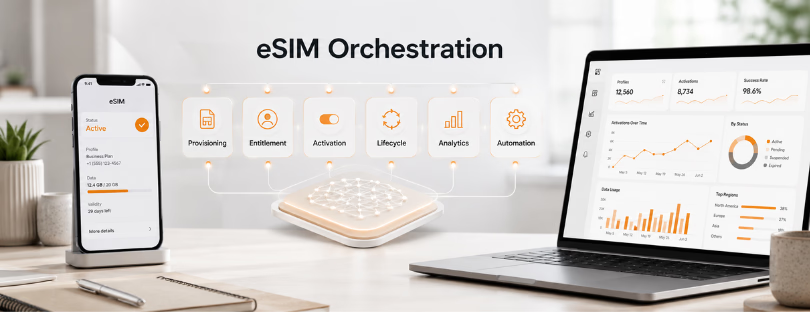
That journey now includes device recognition, activation, entitlement checks, customer support, billing logic, analytics, diagnostics, automation and increasingly AI-driven workflows. The consumer only sees a smooth activation button. Behind that button, a much bigger platform battle is happening.
What the chart really shows
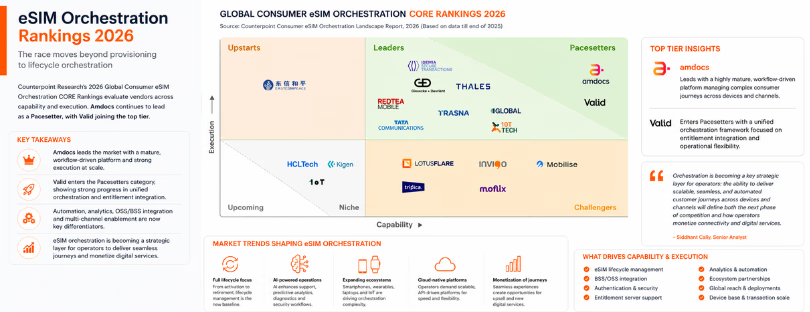
The attached Counterpoint chart is useful because it does not just rank companies in a list. It maps them by capability and execution.
Amdocs sits clearly in the top-right “Pacesetters” zone. That position matters. It signals both strong technology depth and strong market execution. In orchestration, execution is not a small detail. Operators do not buy theory. They need platforms that can work inside complicated billing systems, support multiple channels, manage lifecycle events and scale across millions of users.
READ MORE: Amdocs, IDEMIA Named Pacesetters in eSIM Orchestration Rankings
Valid is also in the Pacesetters area, slightly closer to the Leaders boundary. That is actually one of the most interesting parts of the chart. It suggests momentum. Valid is not only being recognized for having eSIM capability, but for building a more unified orchestration framework and improving its execution.
The Leaders zone is crowded, and that tells its own story. Thales, IDEMIA Secure Transactions, G+D, 10T Tech, RedTea Mobile, Tata Communications, Trasna and 1GLOBAL all sit in this group. Some come from secure identity and SIM heritage. Others bring telecom infrastructure, global connectivity, roaming or digital enablement experience.
That mix is important. eSIM orchestration is becoming a convergence layer. It touches mobile operators, OEMs, travel eSIM providers, enterprise mobility, connected devices and digital service platforms.
The Challengers group, including Mobilise, LotusFlare, Invigo, triPica and Moflix, also deserves attention. These companies may not yet have the same execution scale as the biggest players, but many bring SaaS-led, cloud-native and API-first approaches. For operators tired of slow legacy projects, that flexibility can be attractive.
Then there is the Niche group: Kigen, 1oT and HCLTech. This does not mean they are unimportant. It means their strengths appear more focused or use-case specific within the consumer orchestration landscape.
The big shift
Senior Analyst Siddhant Cally captured the market shift well:
“Consumer eSIM orchestration is moving from an adjacent provisioning capability to a core layer within the broader eSIM ecosystem. Vendors are expanding orchestration capabilities, deepening entitlement integration, and building more comprehensive lifecycle management frameworks in response to the growing importance of orchestration in managing increasingly complex device ecosystems and OEM-driven connectivity journeys. AI is also gaining ground across the ecosystem powering chatbot support, predictive capabilities, diagnostics, and security-focused workflows.”
That quote is the heart of this story. Provisioning was once the technical backend. Now orchestration is becoming the strategic control layer.
Why? Because eSIM adoption is expanding across smartphones, wearables, travel connectivity and enterprise use cases. More devices mean more complexity. More channels mean more customer journeys. More digital-first expectations mean less tolerance for failed activations, confusing QR codes or support tickets that bounce between the operator, device maker and connectivity provider.
READ MORE: My10T Smart Orchestration: Simplifying eSIMs for Carriers
This is where GSMA standards matter too. The GSMA defines eSIM as a global specification enabling remote SIM provisioning, and its consumer specifications support smartphones, wearables and connected laptops. But standards alone do not create a good customer experience. Orchestration is what turns the technical possibility into something operators can manage commercially.
Cally added another important point:
“Orchestration is becoming a key strategic layer for operators: the ability to deliver scalable, seamless, and automated customer journeys across devices and channels will define both the next phase of competition and how operators monetize connectivity and digital services.”
That is the line operators should pay attention to. The next competition is not only about who connects the device. It is about who owns the journey around the connection.
Why Amdocs leads
Counterpoint’s Principal Analyst Varun Gupta explained what separates the strongest vendors:
“Strong capabilities across automation, analytics, OSS/BSS integration, entitlement frameworks, and multi-channel enablement continue to differentiate the leading orchestration platforms in the market.”
This is exactly why Amdocs has a strong position. Amdocs already lives deep inside operator systems. Its natural strength is not just eSIM. It is workflow, customer management, billing, service orchestration and integration with the operational machinery that telecom companies already use.
That may sound less exciting than a slick travel eSIM app, but it is where real scale happens.
A consumer wants the eSIM to activate instantly. An operator needs that activation to connect correctly to CRM, billing, network systems, device status, customer support and entitlement logic. If one part breaks, the customer experience breaks.
Gupta added:
“Amdocs continued as the leading pacesetter in this year’s rankings, supported by its highly mature and workflow-driven orchestration platform capable of managing increasingly complex consumer connectivity journeys across devices and channels.”
This is the difference between simple enablement and mature orchestration. The winners are not just helping operators issue profiles. They are helping them manage connectivity as a digital service.
Why Valid’s move matters
Valid entering the Pacesetters category is one of the strongest signals in the report.
Gupta said:
“Valid entered the pacesetters category for the first time this year, reflecting its strong progress in building a unified orchestration framework with growing focus on entitlement integration and operational flexibility.”
This matters because the market is becoming less forgiving. Early eSIM adoption could survive awkward activation flows. The next phase will not. When eSIM is embedded into OEM journeys, wearables, travel apps, enterprise platforms and digital bundles, orchestration needs to be flexible, automated and reliable.
Operational flexibility is especially important. Operators increasingly need to support multiple sales and service channels: mobile apps, web stores, retail, OEM flows, partner channels and customer care. A rigid platform becomes a problem very quickly.
READ MORE: Simetric and Thales Redefine eSIM Orchestration
Valid’s position suggests it is moving beyond traditional secure connectivity roots and into the broader orchestration conversation. That is a smart place to be.
Gupta also noted:
“In addition to platform depth, both vendors continue to strengthen their market presence through growing eSIM transaction volumes, expanding operator relationships, and broader ecosystem execution across both large and small operator groups.”
That last part is important. The chart is not only about product features. It is also about traction. In this market, capability without operator adoption is not enough.
Leaders and challengers
The Leaders group may be the most competitive part of the landscape. Thales, IDEMIA Secure Transactions and G+D bring deep experience in secure identity, SIM technology and operator relationships. That gives them credibility in a market where trust, certification and resilience still matter.
Tata Communications and 1GLOBAL bring a different angle, closer to global connectivity and cross-border service enablement. This is particularly relevant for Alertify readers because travel eSIM, enterprise mobility and consumer eSIM are starting to overlap. A bank may bundle roaming data into a premium account. An airline may sell an eSIM during check-in. A business traveler may use a consumer-style eSIM product, while an enterprise wants visibility and controls behind the scenes.
READ MORE: Cerqle Showcases eSIM Orchestration Platform at MWC
Trasna’s move into the Leaders category also shows that the market is not frozen. There is still room for companies to climb if they improve capability, ecosystem reach and execution.
Meanwhile, the Challengers are worth watching because they often represent the pressure coming from below. Mobilise, LotusFlare, Invigo, triPica and Moflix bring more agile approaches around cloud platforms, APIs, automation and customer experience. They may not yet match the biggest players on scale, but they can shape what operators expect from usability and speed.
Consumer eSIM orchestration platforms – What this really means?
The 2026 Counterpoint ranking confirms a bigger market truth: eSIM is no longer just a provisioning story. It is becoming an orchestration story.
Amdocs leads because it connects eSIM into the heavy systems operators already depend on. Valid’s rise matters because it shows that unified orchestration, entitlement integration and operational flexibility are becoming top-tier capabilities. The Leaders group proves that secure identity vendors, telecom infrastructure players and global connectivity companies are all chasing the same strategic layer. The Challengers remind us that API-first platforms can still disrupt if they scale execution.
For operators, the key question is no longer “Can this vendor support eSIM?” Most serious vendors can. The better question is: can this vendor help us turn eSIM into a smoother customer journey, a lower-cost support model and a monetizable digital service?
For travel eSIM providers, airlines, banks, OEMs and enterprise mobility platforms, this is the hidden infrastructure story behind the customer experience. The user sees one button: activate. The market sees something much bigger.
The real winners will be the companies that make connectivity feel instant, intelligent and almost invisible.