Valid eSIM: The Quiet Infrastructure Behind Digital SIMs
Most eSIM stories still start at the consumer end: a traveler lands, scans a QR code, gets data, avoids roaming shock. Useful, yes. But that is only the visible layer. Underneath that smooth activation sits a much less glamorous, much more important question: who makes the eSIM actually work securely, at scale, across devices, operators and markets?
Valid positions itself around “trusted connectivity,” covering SIMs, eSIMs, 5G, Remote SIM Provisioning platforms and IoT solutions. Its eSIM offer is not just a downloadable travel data product. It is an infrastructure stack for mobile operators, OEMs, IoT providers and connectivity brands that need to manage digital SIM profiles reliably. Valid says its end-to-end eSIM solution includes the eSIM or eUICC, Remote SIM Provisioning services and other components depending on device type and use case.
Why Valid matters now
The market has moved past the “eSIM is convenient” phase. Convenience is now expected. The harder problem is orchestration.
Operators need profile downloads that do not fail halfway. MVNOs need faster onboarding without building the whole provisioning stack themselves. IoT companies need devices that can be deployed once and managed remotely for years. Travel eSIM brands need activation flows that feel instant, even when the technical reality behind them is anything but simple.
Valid’s Remote SIM Provisioning platform is designed to let mobile operators manage eSIM services with more efficiency, security and flexibility. In practical terms, that means consumers can download and activate eSIM profiles over the air, moving from purchase to connectivity much faster than with physical SIM logistics.
That sounds boring until it breaks. Then it becomes the whole product.
Anyone who has tested enough travel eSIMs knows this: two providers can sell access to similar destinations, even similar networks, but the activation experience can feel completely different. One QR code installs cleanly. Another creates a support ticket. One profile appears instantly. Another leaves the user restarting the phone in an airport corner. Infrastructure quality shows up in those small moments.
More than QR codes
Valid’s eSIM Onboarding Journeys are also worth noting because activation is becoming part of the customer experience, not just a technical step. The company describes support for different onboarding flows, including individual QR delivery via website, with the goal of making eSIM activation easier for both operators and customers.
This is a smart direction. The industry has spent years treating QR codes as the default eSIM interface. They work, but they are not elegant. For less technical users, they still feel slightly fragile. For travel brands, banks, airlines or apps that want to embed connectivity into their own customer journey, “scan this code and hope” is not exactly premium.
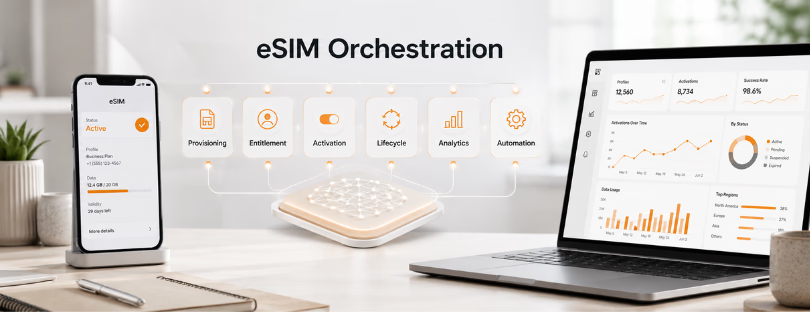
That is why the next eSIM battleground is not only coverage or price. It is onboarding, entitlement, device compatibility, support visibility and recovery when something goes wrong.
Valid also highlights entitlement server capabilities and operator support tools as part of its eSIM solutions portfolio. That matters because eSIM is increasingly tied to device ecosystems, wearables, companion devices and bundled services, not only one-off mobile data plans.
The IoT angle
The consumer travel market gets the attention, but IoT may be where the deeper eSIM infrastructure race becomes more important.
Valid’s IoT connectivity offer includes embedded SIM technology designed to simplify provisioning and lifecycle management for connected devices. It also references eIM, which is relevant as the industry moves toward newer IoT eSIM management models.
This aligns with the broader market direction. GSMA specifications separate consumer, M2M and IoT eSIM approaches, and the newer IoT specification is designed for devices that may be constrained by power, interface or network conditions.
For enterprises, this is not theoretical. A connected meter, vehicle tracker, health device or industrial sensor may live in the field for years. Sending someone to swap a SIM card is expensive and sometimes impossible. Remote provisioning becomes less about convenience and more about operational survival.
Where Valid sits against the big players
Valid is playing in a serious category. Thales offers eSIM solutions covering Remote SIM Provisioning platforms and eSIM products for MNOs, OEMs, enterprises and IoT service providers. G+D also has a major eSIM management portfolio, including AirOn360 for carriers, automotive manufacturers and IoT device makers.
So Valid is not alone, and that is exactly the point. The eSIM infrastructure market is becoming a layer of competition beneath the brands consumers actually see.
Thales often presents itself around scale, global deployment and lifecycle management. G+D leans heavily on secure eSIM management, automotive, IoT and long-standing eUICC expertise. Valid’s angle feels slightly more focused on trusted connectivity as an interoperable, end-to-end foundation across consumer, IoT, M2M, 5G and remote provisioning.
For Alertify readers, the useful takeaway is this: the best eSIM experience is rarely created by the front-end brand alone. It depends on the stack behind it. RSP quality, onboarding logic, operator integrations, eUICC expertise and support tooling all shape whether an eSIM feels seamless or frustrating.
Final take
Valid is not the loudest name in travel eSIM marketing, and it does not need to be. Its relevance sits behind the screen, where eSIM becomes less of a product and more of a connectivity operating layer.
That is where the market is heading. Travel eSIM brands, MVNOs, operators, fintechs, airlines and IoT companies all want to sell or manage connectivity without becoming telecom engineers. The winners will be the companies that make eSIM feel invisible for the user while keeping it secure, interoperable and manageable for the business.
Valid belongs in that conversation. Not as another travel eSIM storefront, but as one of the infrastructure players helping decide whether the next wave of eSIM adoption feels polished, scalable and trusted, or just digital SIM chaos with better branding.
Driven by wanderlust and a passion for tech, Sandra is the creative force behind Alertify. Love for exploration and discovery is what sparked the idea for Alertify, a product that likely combines Sandra’s technological expertise with the desire to simplify or enhance travel experiences in some way.