Airalo and Valid Are Fixing What Travel eSIM Coverage Doesn’t Show
The global eSIM market is quietly entering its next phase. Coverage and pricing are no longer the only battlegrounds. Reliability, performance transparency, and real-time network intelligence are becoming the real differentiators. Against that backdrop, a new strategic collaboration between Valid and Airalo signals where the travel connectivity market is heading next. Airalo network quality
Valid, a long-established player in trusted connectivity and digital security, has teamed up with Airalo, the world’s largest travel eSIM platform, to strengthen how eSIMs are provisioned, monitored, and optimized at scale. The partnership combines Valid’s Remote SIM Provisioning infrastructure with a Quality of Service intelligence layer designed to continuously evaluate mobile network performance across the globe.
For travelers, the impact is largely invisible but meaningful. For the industry, it is a clear sign that eSIMs are maturing from a convenience product into a performance-driven connectivity service.
Why this partnership matters for the eSIM market
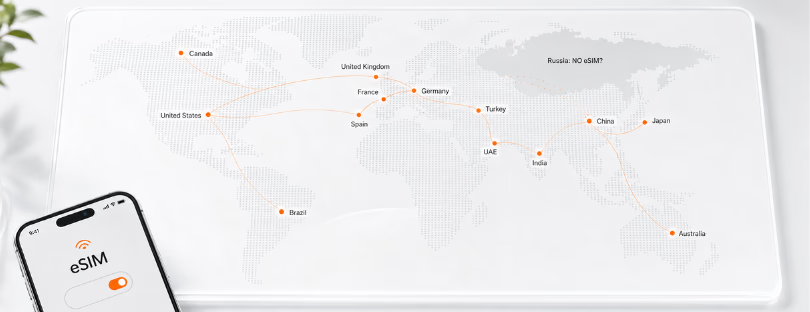
Airalo operates at a scale few travel eSIM brands can match. With coverage in more than 200 destinations and a user base exceeding 20 million, even small improvements in activation speed, stability, or network selection have an outsized impact on user experience.
By integrating Valid’s high-availability SM-DP+ platform, Airalo now manages the full lifecycle of eSIM profiles through infrastructure designed for secure, global-scale deployments. This means faster profile downloads, more consistent activation flows across devices, and reduced friction at the moment travelers care about most: when they land and need data immediately.
But the more interesting layer sits above basic provisioning.
Valid’s Quality of Service solution adds real-time network intelligence to the eSIM stack, giving Airalo visibility into how partner networks actually perform on the ground, not just how they look on paper.
More on Alertify
Follow the latest Airalo news
eSIM updates, travel connectivity stories and market moves from one of the biggest names in global eSIM.
Explore news →
From coverage maps to real-world performance
Coverage claims have long been a weak signal in the roaming and eSIM world. Two networks may both “cover” a destination, yet deliver vastly different experiences depending on congestion, latency, or device behavior.
Valid’s QoS intelligence continuously evaluates mobile network performance across carriers and regions, tracking indicators such as throughput, latency, network availability, and out-of-service events. For Airalo, this unlocks several practical capabilities.
First, it allows benchmarking of network partners across destinations. Instead of relying solely on commercial agreements or static testing, Airalo can compare how networks perform in real-world conditions over time.
Second, it enables proactive issue detection. Performance degradation can be identified early, before it escalates into widespread customer complaints or refund requests.
Third, it provides insight into device behavior. Different OEM devices can behave very differently on the same network. Understanding those patterns helps fine-tune network selection and support strategies.
Ultimately, this intelligence layer helps Airalo do something travelers increasingly expect: guarantee not just connectivity, but good connectivity.
What Airalo gains beyond basic connectivity
From the outside, travel eSIMs can look interchangeable. Similar data bundles, similar destination lists, similar pricing in euros or yen depending on the market. Under the hood, however, operational sophistication makes a real difference.
With Valid’s platform, Airalo gains full visibility into the connectivity experience across millions of sessions worldwide. This shifts the company from a reactive support model to a predictive one.
Instead of responding after users experience slow speeds or outages, Airalo can adjust network prioritization, investigate regional anomalies, or refine partner strategies based on live data.
It is a move away from “best effort” roaming and toward performance-managed connectivity, a model already common in enterprise telecom but still rare in consumer travel eSIMs.
Although the QoS platform is currently deployed to enhance Airalo’s travel eSIM offering, it is architected for broader use cases, including IoT deployments where thousands or millions of devices depend on stable, predictable network behavior.
A technical foundation built for scale
At the core of the collaboration is Valid’s Remote SIM Provisioning infrastructure. SM-DP+ platforms are not all created equal, and at global scale, availability and security are non-negotiable.
Valid’s RSP infrastructure is designed to support secure, scalable eSIM profile downloads across a wide range of devices and operating systems. For Airalo, this translates into faster activations, fewer failed downloads, and consistent performance regardless of geography.
When combined with Quality of Service intelligence, the result is an end-to-end view of the eSIM experience, from profile download to network performance in use.
As Gustavo Rubio, Worldwide Solutions Sales Director at Valid, puts it:
“Airalo is simplifying how people connect globally, and Valid is proud to help power that experience with secure eSIM provisioning and advanced network intelligence,” said Gustavo Rubio, Worldwide Solutions Sales Director at Valid. “Our Quality of Service solution ensures Airalo users always receive the highest-quality connectivity, wherever they are.”
From Airalo’s side, the emphasis is clearly on product integrity rather than marketing promises.
“Our priority is a high-quality, honest product, and Valid gives us the technical foundation to back that up,” says Peter Nussbaumer, VP of Networks at Airalo. “Their insights allow us to move beyond basic connectivity and provide a layer of intelligence that ensures our customers stay safe and connected, no matter where they are.”
How does this compare to other eSIM players?
Most large travel eSIM brands today focus on three levers: destination count, price in local currencies such as euros or yen, and ease of installation. Fewer invest deeply in network performance intelligence.
Some players rely on single-network agreements per country, limiting flexibility. Others aggregate multiple networks but lack real-time visibility into how those networks behave under load or across device types.
By contrast, Airalo’s approach, supported by Valid, aligns more closely with how enterprise MVNOs and IoT connectivity platforms operate. Continuous monitoring, benchmarking, and optimization are standard practices in those segments.
This is also consistent with broader industry trends. According to GSMA Intelligence and industry analyses from firms like Kaleido Intelligence, the next growth phase of eSIM will be driven less by awareness and more by quality differentiation. As more consumers adopt eSIM-capable devices, expectations rise accordingly.
Why Quality of Service is becoming a differentiator
As travel eSIM adoption grows, customer tolerance for poor performance shrinks. Travelers may accept slower speeds at peak times, but persistent latency, unreliable connections, or sudden service drops quickly erode trust.
Quality of Service intelligence addresses this gap by turning network performance into something measurable and actionable. It also creates accountability across the ecosystem, from wholesale partners to platform operators.
For brands like Airalo, this helps protect reputation at scale. For the wider market, it sets a new baseline for what “premium” travel connectivity actually means. Airalo network quality
Conclusion: a signal of where travel eSIMs are headed
This collaboration is less about a single platform upgrade and more about a shift in mindset. As travel eSIMs move from early adoption to mass usage, success will depend on infrastructure depth, not just distribution reach.
Airalo’s partnership with Valid reflects a broader trend toward performance-driven connectivity, where real-time intelligence and network transparency become core product features rather than backend tools.
Compared with many competitors still competing primarily on price per gigabyte, this approach positions Airalo closer to the standards seen in enterprise and IoT connectivity markets. It also aligns with signals from GSMA, Kaleido Intelligence, and other industry observers who point to Quality of Service and lifecycle management as key differentiators in the next phase of eSIM growth.
For travelers, the benefits show up as fewer surprises and more reliable connections. For the industry, it raises the bar. And for the eSIM market as a whole, it is another clear sign that the era of “just works” connectivity is giving way to something more accountable, measurable, and mature.
Driven by wanderlust and a passion for tech, Sandra is the creative force behind Alertify. Love for exploration and discovery is what sparked the idea for Alertify, a product that likely combines Sandra’s technological expertise with the desire to simplify or enhance travel experiences in some way.