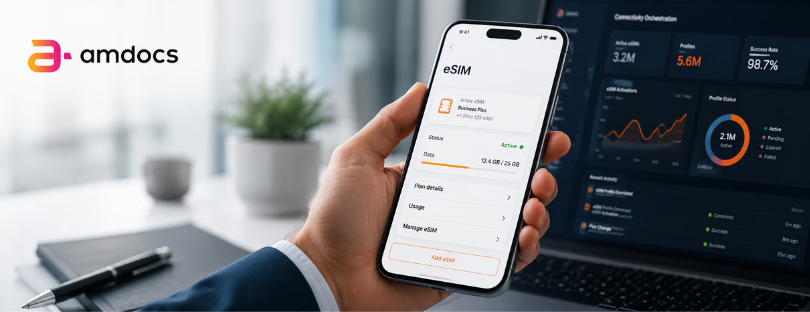
Amdocs and the New Battle for eSIM Orchestration
Most people still talk about eSIM as if it is a travel product. Buy a plan, scan a QR code, land in Barcelona, and hope WhatsApp works before the taxi driver disappears. That is the visible part. Useful, yes. But not the whole story.
Amdocs sits on the less glamorous, more important side of the eSIM market: the infrastructure layer that lets operators actually manage eSIM at scale. And that matters because eSIM is no longer just a cleaner version of the plastic SIM card. It is becoming a control point for activation, device onboarding, roaming, subscriptions, customer support, IoT, wearables, and eventually a much broader set of connected services.
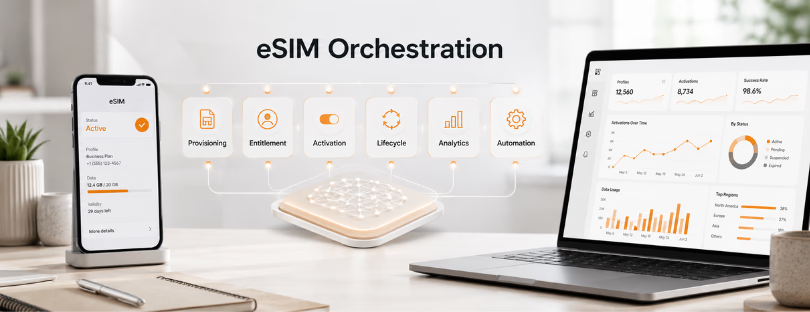
Amdocs describes its eSIM Cloud as a SaaS, cloud-native platform for activation, onboarding, subscription and lifecycle management. In plain English: it helps communications service providers launch and manage eSIM services without having to stitch together every piece themselves. That includes activation journeys, orchestration, entitlement, customer support and lifecycle handling across device types and customer segments.
Why this matters now
For years, operators treated eSIM as a technical migration. Replace the SIM card, reduce logistics, and make activation digital. Nice efficiency story. But the market has moved faster than that.
Travel eSIM apps proved something uncomfortable: customers are willing to bypass their home operator when the alternative is cheaper, faster and easier. Airalo, Holafly, Nomad eSIM and similar players did not wait for traditional telecom roadmaps. They turned connectivity into an app experience.
READ MORE: eSIM Orchestration Rankings 2026: Amdocs and Valid Lead
That is where Amdocs’ recent direction becomes interesting. At MWC 2026, the company launched its Global eSIM Traveler Solution, designed to help telcos offer instant, branded eSIM travel plans through their own digital channels. The idea is simple but strategically sharp: if customers are already buying travel data before they fly, operators should not let that relationship move entirely to third-party eSIM aggregators.
This is not just about “winning back roaming revenue,” although that is obviously part of it. It is about keeping the operator inside the customer journey. Buy, bill, activate, support, renew. If the operator loses those moments, it slowly becomes background infrastructure while someone else owns the experience.
The entitlement layer
One of the reasons Amdocs is worth watching is its focus on entitlement servers. That sounds painfully technical, but it is becoming one of the most important pieces of modern connectivity.
An entitlement server helps decide whether a device can access and activate certain services. That can include eSIM activation, wearable pairing, VoLTE, VoWiFi, RCS, 5G services and other network-linked features. As more devices and services become software-controlled, this layer becomes more strategic.
READ MORE: Amdocs Sets New eSIM Entitlement Server Benchmark
Counterpoint Research named Amdocs a leading player in its eSIM orchestration and entitlement rankings. In May 2026, Counterpoint said Amdocs led its 2026 Consumer eSIM Orchestration Rankings as the top pacesetter, with Valid also moving strongly in the category.
That recognition matters because eSIM orchestration is no longer a niche back-office function. It is where telecom meets device ecosystems, cloud platforms and customer experience. Apple’s own support documentation shows how normal eSIM has become for users, including carrier activation, QR activation, app-based activation and phone-to-phone transfer. The user sees a simple “Add eSIM” journey. Behind that, operators need reliable orchestration.
Where Amdocs fits
Amdocs is not trying to be Airalo. It is not a consumer travel eSIM storefront. It is not selling the traveler a cheap 5GB Italy plan with a nice app icon. Its role is closer to the engine room.
That makes it comparable to players such as IDEMIA Secure Transactions, Valid, Thales, 1GLOBAL, G+D and other eSIM infrastructure specialists. But Amdocs has a particular advantage: it already sits deeply inside telecom BSS, OSS, billing and customer management environments. For large operators, that matters. eSIM is not just provisioning. It touches billing, identity, support, fraud, device eligibility, roaming strategy and digital channels.
Compared with Valid or IDEMIA, Amdocs feels less like a pure secure connectivity specialist and more like a telecom systems partner expanding deeper into eSIM orchestration. Compared with 1GLOBAL, which has a strong telco-native and connectivity-led story, Amdocs is more focused on enabling existing operators to modernize their eSIM experience without losing control of the customer relationship. 1GLOBAL, for example, has also been recognized in Counterpoint’s 2026 eSIM orchestration work, especially around automation and IoT-facing connectivity models.
The travel eSIM tension
The most interesting part of Amdocs’ eSIM story is the tension between operators and travel eSIM brands.
Travel eSIM companies grew because they solved a real consumer frustration. Roaming was expensive, confusing and often badly explained. But operators still have advantages: trusted billing, existing customer data, domestic brand relationships, support channels and network partnerships. What they often lacked was speed and product simplicity.
READ MORE: Amdocs, IDEMIA Named Pacesetters in eSIM Orchestration Rankings
Amdocs’ Traveler Solution is clearly built around that gap. It gives operators a way to offer destination-based eSIM plans directly, with activation and billing tied into their existing systems. Developing Telecoms reported that the solution is designed to let CSPs offer instant branded eSIM data plans for international travelers, helping them counter the rise of travel eSIM aggregators while keeping the home operator in the buy-bill-support relationship.
That is a smart move. But it will only work if operators stop making travel connectivity feel like a tariff brochure. The market has changed. Travelers now expect transparent pricing, fast activation, clean app flows and no nonsense around “unlimited” data.
Conclusion
Amdocs is not the loudest name in eSIM, but it may be one of the more strategically important ones. Consumer brands get the visibility, and infrastructure players shape what is actually possible.
The bigger trend is clear: eSIM is moving from a SIM replacement to a service control layer. That shift favors companies that can connect provisioning, entitlement, billing, customer experience and analytics in one operational flow. Amdocs is strong precisely because it understands telecom complexity, not because it pretends that complexity does not exist.
Still, the market will not reward infrastructure for its own sake. Operators using platforms like Amdocs eSIM Cloud need to deliver experiences that feel as simple as the travel eSIM apps they are trying to compete with. If they do, telcos have a real chance to reclaim part of the travel connectivity journey. If they do not, Amdocs may help them build excellent machinery for products that customers still choose to avoid.