China Telecom Enters AI Token Economy with $1.4 Plans
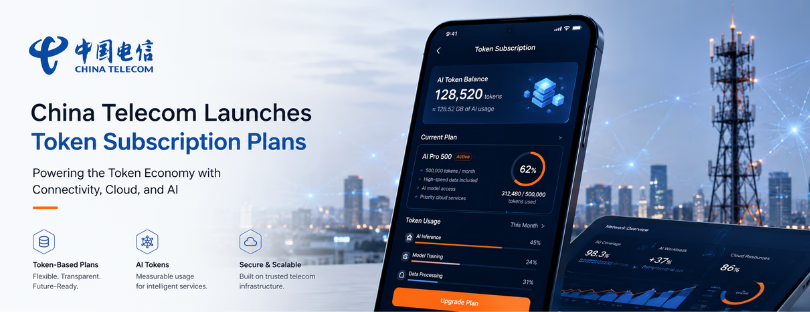
China Telecom has just made one of the clearest moves yet by a traditional operator into the AI economy. On May 17, World Telecom Day, the company launched its first trial commercial Token subscription plans, with personal packages reportedly starting at 9.9 yuan per month, or roughly $1.4, for 10 million tokens. The bigger story is not the price. It is the packaging. China telecom AI token economy
Telecom operators know how to sell units. Minutes, SMS, gigabytes, roaming passes, cloud storage. Now China Telecom is trying to make AI usage feel just as normal as buying mobile data. Instead of asking customers to choose one AI model, one developer platform, or one cloud provider, it is wrapping access to computing resources into subscription-style bundles.
That sounds technical, but the logic is very familiar. A token is the basic unit an AI model processes when it reads or generates text, code, prompts, documents, or instructions. In simple terms, tokens are to AI what megabytes are to mobile internet. You do not really “see” them, but they determine how much usage you get, how much it costs, and how scalable the service becomes.
What the token economy means
The token economy is not about crypto tokens here. That distinction matters.
In this case, “token” means measurable AI usage. Every prompt, every chatbot answer, every line of generated code, every AI agent action consumes tokens. The more businesses use AI for customer service, coding, analytics, translation, office work, workflow automation, and content generation, the more token consumption becomes a real operating cost.
That is why telecom operators are suddenly interested. China is treating AI computing power less like a niche cloud service and more like national infrastructure. South China Morning Post reported that Chinese policymakers are framing computing power as part of a wider “national computing network,” with tokens compared to mobile data as the measurable commodity of the AI era. The same report said daily token calls in China exceeded 140 trillion in March 2026, more than 1,000 times the level at the start of 2024.
So the token economy means this: AI usage becomes packaged, priced, distributed and managed like connectivity. And if any industry understands that playbook, it is telecom.
Who China Telecom is targeting
China Telecom’s plans appear to be split across several user groups.
For individual and household users, the low-cost packages are designed for everyday AI needs: office assistance, studying, writing, light research and content creation. The entry tier reportedly gives users 10 million tokens for 9.9 yuan per month, while a higher personal tier offers 80 million tokens for 49.9 yuan.
READ MORE: China Telecom Launches Direct-to-tone Phone Satellite Connectivity in Hong Kong
For developers and small-to-medium businesses, the bundles are larger, reportedly ranging from 15 million to 250 million tokens per month, with prices from 39.9 yuan to 299.9 yuan. These are aimed at AI programming, debugging, agent deployment and other heavier workloads.
The interesting part is the cross-model structure. Instead of selling only access to China Telecom’s own Xingchen large language model, the offer reportedly includes access to other domestic models such as GLM and DeepSeek. That changes the value proposition. China Telecom is not only acting as a model provider. It is trying to become a model marketplace, billing layer and usage manager in one.

Why operators like this model
For telecoms, this is a natural next step. Mobile growth is mature. Connectivity is still essential, but the old revenue engines are under pressure. AI gives operators a new way to monetize their networks, cloud platforms, billing systems, enterprise relationships and security capabilities.
Shanghai Telecom moved in the same direction just days earlier, with token-based AI computing packages that reportedly include a pay-as-you-go model of 1 yuan for 250,000 tokens. That is a very telecom-style proposition: clear unit, simple billing, easy entry point.
READ MORE: China Telecom tests quantum-encrypted phone calls on smartphones
China Mobile is also pushing hard. Its MoMA platform brings more than 300 models behind a unified API gateway, including DeepSeek, Tongyi Qianwen, Kimi, Doubao and GLM, while adding routing tools that can switch between cost-first, quality-first and balanced model strategies. AIbase reported that MoMA also claims token cost reductions of more than 30% through caching, routing and domestic computing optimization.
That tells us this is not a one-off product launch. China’s operators are positioning themselves as AI utility companies.
The DeepSeek effect
DeepSeek matters here because it changed the pricing psychology around AI. It showed that powerful models do not have to be locked behind expensive Western cloud economics. Reuters recently reported that DeepSeek’s newer model direction is also tied more closely to Huawei chips, underlining China’s push for AI self-sufficiency and domestic infrastructure independence.
For operators, that creates an opening. If AI models become cheaper, more local and more interchangeable, the real business shifts toward access, orchestration, trust, billing and enterprise distribution. In other words, the telecom layer becomes valuable again.
This is very similar to what happened in mobile data. Users did not care which packet-routing architecture sat behind their 4G plan. They cared whether it worked, how fast it was, and how predictable the bill looked. AI may be moving in the same direction.
Conclusion
China Telecom’s token plans are not just another AI pricing experiment. They show where telecom may be heading: from selling connectivity to selling intelligent capacity.
The comparison with China Mobile and Shanghai Telecom is important. Shanghai Telecom is making token usage feel like pay-as-you-go data. China Mobile is building a large model aggregation and routing platform. China Telecom is bundling tokens into consumer and developer subscriptions. Different approaches, same direction.
For Alertify readers, the bigger signal is clear. Telecom operators do not want to be passive pipes in the AI era. They want to become the layer that packages AI access, manages usage, controls billing, adds security and gives businesses a simpler way to consume models.
That is the real token economy. Not hype. Not crypto. Not another vague “AI transformation” slogan. It is the beginning of AI usage becoming a billable utility, and telecoms are trying very hard to make sure they own part of that bill.