When the EU introduced “Roam Like at Home,” it fixed one of travel’s most annoying problems: landing in another European country and instantly worrying about mobile data. For millions of travellers, it worked. Calls, SMS and mobile data inside the EU and EEA became much more predictable, with domestic prices applying during periodic travel under fair-use rules. The current EU roaming regulation runs until June 2032, which shows how central the policy has become to the European travel experience.
Because Europe is not the whole travel map. And “roam like at home” was never designed to solve every connectivity problem. It was designed to make temporary roaming inside the EU and EEA fairer. That is a huge win, but it leaves plenty of messy territory outside the neat Brussels framework.
The fair-use reality
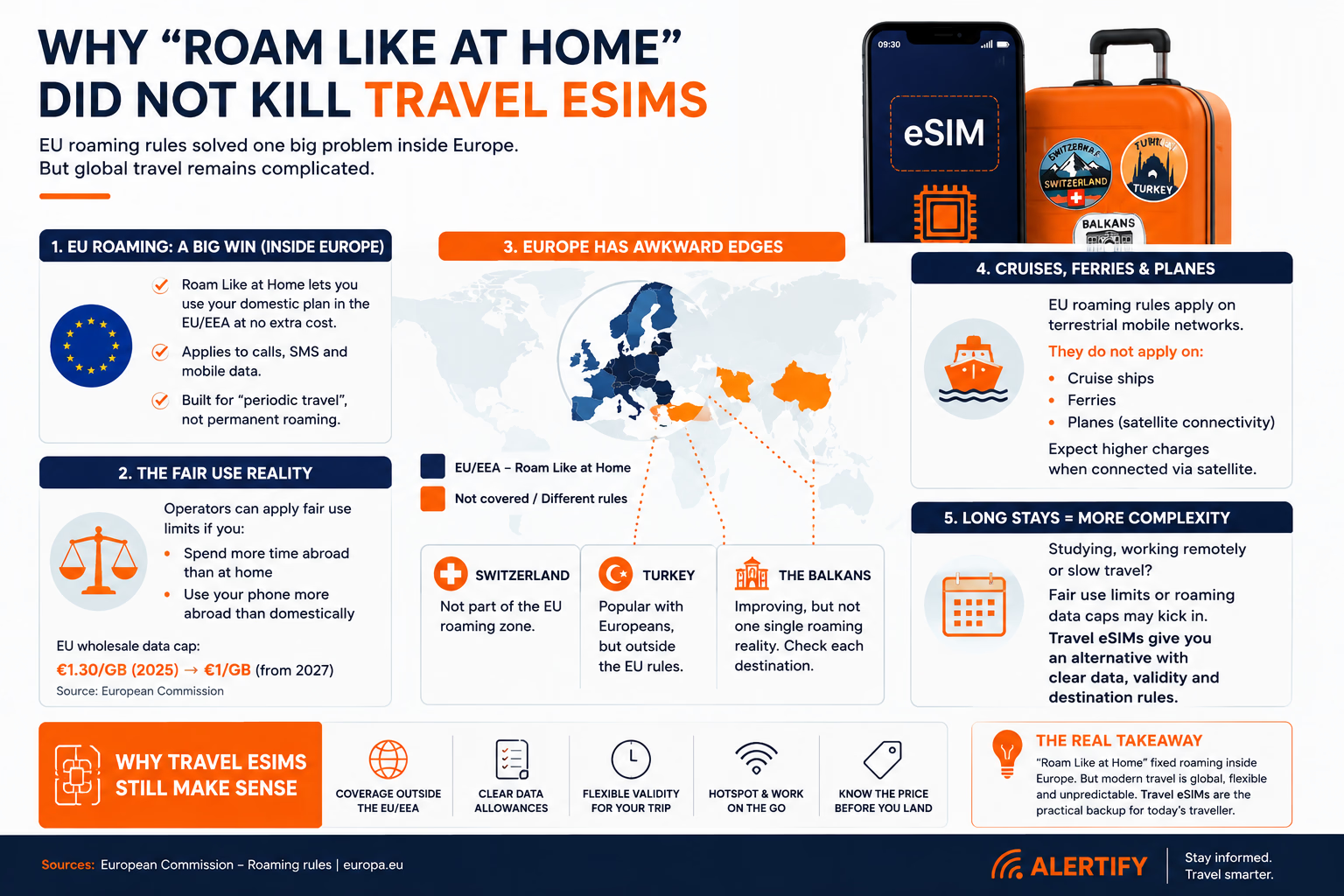
The first thing travellers often miss is that “Roam Like at Home” does not mean unlimited Europe forever. It is built around periodic travel, not permanent roaming. The European Commission is very clear on this: if you spend more time abroad than at home and use your phone more abroad than domestically over a monitored period, your operator can ask questions and may apply surcharges if the pattern continues.
This matters for digital nomads, students, remote workers and anyone doing a long stay. A two-week holiday in Spain is one thing. Three months moving between Portugal, Italy and Croatia is another. Even unlimited domestic plans can have roaming data allowances, and operators are allowed to apply fair-use data limits. In 2025, the EU wholesale data cap used in these calculations is €1.30 per GB plus VAT, falling to €1 per GB from 2027.
That is exactly where travel eSIMs found their lane. They are not always cheaper in every case, and they do not replace every mobile plan. But they give travellers a second option when their home plan becomes unclear, restrictive or simply unsuitable for the trip.
Europe has awkward edges
The second reason travel eSIMs survived is geography. Travellers do not think in regulatory zones. They think in terms of trips.
A person might fly from Germany to Switzerland, continue to Turkey, take a Balkan road trip, then finish with a few days in Greece. On paper, that sounds like one European journey. In roaming terms, it can be several different pricing realities.
Switzerland is the classic trap. It sits in the middle of Europe, but EU roaming rules do not automatically apply there. Turkey is another major example. It is one of Europe’s most popular travel destinations, but it is outside the EU roaming zone. The WesternBalkans are improving, and the region has its own roaming initiatives, but that does not mean every EU customer can treat Serbia, Bosnia and Herzegovina, Albania or Montenegro exactly like France or Spain. The European Commission has discussed expansion and cooperation with neighbouring regions, including the Western Balkans, but that is still not the same as universal EU-style roaming everywhere.
This is where many travellers get caught. They do not read roaming zones before a trip. They assume “Europe” means “covered.” Then the welcome SMS arrives, and suddenly the price per MB looks like something from 2012.
Ships, planes and the satellite problem
Cruises are another reason this market did not disappear. EU rules apply when your phone connects to a terrestrial mobile network, for example, near a harbour or on land. They do not protect you when the connection is provided through satellite systems on ships or planes. The Commission specifically warns travellers that EU roaming price caps no longer apply in those cases.
That is why the old roaming shock is not dead. It just moved into narrower, more confusing corners. Cruise ships, ferries, border areas, islands, airports and non-EU stopovers can still create bad surprises.
Travel eSIMs are attractive because they make the decision more deliberate. You buy a plan for Turkey, Switzerland, Asia, the US or a global route before you need it. You know the data allowance, validity and price. At least, you should. The best providers make those details obvious. The weaker ones bury fair-use limits, throttling rules or refund conditions in small print.
eSIMs won because travel is fragmented
The rise of travel eSIM providers was never only about beating EU roaming of course. It was about dealing with fragmented global travel. Some travellers need 3 GB for a city break. Some need unlimited-style usage for maps, hotspot, video calls and work. Some want regional coverage. Others want a simple country plan because they do not trust “global” packages that hide exclusions.
Operators still have an advantage: they own the main customer relationship, the phone number, the billing account and often the best domestic bundle. But eSIM providers have built their appeal around speed, clarity and destination-specific choice. That is powerful when the trip falls outside the comfortable EU bubble.
Practical check before you travel
Before relying only on your home SIM, check four things: whether your destination is inside the EU/EEA roaming zone, whether your operator includes Switzerland, Turkey or the Balkans, how much roaming data your plan actually allows, and whether your trip includes ferries, cruises or flights with satellite mobile connectivity.
That small check can decide whether your home plan is enough or whether a travel eSIM is the smarter backup.
The real takeaway
“Roam Like at Home” did not kill travel eSIMs because it solved a regional problem, not a global one. It made EU travel easier, and that deserves credit. But modern travel is messier than the EU map: people stay longer, cross more borders, work abroad, take cruises, visit Turkey and Switzerland, and expect their phone to behave everywhere as it does at home.
The future is not roaming versus eSIM. It is friction versus clarity. Traditional operators will keep improving roaming bundles, especially for premium customers. Travel eSIM brands will keep winning when they explain coverage, fair use, validity and destination limits better. The winners will not be the companies shouting “global” the loudest. They will be the ones who tell travellers exactly what will happen when the plane lands.
Driven by wanderlust and a passion for tech, Sandra is the creative force behind Alertify. Love for exploration and discovery is what sparked the idea for Alertify, a product that likely combines Sandra’s technological expertise with the desire to simplify or enhance travel experiences in some way.