Technically, they did. A few gigabytes. Maybe 10GB. Maybe “unlimited.” Maybe a very attractive 30-day plan that looked almost too good to ignore. But what they actually needed was not data. They needed connectivity.
And those two things are not the same.
Data is the number printed on the product page. Connectivity is what happens after you land, open maps, try to load your hotel booking, join a video call from an airport lounge, or message a driver who is waiting outside the wrong terminal.
That is where the difference shows up.
Cheap GBs can look fantastic in a comparison table. They are easy to understand, easy to sell, and easy to rank. But mobile connectivity is not only about how much data you get. It is about routing, network access, latency, fair usage rules, hotspot policy, customer support, refund terms, transfer options, and how quickly the eSIM actually behaves when your trip becomes messy.
The eSIM itself is only the delivery mechanism. GSMA describes eSIM as a global specification that enables remote SIM provisioning, allowing users to activate mobile subscriptions digitally on compatible devices. That is powerful, but it does not magically make every travel eSIM equal. The profile can be digital. The experience can still be very different.
The GB illusion
The travel eSIM market has trained customers to compare plans like supermarket shelves.
5GB versus 10GB. 30 days versus 15 days. One country versus regional. Unlimited versus fixed. The cheapest per-GB price often wins attention, especially for casual travelers who just want WhatsApp, maps, and Instagram to work.
But per-GB pricing hides the infrastructure story.
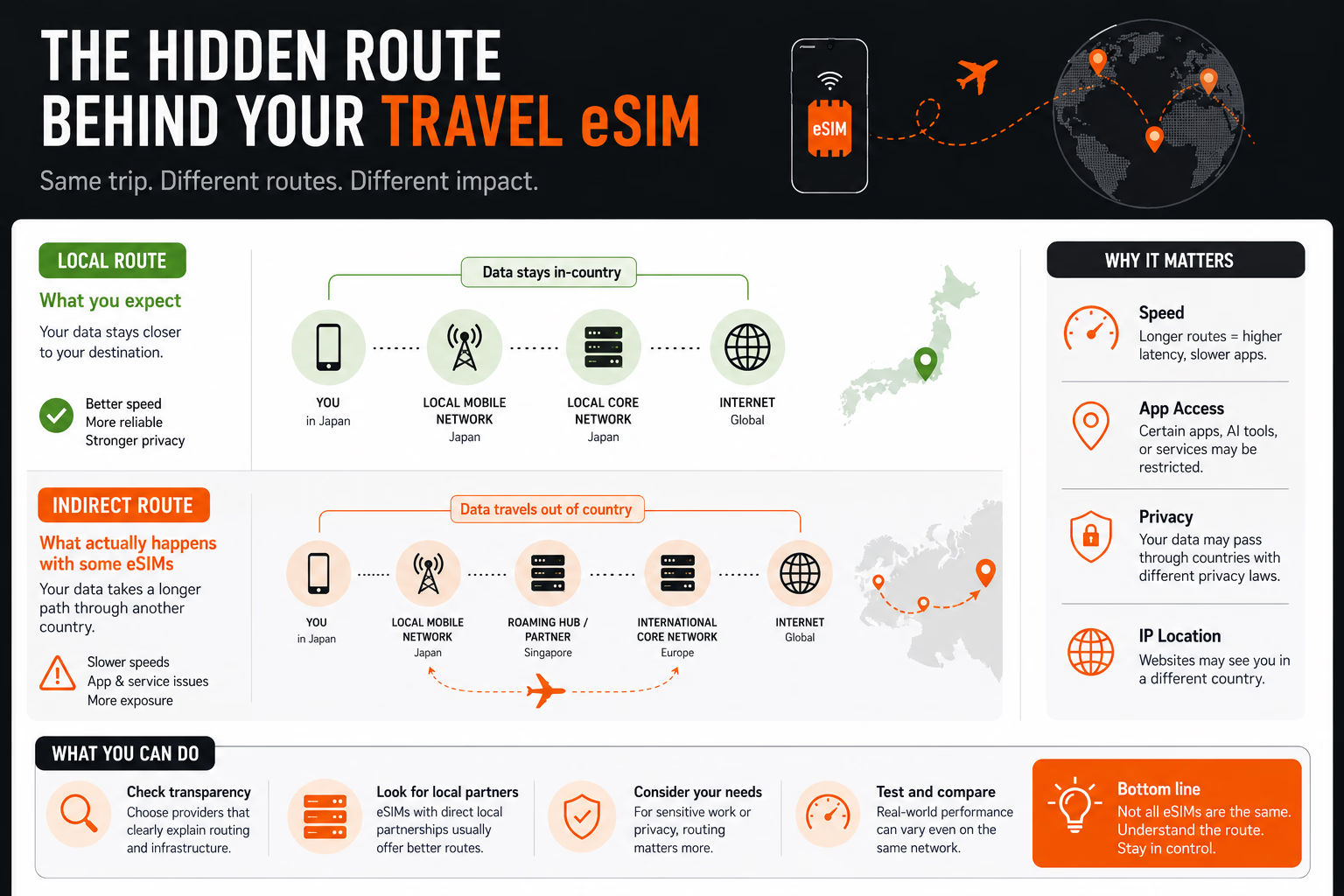
Two providers can sell a “Europe 10GB eSIM” and deliver very different experiences. One may route traffic locally or regionally with decent latency. Another may send traffic through a distant roaming hub, creating slower response times even when the phone shows 4G or 5G. One may have access to multiple networks in a country. Another may rely on one partner network, which is fine until that network is weak in the exact place you are staying.
That is why some travelers complain that their eSIM shows a signal but feels slow. The phone is connected. The experience is not.
This is also why “5G included” can be a weak promise. 5G access matters, but it is not the full story. Latency, routing, network priority, congestion, and operator agreements all shape the real user experience. A plan can look generous and still feel fragile.
Routing is the part nobody sees
Routing is one of the least understood parts of travel eSIM quality.
Most consumers assume that if they buy a data plan for Japan, Italy, the United States, or Turkey, their data behaves like a local mobile plan. Sometimes it does. Sometimes it does not.
In roaming-based eSIM models, traffic may be routed through the provider’s core network, a partner platform, or an international hub. This can affect latency, app behavior, IP location, streaming access, banking verification, and even search results. The user sees a simple eSIM plan. Underneath, there is a stack of commercial and technical decisions.
A 2024 academic analysis of Airalo’s ecosystem found that network throughput for roaming eSIMs can depend heavily on the virtual mobile network operator’s policies, not just the roaming topology. In plain English: the provider’s backend relationships and rules matter. The sticker price does not tell the whole story.
This is where serious providers start to separate themselves from price-led sellers.
Some eSIM brands are basically distribution layers. They package access, make it easy to buy, and compete on destination coverage and price. Others invest more deeply in network agreements, app experience, support, troubleshooting, enterprise controls, or persistent global connectivity models.
For the traveler, the difference may be invisible at checkout. It becomes very visible when the eSIM fails to activate at midnight in Bangkok.
Fair usage is not a footnote
Unlimited data is another place where the market gets slippery.
Unlimited can mean truly unlimited at usable speeds. It can also mean unlimited access with speed reductions after a daily threshold. It can mean no hard cutoff, but performance that changes after a fair usage limit. Sometimes those rules are clear. Sometimes they are buried.
This is not automatically bad. Networks need fair usage policies. Capacity is not infinite, and mobile operators have to prevent abuse. The problem is when marketing sells freedom and the terms deliver compromise.
BEREC, the Body of European Regulators for Electronic Communications, has repeatedly emphasized the importance of clear consumer information around roaming charges, fair usage policies, coverage, and quality of service. That principle matters far beyond EU roaming. It should apply to the travel eSIM market too.
Because the customer does not care whether the issue is technical, commercial, or contractual. They care that their “unlimited” plan slowed down when they needed it most.
Support is part of the product
Support sounds boring until it becomes the only thing that matters.
A cheap eSIM with weak support is not cheap if it leaves the user without data on arrival. This is especially true for business travelers, families, older travelers, and people visiting countries where airport Wi-Fi is unreliable or login portals require SMS verification.
The best travel connectivity products are not only selling access. They are reducing anxiety.
Can the user reinstall the eSIM? Can they transfer it to another device? Is the QR code still available? Is there live chat? Is support available across time zones? Are refund rules realistic? Does the app explain whether roaming must be enabled? Does it warn users before deleting an eSIM profile?
These details do not look glamorous in a comparison chart. But they are the difference between a digital product and a dependable travel utility.
This is also why device-native eSIM adoption matters. As more phones support eSIM and remote provisioning becomes normal, the market will move away from “Can I install this?” toward “Can I trust this provider when I travel often?” GSMA Intelligence has framed travel eSIM as part of a broader shift in roaming and user experience, not just another SIM replacement story.
The market is splitting
The interesting trend is that travel eSIM providers are no longer competing on the same thing.
Airalo built huge consumer recognition around simplicity, coverage, and marketplace-style access. Holafly leaned heavily into unlimited travel data and has recently pushed toward more persistent global connectivity models. TechRadar reported in late 2025 that Holafly launched a global data plan designed to work across more than 160 countries through one installed eSIM, moving closer to an always-on subscription concept rather than one-off trip bundles.
Yesim has been moving in a slightly different direction, with consumer plans but also stronger relevance in B2B, partner APIs, and balance-based models. GigSky, Ubigi, Nomad, Saily, Roamless, and others each approach the problem differently, from app-first travel data to pay-as-you-go flexibility, regional bundles, or infrastructure-backed positioning.
The point is not that one model is universally better. It is that “cheap GBs” are becoming the least interesting part of the market.
The next phase is about reliability, control, transparency, and how well connectivity fits into the traveler’s actual journey.
Conclusion about cheap eSIM data plans
The travel eSIM industry has been very good at making data easy to buy. It has been less good at helping users understand what they are really buying.
A low price per GB is useful. It is not enough.
For light travelers, cheap data may work perfectly. For frequent travelers, business users, digital nomads, families, and anyone who depends on stable mobile access, the smarter question is different: who is behind the connectivity, how is the traffic routed, what happens after fair usage kicks in, and will anyone help when the plan does not behave as promised?
This is where the market is heading. Not away from affordability, but beyond the illusion that affordability alone equals value.
The best eSIM brands will not win only because they sell more gigabytes. They will win because they make connectivity feel boring in the best possible way: stable, clear, predictable, and there when you need it.
Driven by wanderlust and a passion for tech, Sandra is the creative force behind Alertify. Love for exploration and discovery is what sparked the idea for Alertify, a product that likely combines Sandra’s technological expertise with the desire to simplify or enhance travel experiences in some way.