T2 Launches Free Unlimited Roaming in 34 Countries
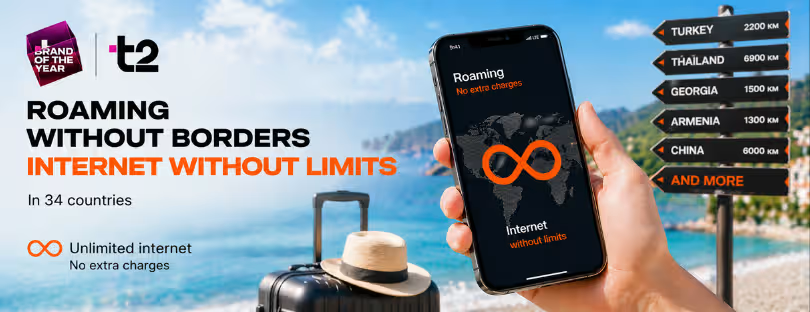
Just ahead of peak travel season, T2 is rolling out something you don’t often hear from traditional telecom operators: free unlimited mobile data abroad.
The offer covers 34 destinations and targets exactly the moment when roaming frustration usually peaks. Airports, arrivals, first Uber rides, hotel check-ins. That gap where connectivity becomes essential and expensive at the same time.
T2 is trying to remove that friction entirely.
What the offer actually includes
The mechanics are surprisingly simple.
Subscribers on selected tariff plans get daily unlimited internet while roaming, at no extra cost. The number of included days depends on the plan:
- 15 days of free unlimited data for customers on Premium, Black, My Online+, Online Everywhere, and certain corporate plans
- 22 days for users on MiXX S, M, and Max subscriptions
After those days are used, users can continue with unlimited internet under standard roaming terms.
Activation is straightforward. Users just enable the offer once via the T2 app or website before traveling, and it stays active throughout the promotional period.
The country list includes high-demand travel destinations like Turkey, Thailand, Georgia, China, and Armenia, with a broader list available on T2’s official page.
This isn’t global coverage, but it’s clearly designed around real travel flows for Russian users.
Why this matters more than it looks
At first glance, this feels like a seasonal promo. In reality, it signals something deeper.
Traditional telecom operators have historically treated roaming as a premium revenue stream. High margins, complex pricing, and limited transparency. That model has been under pressure for years, especially with the rise of eSIM providers.
What T2 is doing here is essentially flipping the logic.
Instead of monetizing roaming directly, they are using it as a retention and differentiation tool.
And that’s a big shift.
Because once a user experiences “no-cost roaming,” even if it’s limited to 15 or 22 days, it resets expectations. Suddenly, paying €5 to €10 per day for data abroad feels outdated.
Competing with eSIM without saying it
Let’s be clear. This move is not happening in a vacuum.
Travel eSIM players like Airalo, Holafly, and Ubigi have spent the last few years educating travelers that connectivity abroad should be simple, transparent, and affordable.
Unlimited plans, prepaid packages, instant activation. No surprises.
T2’s offer mirrors that experience, but within the operator’s own ecosystem.
No need to download another app. No need to switch providers. No need to think about connectivity at all.
That’s the real competitive angle here.
It’s not about beating eSIM providers on price. It’s about reducing the need to consider them in the first place.

The strategic layer behind it
There’s also a more strategic play happening.
Operators are increasingly realizing that connectivity is no longer just a utility. It’s part of the broader digital experience.
Travel, payments, navigation, communication. None of it works without reliable data.
By bundling roaming into existing plans, T2 is effectively positioning itself as a continuous connectivity provider, not just a domestic network.
That aligns with a broader industry trend.
According to the GSMA, global eSIM adoption continues to accelerate, particularly among frequent travelers and premium users. At the same time, operators are under pressure to simplify offerings and reduce churn.
Free roaming, even temporarily, ticks both boxes.
What’s the catch?
There’s always one.
The offer is limited in duration, restricted to specific plans, and applies only to selected countries. It’s not a full replacement for global roaming or long-term travel needs.
But that’s not really the point.
This is a targeted intervention. Designed for peak travel periods. Focused on high-value users.
And most importantly, it changes perception.
What this means going forward
If this kind of offer performs well, expect to see more operators experimenting with similar models.
Short-term unlimited roaming bundles. Travel passes baked into subscriptions. Seasonal connectivity perks.
We’re already seeing early versions of this in parts of Europe and Asia, but usually in a more restricted or paid format.
T2 is pushing it one step further by removing the price barrier entirely, at least temporarily.
That’s what makes it interesting.
Conclusion: A small offer with big implications
T2’s move may look like a summer promotion, but it reflects a much larger shift in telecom thinking.
The industry is slowly moving away from monetizing friction and toward removing it.
eSIM players forced that conversation. Now operators are adapting.
The question is not whether users want simpler roaming. That’s already clear.
The real question is who will own that experience long term.
Operators like T2 have one advantage. They already own the customer relationship.
But companies like Airalo, Holafly, and Ubigi set the expectation of how travel connectivity should work.
And that’s harder to win back once it’s lost.