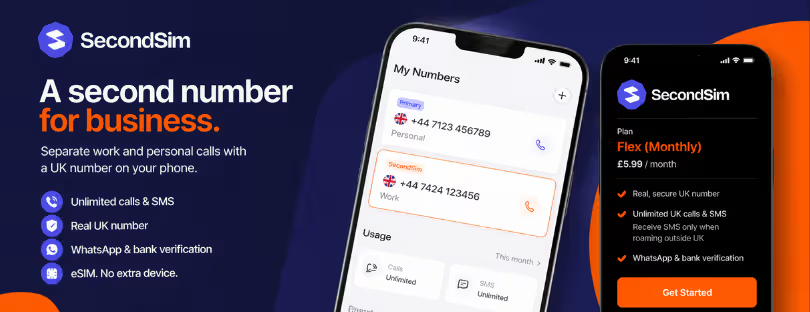
There’s a quiet problem in the mobile market that rarely gets addressed directly. Not coverage, not pricing, not even roaming. It’s the simple fact that millions of people are still using one phone number for everything.
Work. Personal life. Clients. Family. Late-night calls. Weekend interruptions.
A new UK-based eSIM service, SecondSim, is trying to fix that. And it’s doing it with a surprisingly simple idea: give people a second number without forcing them to carry a second phone.
A second line without the second phone
SecondSim is positioned as a lightweight eSIM service that runs alongside your existing number. Instead of juggling devices, users can add a fully functional second line directly to their smartphone.
The target audience is clear. Freelancers, sole traders, and SMEs who’ve outgrown the “one number for everything” phase but don’t want the friction of managing multiple devices.
Co-founder Jenna Banks explains the thinking behind it:
“When we were developing this brand, we spoke to tradespeople, freelancers and small business owners. Every day they’re having to make difficult choices about how and when they shut off in the evenings and at weekends. Often their personal number is their business number, plastered across websites and social channels which can result in people calling at any time of the day or night.”
That tension between availability and boundaries is exactly where SecondSim is trying to sit.
“SecondSim has been designed to solve that problem, giving people a cheap and easy way to add a business line which does all the usual stuff such as making and receiving calls and What’sApp Business, without the need for an extra phone and in a way which creates professional and healthy separation.”
Built by people who’ve seen telecom from the inside
This isn’t a random startup entering telecom. The founding team brings a mix of brand, product, and infrastructure experience.
Banks previously held roles at BBC and TalkTalk, while also serving as marketing director at Slice Mobile. She’s joined by Stephen Monaghan, who brings deep technical experience from companies like BT, and Rob Brock, a product specialist with experience at Moonpig and Lastminute.com.
The trio originally worked together at Slice Mobile, where they helped launch a new network. SecondSim feels like a continuation of that work, but with a much sharper focus on a specific use case.
Solving a very real SME problem
The SME angle is where this gets more interesting.
Businesses with multiple employees often end up issuing separate devices just to maintain professional communication channels. That creates obvious cost issues, but also operational and environmental ones.
According to internal estimates referenced by the company, between 10 and 15 million people in the UK currently carry two phones. It’s inefficient, expensive, and increasingly unnecessary in a world where eSIM adoption is accelerating.
Stephen Monaghan puts it bluntly:
“Adding new devices for new starters can quickly become costly for businesses; these devices come with other HR and environmental headaches too. Our research suggests employees hate having to carry two phones too, but they like being able to switch off the work number when they’re not contactable. With SecondSim, they can still do this, but without having to carry around the ‘work brick.’”
That last point matters more than it seems. This isn’t just about cost savings. It’s about control. The ability to switch off work without fully disconnecting from your personal life.
Running on Vodafone, powered by eSIM infrastructure
SecondSim operates on the Vodafone UK network, with connectivity delivered via eSIM Go. That combination gives it strong baseline coverage while allowing the company to focus on the user experience layer.
Behind the scenes, the service is built on a platform developed by the founders under their parent company, Jolli Group. This platform is designed to enable fully branded mobile experiences for communities, brands, and organizations.
In other words, SecondSim is both a product and a proof of concept.
Rob Brock highlights this:
“SecondSim is the first product we’re bringing to market using our Jolliplus platform. It has been designed to be incredibly intuitive for people to install and use, providing them with seamless integration, outstanding coverage from our partner eSIMgo and all the basics you need to run a business.”
The bigger play here is clear. If the platform works, it could be replicated across multiple verticals beyond freelancers and SMEs.
Simple pricing that avoids telecom confusion
One of the more refreshing aspects of the launch is the pricing structure. It’s deliberately straightforward, something the telecom industry has struggled with for years.
Across all plans, the value proposition stays consistent. A secure UK number, full calling and messaging capabilities, and the ability to keep personal and business communication separate. There’s also a 100% money-back guarantee, which lowers the barrier to entry even further.
One detail worth noting: when roaming outside the UK, users can still receive SMS, which is critical for verification flows like banking and WhatsApp activation.
Early traction and what it signals
SecondSim has already signed up more than 1,500 businesses across the UK. That’s not massive scale yet, but it’s enough to validate demand for this type of product.
And it fits into a broader shift happening in telecom.
We’re moving away from “one SIM, one identity” toward more flexible, layered connectivity. Multiple numbers. Multiple profiles. Different contexts. All on a single device.
This isn’t entirely new. Players like Airalo and Holafly have already normalized the idea of adding temporary data profiles for travel. Meanwhile, virtual number providers and VoIP apps have tried to solve the “second number” problem for years.
But most of those solutions either lack reliability, don’t integrate cleanly with native phone features, or feel like workarounds rather than real telecom products.
SecondSim is trying to position itself differently. Less like an app. More like a proper mobile line, just without the hardware.
Where this fits in the bigger picture
The timing of this launch isn’t accidental.
According to GSMA, eSIM adoption is accelerating rapidly, with billions of eSIM-capable devices expected in circulation over the next few years. At the same time, the rise of remote work and freelance economies is reshaping how people use connectivity.
The traditional mobile contract, tied to a single identity and long-term commitment, doesn’t map well to that reality anymore.
What SecondSim is doing is relatively small in scope, but strategically aligned with where the market is heading.
Conclusion
SecondSim isn’t trying to reinvent telecom. It’s doing something more practical. It’s removing friction from a very specific, very common problem.
And that’s exactly why it might work.
Compared to global eSIM players like Airalo or Holafly, which focus heavily on travel data, SecondSim is going after identity and communication. Compared to enterprise solutions, it’s lightweight and accessible. Compared to VoIP apps, it feels closer to a real mobile experience.
That positioning sits somewhere in the middle of a market that’s becoming increasingly fragmented.
If the next phase of telecom is about embedding connectivity into different parts of life and work, then services like SecondSim are an early signal of how that plays out.
Driven by wanderlust and a passion for tech, Sandra is the creative force behind Alertify. Love for exploration and discovery is what sparked the idea for Alertify, a product that likely combines Sandra’s technological expertise with the desire to simplify or enhance travel experiences in some way.