Amadeus Acquires SkyLink to Scale AI Travel
The AI conversation in travel is no longer about pilots and prototypes. It is about scale, orchestration, and production-grade deployment. Amadeus SkyLink acquisition
Today, Amadeus IT Group announced the acquisition of SkyLink, a New York–headquartered, AI-native corporate travel platform that has quietly built one of the most advanced orchestration engines in the space. On the surface, this looks like another strategic M&A move in enterprise travel. But zoom out, and it signals something much bigger: conversational AI is becoming embedded into the core infrastructure of global travel.
From booking tools to orchestration engines
SkyLink was founded to fix a specific pain point: the friction of corporate travel. Not the idea of travel, but the workflow chaos around it.
Instead of forcing employees into traditional booking portals or pushing everything back to offline agents, SkyLink built a proprietary AI architecture with a multilayer orchestration engine. The system integrates directly into workplace tools like Slack and Microsoft Teams. Employees can search, compare, book, and service flights or hotels conversationally in seconds. The AI understands traveler intent, corporate policy, and operational constraints in real time.
That is not just chatbot logic. It is workflow automation layered on top of complex travel systems.
And it is already working. Tens of thousands of bookings have been completed. Adoption is accelerating. In a market that has spent years discussing AI proof of concepts, SkyLink has been shipping.
Why this matters for Amadeus
For Amadeus, this acquisition fits a long-term pattern. The company has been applying AI inside travel systems for decades, from revenue management optimization to search ranking and disruption management. But those capabilities often operated behind the scenes.
Now the layer is shifting upward. The user interface is becoming conversational.
Luis Maroto, President and CEO, Amadeus, said:
“Amadeus is the embedded and neutral execution layer for travel; built on three pillars: our global scale, the power of our integrated and deeply connected business logic, and our status as a trusted system of record in the industry since 1987. These pillars enable us to apply AI-driven capabilities consistently across airlines, airports, hotels, travel sellers and the wider travel ecosystem. Our technology is deeply integrated across the travel industry, connecting systems and workflows developed over decades. It combines industrial-grade reliability, operational resilience, and data-driven insight that enable us to deploy AI in real-world production environments globally. Together, these pillars reinforce Amadeus’ role as the trusted technology partner enabling innovation at scale and allowing AI to augment and reinforce the travel experience.”
That word is important: execution layer.
Amadeus operates in more than 190 markets, processing billions of search requests and millions of transactions daily. It is deeply integrated into airline PSS systems, airport IT, hospitality distribution, and travel sellers. When you combine that scale with an AI-native orchestration engine like SkyLink’s, you are not just improving a booking tool. You are embedding conversational intelligence into the plumbing of global travel.
The TMC angle
One of the most immediate impacts will be in the Travel Management Company world.
Corporate travel has been under pressure from multiple angles: cost control, traveler experience, duty of care, and productivity expectations. Traditional TMC workflows still rely heavily on email threads, offline coordination, and fragmented tools.
SkyLink’s technology complements Amadeus’ existing corporate portfolio, particularly in North America. By integrating conversational automation into TMC environments, companies can reduce manual coordination, increase policy compliance in real time, and unlock productivity gains.
Employees book faster. Finance teams see clearer spend. Travel managers gain more visibility. Agents can focus on complex, high-value cases instead of repetitive changes.
Atyab Bhatti, CEO & Co-Founder, SkyLink, summarized the shift clearly:
“Combining our AI-native technology with Amadeus’ scale and industry reach will allow us to deploy our technology faster and bring powerful new capabilities that benefit travelers and companies across the travel industry. It’s a pivotal time to deliver concrete AI solutions and, now with Amadeus, we can accelerate the next phase of travel innovation,”
The phrase “concrete AI solutions” reflects the current industry mood. The experimentation phase is closing. The operational phase has begun.

Beyond corporate: airlines, airports, hospitality
Amadeus has already been enabling AI-powered conversational layers across its product suite. The SkyLink acquisition accelerates that roadmap.
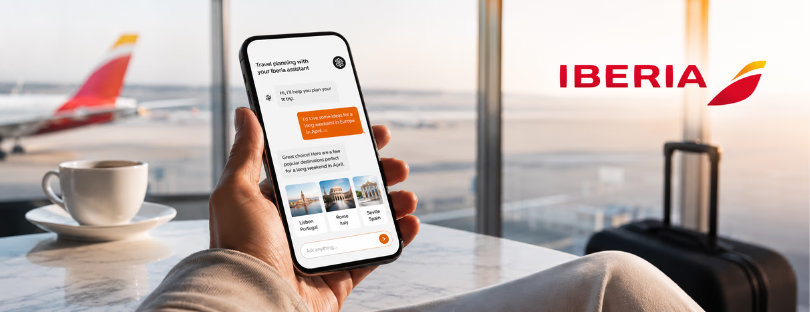
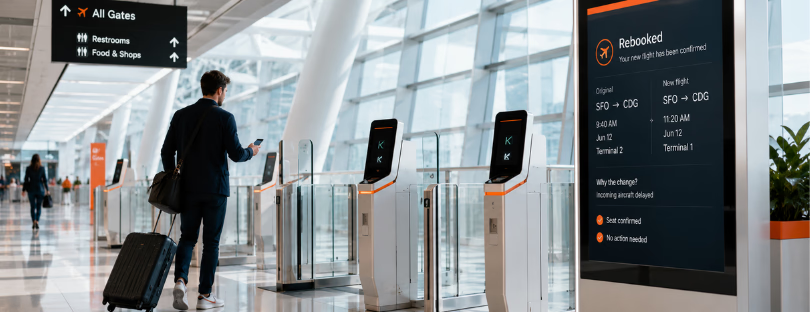
Over time, these capabilities will extend beyond corporate travel into airlines, airports, hospitality, and the broader travel ecosystem. Think conversational companions embedded into airline apps. AI-powered servicing during disruptions. Hotel booking assistants are integrated into loyalty ecosystems. Airport flow management enhanced by predictive, conversational insights.
The vision is consistent: AI not as a marketing add-on, but as an embedded interaction layer across the journey.
Before the trip. During the trip. After the trip.
For travelers, that means fewer clicks and fewer handoffs. For providers, it means more scalable, responsive, and data-driven engagement.
AI, but grounded in operational reality
What differentiates this move from generic “AI-first” announcements is the operational backbone.
Amadeus is not a startup layering AI on top of disconnected APIs. It is a system of record that has been embedded in travel infrastructure since 1987. That status matters. Industrial-grade reliability, compliance, data governance, and resilience are not optional in travel. They are existential requirements.
The company has also emphasized a robust AI ethics framework and secure developer access. As regulators in the EU and US increasingly focus on responsible AI deployment, this governance layer becomes a strategic asset.
In other words, scale without governance is risk. Governance without scale is irrelevant. This acquisition aims to combine both.
The bigger market context
This move comes at a time when AI adoption in travel is accelerating rapidly. According to industry reports from organizations like Phocuswright and Skift Research, AI-driven automation and personalization are now top investment priorities for travel technology leaders. Meanwhile, enterprise SaaS trends show conversational interfaces becoming normalized across verticals.
Competitors are not standing still. Other global distribution and technology providers are experimenting with AI assistants, dynamic servicing tools, and automation layers. Corporate booking platforms and expense management companies are embedding AI to reduce friction and increase compliance.
But many of these initiatives remain interface-level enhancements. The deeper opportunity lies in orchestration: connecting intent, policy, inventory, servicing, and compliance across multiple systems in real time.
That is where SkyLink’s multilayer engine becomes strategically significant.


A shift from interface to infrastructure
The real story here is not just conversational booking. It is control.
As APIs become more powerful and travel stacks become more modular, the control layer becomes decisive. Who owns the orchestration logic? Who mediates between traveler intent and supplier systems? Who enforces policy and compliance dynamically?
By integrating SkyLink, Amadeus strengthens its position not only as a data processor or distribution engine, but as an intelligent mediator across the ecosystem.
And that aligns with a broader industry transition. Travel technology is moving from static systems to programmable infrastructure. AI is becoming the interface to that infrastructure.
Conclusion Amadeus SkyLink acquisition
This acquisition is less about chatbots and more about strategic positioning in the next era of travel technology.
Players like Sabre, Travelport, and emerging AI-native platforms are all racing to redefine how travel systems interact with users. Meanwhile, corporate buyers increasingly expect automation, policy enforcement, and real-time servicing as baseline capabilities. According to recent enterprise software trends highlighted by Gartner and McKinsey, organizations are prioritizing AI investments that directly improve productivity and operational efficiency, not just customer-facing novelty.
In that context, Amadeus’ move is coherent. By acquiring an AI-first orchestration engine that is already proven in production, it avoids the trap of building isolated pilots. Instead, it embeds conversational intelligence into a globally scaled, deeply integrated system.
The bigger picture is clear. Travel is no longer just about distribution. It is about intelligent execution. The companies that win will not be those with the flashiest AI demos, but those that can reliably deploy AI at an industrial scale, across real workflows, in real time.
With SkyLink now inside its ecosystem, Amadeus is signaling that AI in travel has officially crossed the line from promise to infrastructure.