ECB Digital Euro Plan Challenges Visa, Mastercard
Here’s the thing about Europe’s payments landscape: it works, but it doesn’t really belong to Europe. digital euro Europe
That tension is now starting to show more clearly. And if the latest move by the European Central Bank is any indication, the region is getting serious about changing that.
A quiet shift with big implications
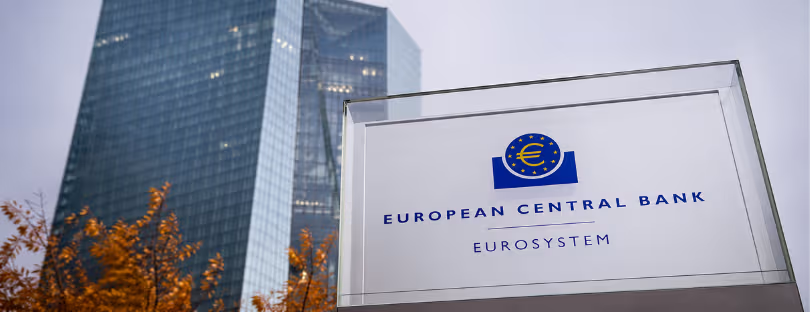
According to reporting from the Financial Times, the ECB has taken a concrete step toward launching a digital euro by approving a new set of technical standards. On paper, it sounds procedural. In reality, it’s strategic.
The idea is simple but ambitious: ensure that every payment terminal and card system across the eurozone can seamlessly support a future digital euro. No fragmentation, no patchwork compatibility. Just one infrastructure layer ready for a new form of money.
And the timeline is no longer abstract. The target being discussed is 2029.
Europe’s dependency problem
Right now, Europe’s payment system has a structural weakness that’s hard to ignore. Around two-thirds of card payments in the eurozone are processed by international schemes. That means companies like Visa and Mastercard sit at the center of everyday transactions across the continent.
It’s not just about market share. It’s about control over infrastructure, pricing, and innovation.
Many European countries simply don’t have strong domestic alternatives. There are exceptions like France’s Carte Bancaire or Germany’s Girocard, but these remain fragmented and largely national. At a European level, there’s no unified system with comparable scale.
That’s the gap the ECB is trying to close.
What the digital euro is really trying to do
The digital euro is being positioned as a digital form of cash. Not a crypto asset. Not a speculative instrument. Just central bank money in a digital format, with legal tender status alongside coins and banknotes.
But there’s a second layer to this strategy that matters just as much: sovereignty.
ECB Executive Board member Piero Cipollone summed it up clearly in his comments to the Financial Times, describing the goal as creating “a European free alternative” to existing proprietary systems.
That “free” element is important. Current global standards, largely managed by EMVCo, operate within a commercial framework. Fees are baked into the system.
The ECB is signaling something different. A public infrastructure layer that private players can build on, without the same dependency on non-European networks.
The standards that most people never see
This is where things get more technical, but also more interesting.
Instead of relying on global standards bodies dominated by non-European companies like American Express, Discover, JCB, UnionPay, Visa, and Mastercard, the ECB is backing European-developed frameworks.
Specifically, standards from the European Card Payment Cooperation, nexo standards, and the Berlin Group.
These are not new. They already power parts of Europe’s existing payment infrastructure. What’s changing is their role. They’re being elevated from regional solutions to the foundation of a continent-wide system.
And that has real consequences.
Under the proposed framework, private payment providers would eventually need to update terminals and infrastructure to support these standards once the digital euro becomes legal tender. That’s a significant shift in how the ecosystem operates.
Political friction is still real
For all the technical progress, the digital euro is far from a done deal.
The European Commission and national governments are broadly supportive, but the European Parliament still needs to approve the legislation. And that’s where things get more complicated.
Banks and payment providers are not universally convinced. Some argue the digital euro doesn’t add enough value to justify the disruption. Others worry it could undermine private-sector initiatives that are already trying to build European alternatives to Visa and Mastercard.
It’s a familiar tension. Public infrastructure versus private innovation.
If the legislative process moves forward this summer, negotiations with member states will follow. A final agreement is expected by late 2026 or early 2027.
 Why this matters beyond payments

On the surface, this looks like a payments story. But it’s bigger than that.
What the ECB is really building is a foundational layer for digital value exchange in Europe. Payments are just the starting point.
If you zoom out, you see parallels with what’s happening globally. China’s digital yuan is already in advanced stages of deployment. In the US, discussions around a digital dollar remain more cautious, but the private sector is pushing hard with stablecoins and fintech infrastructure.
Europe is taking a different path. More institutional. More infrastructure-first.
And importantly, more focused on reducing external dependency.
Conclusion: Europe is playing the long game
What’s happening here isn’t a quick disruption. It’s a slow repositioning.
The ECB is not trying to outcompete Visa or Mastercard overnight. That would be unrealistic. Instead, it’s building an alternative layer that can coexist and, over time, shift the balance of power.
Compared to initiatives like the European Payments Initiative (EPI), which struggled to gain momentum as a private-sector solution, the digital euro has one key advantage: it comes with institutional backing and regulatory force.
That changes the equation.
But success is not guaranteed. The risk is that Europe ends up with another fragmented system that adds complexity without solving the core problem. The opportunity, on the other hand, is much bigger. A unified, sovereign payments infrastructure that reduces reliance on external networks and opens the door for new innovation across fintech, banking, and digital services.
The next two years will be critical. Not just for the digital euro itself, but for how Europe defines control over its financial infrastructure in a world that is increasingly platform-driven.
And if you look at where global payments are heading, that question is only going to get more important.