From Co-Working Spaces to Cab Rides: Adapting Your Laptop Workflow Anywhere
Modern work is becoming less and less tied to a single location. Due to this, the very logic of interacting with a laptop is changing. From the home desk to public transportation, professionals are more and more likely to combine different environments and, at the same time, try to maintain stable productivity.
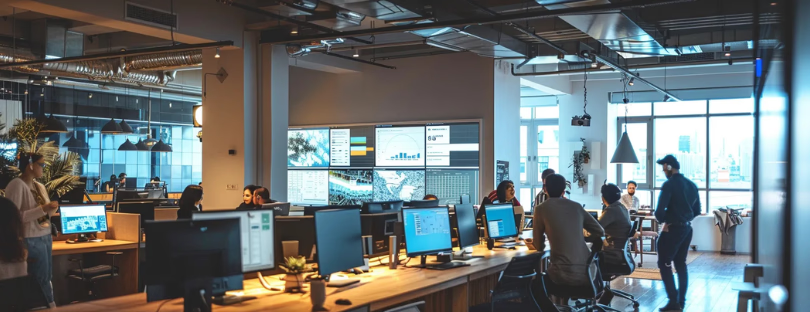
In this reality, a remote work setup becomes not just a technical set of tools, but a way of thinking. One that considers the changing context throughout the day. At the same time, shared and coworking spaces, along with flexible office spaces, are shaping a new work culture. In this new environment, it’s not just resources that matter, but also the ability to adapt quickly. After all, a person might start the day in a structured office, continue it on the go, and finish in a less formal setting. Each of these scenarios requires a different approach to task management and, consequently, different digital tools.
Flexible Digital Work Outside the Office
A modern approach to mobility assumes that the laptop is at the core of the entire work ecosystem. In shared workspaces and coworking spaces, people often enjoy the following benefits:
- reliable internet,
- areas for concentration and social interaction.
All this helps structure the day.
In a flexible office space, it’s usually easier to separate periods of deep work from communication. Thanks to this, task performance improves. It’s also crucial to understand that a remote work setup is effective only when the user thinks through in advance how their tools will perform under various conditions. That is, from a noisy environment to fully autonomous work without an internet connection. In this regard, the choice of device and its capabilities clearly impacts the workflow’s stability.
Notably, reviews and comparisons of the Apple ecosystem help understand how different models balance performance, battery life, and portability. That’s why it’s valuable to review materials that compare Mac models, so you can understand the main differences between the MacBook, Mac mini, and Mac Studio lines. With this knowledge, you’ll be able to match technical specs with real-world use cases. That means everything from mobile work on the go to desktop-level productivity in the office.

Shared workspaces and coworking spaces. How to structure your work in such environments
In these settings, it’s important not only to have access to the right tools but also to know how to switch quickly between tasks. Experience shows that short bursts of concentration work best in open spaces. That is, where there are constant distractions. That’s why many professionals apply the principles of planning their day by thematic blocks. Thanks to this, cognitive load is reduced. This is where laptop productivity tips come in handy, helping to optimize the workflow:
- Split-screen or tiling windows for working with two sources of info at once.
- A minimalist desktop with only active projects and current files.
- Task batching groups related tasks together.
- Keyboard shortcuts for basic actions (switching tabs, copying, searching).
- Focus mode / Do Not Disturb to prevent interruptions during deep work.
- Regularly tidying up and organizing the file system.
- Cloud synchronization for quick access to files between devices.
- Timers to stay in the rhythm of concentration.
- Text templates for repetitive tasks.
Adaptation to changes in the environment and mobility
When work becomes mobile (on the go or between meetings), the approach to completing tasks changes. Mobile work productivity involves light tasks for short periods of time. For example, a quick reply to an email or reviewing documents. In such conditions, access to the following is essential:
- offline tools,
- data synchronization,
- simple interfaces that don’t require deep concentration.
That way, you can still stay productive even when the environment is not suitable for complex analytical work.
Work Habit Optimization in Different Environments
Your productivity on a laptop depends largely on how you allocate your energy among different task types.
- In more structured spaces, like flexible office areas, plan complex analytical tasks or creative work. That is, work that requires sustained focus.
- In less stable conditions, on the other hand, it’s better to switch to simpler tasks that don’t require deep focus.
In this case, mobile work productivity becomes not just a set of techniques but a way to reduce stress from constantly changing contexts.
Users who plan in advance what tasks to perform on the go and which in a stationary setting enjoy better stability in the long term. All of this also allows you to better implement the benefits of each environment, without trying to force all tasks into a single work format.
Conclusion
Flexible laptop work today is about the capacity to adapt to various contexts without losing productivity. The mix of shared workspaces, coworking spaces, and mobile scenarios creates a new shape and model of professional behavior. In this regard, the balance between freedom and structure is crucial. When a remote work setup is thoughtful and tools with habits are tailored to real-world conditions, work ceases to depend on location. Such work becomes a process that naturally moves with the person, changing form while maintaining its rhythm.