EE Launches AI Scam Guard as Fraud Hits Record High
There’s a quiet shift happening in telecom right now. Security is no longer just a background feature. It’s becoming a product.
EE’s newly upgraded Scam Guard makes that shift explicit.
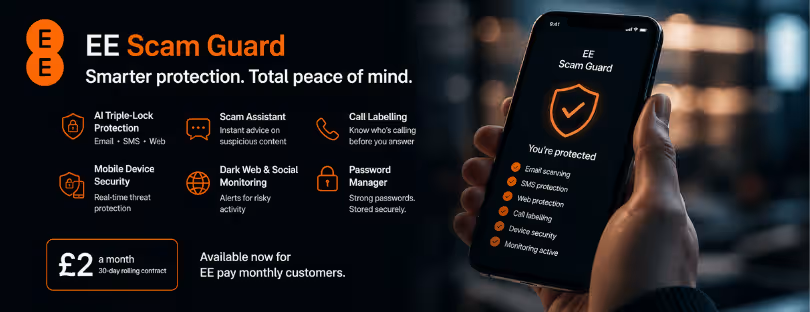
The UK operator has rolled out what it calls its most advanced fraud protection service to date, bundling multiple layers of AI-driven security into a £2-per-month add-on for pay-monthly customers. On the surface, it’s an upgrade. In reality, it’s part of a much bigger move: turning the network into a first line of defence against digital fraud.
And the timing isn’t accidental.
The pressure is real and getting worse
According to Cifas, more than 444,000 fraud cases were recorded in the UK’s National Fraud Database in 2025. That’s the highest number ever. Up 6% year-on-year.
The bigger story is what’s driving it.
AI has changed the economics of scams. Phishing emails are cleaner. Fake websites look legitimate. Voice scams now mimic real people convincingly. SMS attacks are targeted, not random.
This is no longer about spotting obvious red flags. It’s about filtering out things that look real.
Operators like EE are being pushed into a role they didn’t fully own before.
What EE is actually building
EE’s upgraded Scam Guard is built around what it calls “AI Triple-Lock Protection.” That means three layers of defence running continuously across different parts of a user’s digital life.
Email, SMS, and web browsing are all scanned and filtered in real time. Suspicious messages get flagged before you even open them. Malicious sites are blocked before they load. Text messages are analysed for patterns that suggest fraud.
It’s not revolutionary as a concept. But the execution is becoming more aggressive and more integrated.
Then there’s the more interesting part.
The new Scam Assistant lets users upload screenshots of anything suspicious. Text messages, emails, social posts, even QR codes. The system then analyses it and gives immediate feedback on whether it’s likely to be a scam.
That’s a subtle but important shift. Instead of just blocking threats, the network is starting to act like an advisor.

Call Labelling adds another layer. Every incoming call is screened at the network level and tagged with context before you answer. Not just “spam” or “unknown,” but increasingly granular signals about risk.
EE is also extending beyond the network itself.
Social media monitoring and dark web tracking scan for leaked data or suspicious activity tied to a user’s identity. Device-level protection blocks malware, ransomware, and dangerous attachments. There’s even a built-in password manager to reduce one of the most common points of failure in personal security.
In short, this is no longer just telecom protection. It’s creeping into full-stack consumer cybersecurity.
Why operators are moving in this direction
EE says its existing Scam Guard has blocked 169 million scam attempts since launching in 2024. Across BT Group more broadly, the numbers are even bigger: 1.6 billion malicious domain attempts blocked, 200 million scam SMS messages stopped, and tens of millions of calls filtered.
Those are impressive figures, but they also highlight the scale of the problem.
Fraud has become a network-level issue.
And that changes incentives.
Operators sit in a unique position. They see traffic patterns. They control routing. They can intervene before threats even reach the user. That’s something app-level security tools or standalone cybersecurity apps can’t always do effectively.
What’s new is the commercial layer.
Charging £2 per month might seem minor, but it signals that security is becoming monetizable. Not just a hygiene feature.
The bigger trend behind this launch
EE isn’t alone here.
Across the market, telecom operators are expanding into security services. Some bundle them into premium plans. Others partner with cybersecurity firms. A few are building in-house capabilities, like EE.
The direction is consistent.
Security is moving closer to the network edge.
Compare that with players like Apple or Google, who focus on device-level or OS-level protection. Or companies like Norton and McAfee, which operate entirely at the software layer.
Telecom sits one level below all of them.
That position is becoming more valuable as threats get more complex.

What this means for the travel and eSIM space
From an Alertify perspective, this is where things get interesting.
Scams don’t stop when you travel. In fact, they often increase. New networks, unfamiliar numbers, public Wi-Fi, cross-border transactions. It’s a perfect environment for fraud.
But most travel connectivity solutions still treat security as an afterthought.
Basic protections. Maybe some network filtering. Rarely anything this integrated.
That gap is going to become more visible.
Especially as eSIM adoption grows and more users rely on digital-first connectivity instead of traditional roaming.
Conclusion
EE’s new Scam Guard isn’t just a product upgrade. It’s a signal.
Telecom operators are starting to reposition themselves as security providers, not just connectivity providers. And they’re doing it at a time when AI is making fraud faster, cheaper, and harder to detect.
Compared to traditional cybersecurity players, operators have a structural advantage. They see everything that flows through the network. Compared to device ecosystems, they can act before threats even reach the device.
But the real question is whether this becomes standard or stays premium.
If users start expecting network-level protection as part of connectivity, charging extra for it may not hold long-term. Especially as competitors catch up.
At the same time, the travel connectivity space is lagging behind. Most eSIM providers still compete on price, data volume, and coverage. Very few are building meaningful security layers into their offering.
That creates an opening.
Because in a world where scams are increasingly sophisticated, connectivity without protection starts to look incomplete.
And that’s where the next wave of differentiation is likely to come from.