ShopBack Adds Travel eSIMs Through Gigs Deal
Gigs has entered Asia-Pacific through a new partnership with ShopBack, adding a travel eSIM service directly inside the ShopBack app. On paper, this is another travel eSIM launch. In reality, it says something much more interesting about where the eSIM sector is moving. Embedded connectivity platform
The agreement makes ShopBack Gigs’ first major customer in Asia-Pacific and gives the company a regional foothold after building its presence across the US, Europe and Latin America. The service is now available to ShopBack users in Singapore, Hong Kong, Taiwan, Malaysia, New Zealand, Australia and Germany, with one eSIM usable in more than 160 countries, according to the companies.
The important detail is not only the coverage. It is the placement.
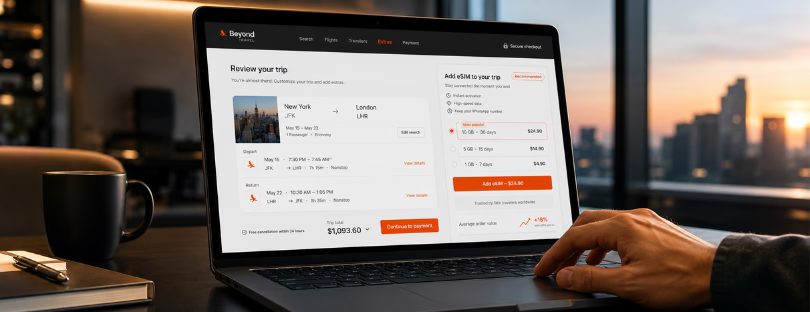
ShopBack users can discover, activate, manage and top up the travel eSIM inside the ShopBack app, instead of being pushed out to a separate eSIM provider website. They can also earn cashback on each purchase and share eSIMs with travel companions. That makes connectivity feel less like a separate travel purchase and more like another utility inside the travel journey.
For a rewards platform, that matters. ShopBack already sits close to travel spending, from booking and shopping to in-destination purchases. Adding mobile connectivity gives it a reason to stay relevant after the hotel is booked, the flight is confirmed and the customer has landed.
Why this deal matters
The eSIM market has spent years talking about cheaper data plans. That part is still important, of course. Travellers still compare prices, gigabytes and country coverage. But the bigger commercial question is becoming: who owns the moment when the traveller actually needs connectivity?
That moment does not always belong to the eSIM provider.
It can belong to the airline at check-in. It can belong to the bank when a card is used abroad. It can belong to the booking platform before departure. It can belong to the rewards app when a customer is already looking for travel value. This is why the Gigs and ShopBack deal is worth watching.
READ MORE: How fintech, neobanks, travel platforms embed connectivity
Gigs is not selling a consumer travel eSIM under its own brand here. It is providing the software and telecom layer that allows another consumer brand to offer mobile data under its own customer experience. That is the embedded connectivity model. The eSIM becomes part of the app, not a separate destination.
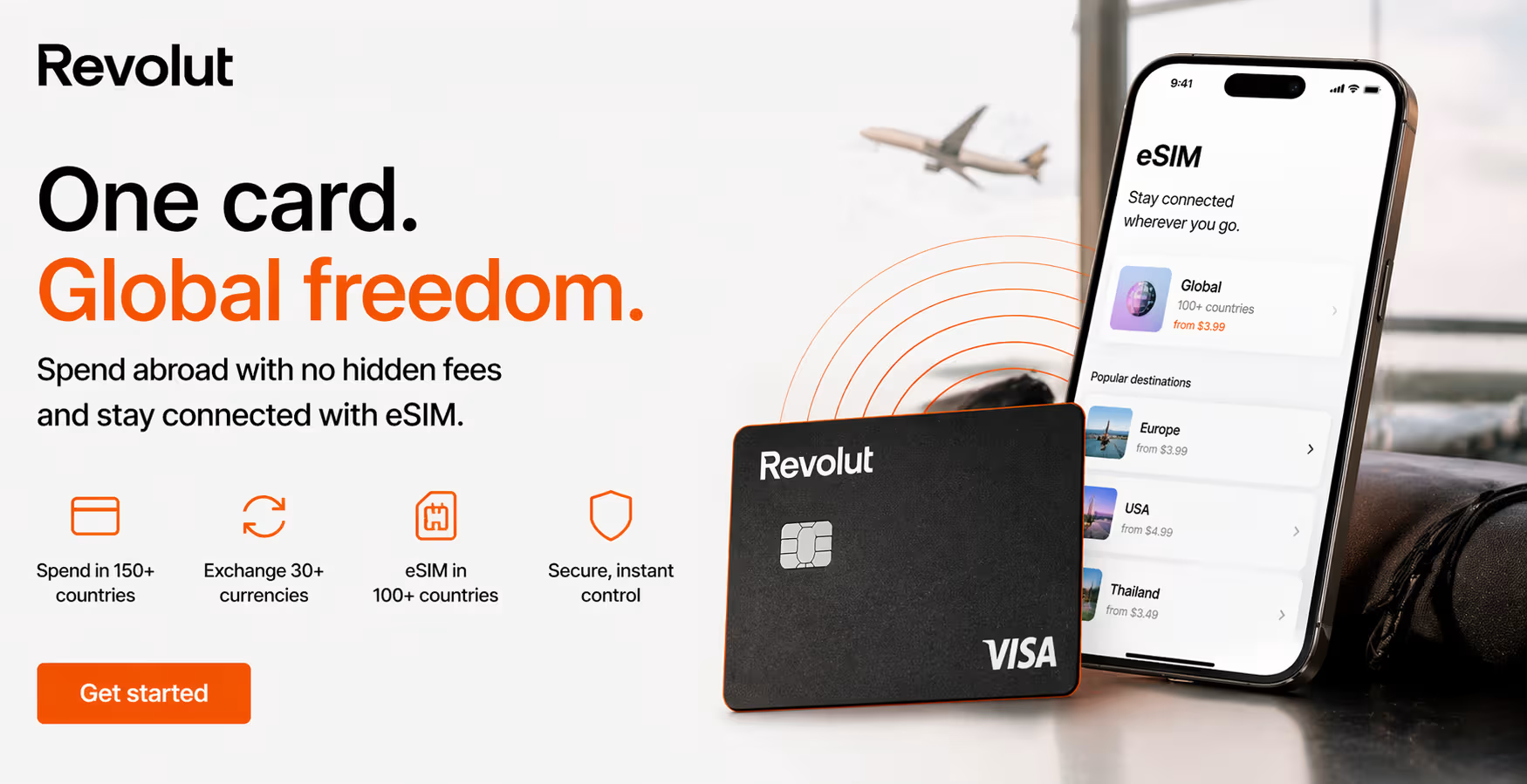
Gigs already works with brands including Revolut, Klarna, OnePay, NETGEAR and Nubank, and says its customer base collectively reaches more than 850 million users. The company has raised around US$100 million from investors including Ribbit Capital, Google and Y Combinator.
That investor mix is telling. This is not only a telecom story. It is a fintech, commerce and platform story.
ShopBack’s travel logic
For ShopBack, the move is a natural extension of its rewards business. The company says it powers more than US$5.5 billion in annual sales for over 20,000 online and in-store partners, and it has also built ShopBack Pay as a payments layer for members.
That combination gives ShopBack three things that most standalone eSIM providers do not have: frequent customer engagement, payment behaviour and a reason to be opened before, during and after a trip.
This is where the travel eSIM category becomes more interesting. For years, travel connectivity was treated as a pre-trip problem. Buy a SIM card before departure. Download an eSIM before boarding. Avoid roaming shock. Done.
But the actual usage pattern is messier. Travellers run out of data. They change countries. They extend trips. They share plans with family members. They look for local transport, food delivery, hotels, shopping and payments once they arrive. If connectivity sits inside an app they already use for rewards, the top-up moment becomes easier to capture.
That is commercially powerful. It reduces friction, keeps the customer inside the app and creates another monetisable travel touchpoint. It also gives ShopBack a more practical role in the trip itself, not just in the booking phase.
The embedded connectivity trend
The Gigs and ShopBack partnership lands at a time when eSIM adoption is moving from early-user behaviour into the mainstream. GSMA Intelligence recently noted that global eSIM smartphone penetration was around 5% at the end of 2025, with expectations that it would reach 10% by the end of 2026 and double again by 2028.
That is still early, but it is enough to change the distribution. Once more devices support eSIM and more travellers understand the concept, the fight shifts from “what is an eSIM?” to “where do I buy one?”
READ MORE: Chime Adds Global eSIM Data via GigSky
This is where consumer platforms have an advantage. Travel eSIM brands such as Airalo, Holafly, Nomad, Ubigi and Yesim have built strong direct-to-consumer recognition. They understand SEO, app performance, traveller education and destination-based demand. But embedded players like Gigs are attacking the market from another angle: they are helping brands with existing users add connectivity as a feature.
That is a very different power game.
Airalo and Holafly compete for the traveller’s attention. Gigs competes for the platform relationship. Ubigi benefits from deep MVNO and device-level integrations through Transatel. 1GLOBAL has pushed a full-stack connectivity narrative, especially for fintechs and embedded telecom use cases. eSIM Go and similar enablement platforms work behind the scenes for travel brands, resellers and digital platforms.
The market is no longer split simply between “eSIM providers.” It is becoming layered. There are retail brands, API platforms, MVNOs, wholesale connectivity players, fintech integrations, device-native flows and app-based distributors. ShopBack’s launch fits directly into that shift.
What Gigs is really testing in APAC
Asia-Pacific is a particularly interesting region for this model because consumer apps are often broader than in Europe or the US. Rewards, payments, shopping, travel, food, mobility and financial services frequently sit closer together in the customer journey.
That makes APAC fertile ground for embedded eSIM distribution. A travel eSIM inside a cashback app may sound small, but the principle is much bigger. If ShopBack can make connectivity feel like a normal rewards-enabled travel purchase, the same logic can apply to fintechs, airlines, online travel agencies, eCommerce apps and super-app style platforms.
Gigs is clearly aware of this. Rafa Plantier, Vice President of Growth at Gigs, framed the deal as validation of the company’s embedded connectivity thesis.
“ShopBack is exactly the kind of partner that defines what Gigs is built for: a platform with massive scale, deep user trust and a genuine commitment to go further for its customers. Bringing embedded connectivity to one of Asia-Pacific’s most active shopping platforms is a landmark moment for us, not just as our first major partnership in the region, but as validation that every great consumer product can and should include connectivity,”
Plantier said.
That last sentence is the key one. “Every great consumer product can and should include connectivity” is ambitious, but it captures where embedded telecom is heading. Connectivity is no longer only a telco product. Increasingly, it is becoming a feature that non-telco brands can add when it improves the user journey.
Your customers will buy connectivity. The question is: from you, or from someone else?
We help airlines, banks, and travel platforms turn that demand into a built-in product — not a missed opportunity.
More than a travel add-on
ShopBack is also positioning the launch as part of a broader travel experience, not just a telecom feature.
“Travel is a key category for ShopBack, and connectivity is a fundamental part of that experience. We already help users get more out of every trip when they plan and book, and now we want that to carry through from the moment they land. Being connected should not be a luxury; it is essential. Not having to hunt down a local SIM or worry about roaming fees the moment you arrive is exactly what making every trip more rewarding looks like,”
said Neetesh Pansare, Director of New Verticals at ShopBack.
That is a very practical framing. It avoids the usual “seamless global connectivity” language and gets closer to the real traveller problem: nobody wants to land and immediately start solving mobile data.
The cashback angle also gives ShopBack a small but meaningful differentiator. Many travel eSIM providers compete on discounts. ShopBack can compete on rewards behaviour. That may be more natural for its audience than a traditional eSIM promotion.
Final thoughts about the Embedded connectivity platform benefits
The Gigs and ShopBack deal is not just another regional expansion announcement. It is a sign that travel eSIM distribution is moving deeper into the apps where travellers already spend, pay, book and plan.
Standalone eSIM brands will still matter. Airalo, Holafly, Nomad, Ubigi, Yesim and others have built consumer trust and category awareness that embedded players cannot simply copy overnight. But the next wave of growth may not come only from travellers searching “best eSIM for Japan” or “cheap eSIM for Europe.” It may come from banks, airlines, rewards platforms and shopping apps offering connectivity at exactly the moment their users need it.
That is why Gigs’ APAC entry is strategically important. It places travel eSIM inside a rewards ecosystem with scale, payment behaviour and travel relevance. For ShopBack, it adds utility. For Gigs, it proves the embedded model can travel across regions. For the wider eSIM sector, it is another reminder that the real competition is no longer only about gigabytes.
It is about distribution, timing and control of the customer journey.