Hyper Logical Adds eSIM to IoT Billing Platform
There’s been a quiet but important shift happening in the IoT connectivity space, and Hyper Logical’s latest update to metascape.com is a good example of where things are going. eSIM IoT platform
The UK-based provider has added full eSIM support to its cloud connectivity platform, and while that might sound like a routine product update, it actually tackles one of the more stubborn problems businesses have been dealing with for years. Managing large fleets of connected devices has never really scaled as cleanly as the pitch decks suggest. Physical SIM cards have been the bottleneck.
Now, with eSIM integrated directly into metascape.com, that bottleneck starts to disappear.
The real problem was never connectivity
If you’ve worked with IoT deployments at scale, you already know the issue. Connectivity itself is not the hard part. It’s everything around it.
Ordering SIM cards, shipping them, installing them on-site, swapping them when something changes, and coordinating with multiple suppliers. It adds friction at every stage. And when you scale from 50 devices to 5,000, that friction compounds fast.
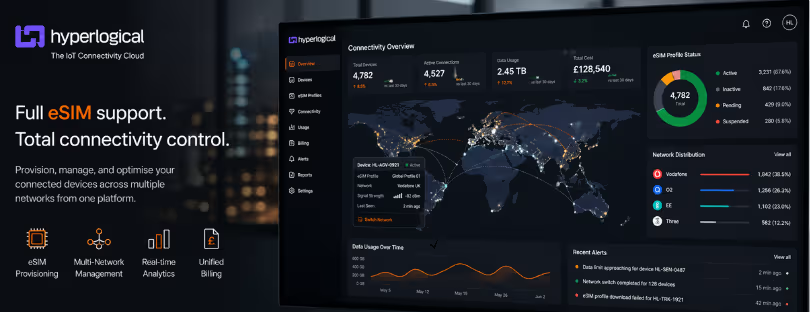
Hyper Logical is clearly aiming at that operational layer. With this update, devices can be provisioned, activated, reassigned, or shut down remotely through a single interface. No physical handling, no on-site visits, no delays waiting for logistics.
For sectors like logistics, utilities, or retail, where devices are scattered across regions or even countries, that shift is not just convenient. It changes how fast you can deploy and how efficiently you can manage costs.
One platform, full lifecycle
What’s interesting here is not just the eSIM support itself, but where it sits inside the platform.
metascape.com has always positioned itself as an IoT billing and connectivity management platform. It already handled usage tracking, cost allocation, and supplier oversight. Now, with eSIM added into the mix, it effectively covers the full lifecycle.
Provisioning, network switching, usage monitoring, and billing reconciliation. All in one place.
That matters because one of the biggest inefficiencies in IoT today is fragmentation. You have one system for connectivity, another for billing, and another for analytics. None of them fully talks to each other.
This update brings those layers closer together.

A more flexible network model
Another piece that stands out is how eSIM enables network flexibility.
Previously, switching between networks or carriers often meant physically replacing a SIM card. That’s not just inconvenient, it’s slow and expensive. With eSIM, those changes can be triggered programmatically.
That opens up a different way of thinking about connectivity. Instead of locking devices into a single network, businesses can respond dynamically to coverage gaps, pricing changes, or performance issues.
Hyper Logical is leaning into that with support for multiple eSIM profiles per device and automated rules for network switching. It’s a step toward what many in the industry have been talking about for a while, but not fully delivering at scale. Connectivity that behaves more like software than infrastructure.
Built for UK businesses, aligned with global trends
Hyper Logical has been clear that metascape.com is designed for UK businesses, but the direction is global.
eSIM is no longer a niche feature. It’s increasingly being specified in new hardware across industries like manufacturing, healthcare, and transportation. The GSMA standards around remote SIM provisioning have matured, and adoption is accelerating.
By integrating eSIM directly into its platform, Hyper Logical is aligning with that shift rather than reacting to it later.
As Archie Cole, Director of Hyper Logical, puts it:
“This update brings eSIM provisioning and billing into a single workflow for the first time on our platform, which means our customers can manage a device estate of 500 or 5,000 units with the same process. We built this for UK businesses that need to deploy fast and control costs at scale, and the eSIM capability removes one of the last remaining friction points in that process.”
That last line is the key. Removing friction.
What this means in practice
From a technical perspective, the platform now supports GSMA-compliant remote SIM provisioning, multi-profile management, and granular billing insights segmented by device, location, or business unit.
From a business perspective, it means fewer moving parts.
No additional licensing costs for existing customers is also a notable decision. It signals that Hyper Logical sees eSIM as a core capability, not an upsell feature.
They’ve also made onboarding easier with documentation for companies transitioning from physical SIM setups. That transition is where many projects stall, so simplifying it is a smart move.
Where this sits in the broader market
If you zoom out, this update fits into a much larger trend.
The IoT connectivity space is gradually shifting from hardware-driven models to software-defined platforms. Players like Cisco IoT Control Center, Vodafone’s IoT platform, and newer connectivity enablers are all moving in this direction. Remote provisioning, multi-network orchestration, and centralized billing are becoming baseline expectations.
At the same time, standards bodies like the GSMA have been pushing eSIM and iSIM as the future of device connectivity, particularly for large-scale deployments.
What Hyper Logical is doing here is bringing those capabilities into a more focused, UK-centric offering, with a clear emphasis on operational simplicity.
The real takeaway
eSIM is often framed as a technology upgrade. In reality, it’s an operational one.
The companies that benefit most are not the ones chasing the newest hardware, but the ones that remove complexity from how connectivity is managed.
Platforms like metascape.com are moving in that direction. Not by reinventing connectivity itself, but by making it easier to control, scale, and optimize.
And that’s where the real value is shifting.
Because in IoT, the problem was never getting devices online. It was everything that came after.