Why Every Airline Should Sell eSIM at Check-In
There’s a quiet shift happening at airports. Not the flashy kind with biometric boarding or AI baggage tracking. Something much more commercial. Much more immediate.
Connectivity is becoming part of the travel product.
And yet, most airlines are still treating it like an afterthought.
That’s the gap.
Because if you look closely, the check-in moment might be the most valuable telecom touchpoint in the entire journey.
The overlooked moment
Think about what happens at check-in.
You’ve already committed to the trip. You’re thinking about logistics. You’re mentally stepping into the destination. And somewhere in the back of your mind, there’s a small but persistent thought:
“How will my phone work when I land?”
That’s not hypothetical. It’s one of the last unresolved anxieties before departure.
Airlines spend millions optimizing seat selection, baggage upsells, and priority boarding. Meanwhile, connectivity—something every traveler will need within minutes of landing—is often buried in an email or ignored completely.
This is where eSIM changes the equation.
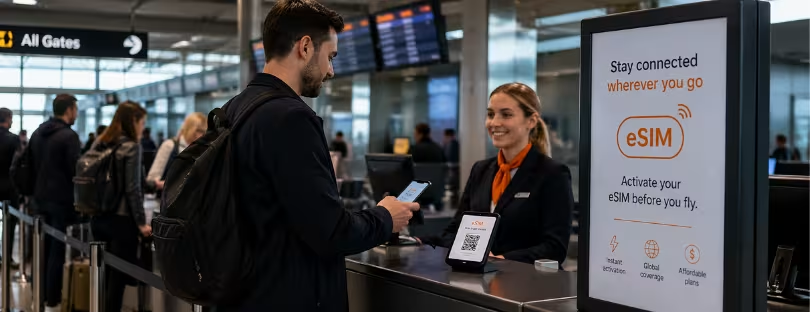
Unlike traditional SIMs, eSIMs can be installed instantly, before departure, and activated automatically on arrival. No kiosks. No queues. No friction.
So instead of solving connectivity at the airport… airlines can solve it at check-in.
And that changes everything.
From ancillary to essential
Airlines have always relied on ancillary revenue. Seat upgrades. Meals. Extra baggage. Insurance.
eSIM fits perfectly into that model. But it’s evolving beyond it.
We’re starting to see airlines integrate connectivity directly into their digital ecosystem.
- LATAM launched its own branded eSIM, even tying it into loyalty rewards
- Multiple global carriers are already partnering with eSIM providers
- Some airlines are experimenting with bundling connectivity into the ticket itself
This isn’t theory. It’s already happening.
And the reason is simple.
The travel eSIM market is growing fast—from roughly $585M in 2025 to over $700M in 2026, with strong long-term growth projected.
Airlines see it.
But most haven’t operationalized it where it matters most.
Check-in.

Why check-in is the conversion moment
Selling eSIM during booking sounds logical. But it’s often too early.
At booking, the traveler is focused on price. Dates. Maybe seat selection.
Connectivity feels optional.
At check-in, it doesn’t.
Now the trip is real. Departure is hours away. The traveler is mentally preparing for arrival.
This is when conversion spikes.
And it’s not just about timing. It’s about context.
At check-in, airlines know:
- Destination
- Duration
- Passenger profile
- Loyalty status
That’s enough to personalize an eSIM offer better than most telecom apps ever could.
Imagine:
“Flying to Tokyo? Activate 10GB before landing. 20% off for members.”
That’s not a generic upsell. That’s relevance.
The airline advantage no one talks about
Here’s the uncomfortable truth for most eSIM providers.
Distribution is their biggest problem.
Discovery is fragmented. Users jump between apps, comparison sites, and reviews. Even in 2025, finding the right eSIM isn’t always intuitive.
Airlines don’t have that problem.
They already own the traveler.
They have attention, trust, and timing—all in one place.
That’s why partnerships are scaling quickly. Some eSIM platforms are already integrated with 25+ airlines globally.
And yet, most implementations are still… passive.
Banner placements. Post-booking emails. Occasional promotions.
Check-in is different. It’s active. It’s transactional.
It’s where decisions happen.

It’s not just about revenue anymore
There’s a shift happening in how travel brands think about connectivity.
It’s no longer just an upsell.
It’s becoming part of the experience.
Some brands are already experimenting with:
- Free data bundles included in tickets
- Loyalty perks tied to connectivity
- Destination-based offers triggered by APIs
The logic is changing.
Connectivity reduces friction. And friction kills customer satisfaction.
A traveler who lands with instant data:
- Gets to their hotel faster
- Uses the airline app abroad
- Books add-ons, and services are more easily
That’s not just ancillary revenue. That’s retention.
What the best implementations are doing right
Seamless activation
No codes, no confusion. Install once, activate on arrival.
Contextual offers
Not “Buy eSIM.” But “Stay connected in Paris from €5.”
Integrated UX
Built into the airline app or check-in flow—not external redirects.
Clear pricing
No telecom jargon. Just data, validity, price.
When it works, it feels like part of the airline product.
When it doesn’t, it feels like an ad.
And travelers can tell the difference instantly.
The missed opportunity is bigger than airlines
If airlines don’t fully own this space, someone else will.
We’re already seeing:
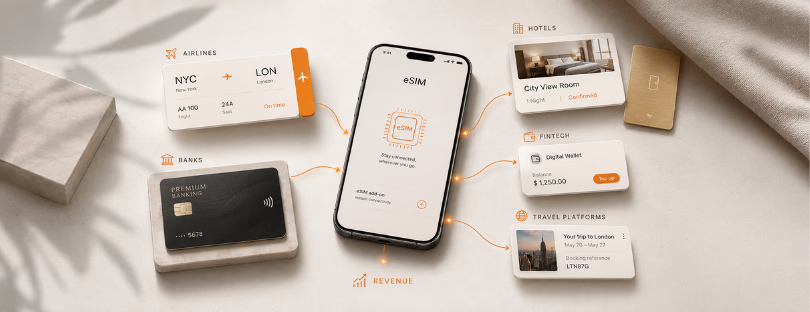
- Airports partnering with eSIM providers
- Fintech apps embedding connectivity into cards
- Travel platforms bundling eSIM with bookings
The infrastructure is there.
The APIs exist.
Even telecom providers are now building platforms specifically to capture revenue from traveler connectivity at scale.
Which means this isn’t a niche play anymore.
It’s a land grab.
Why do most airlines still hesitate
Let’s be honest. This isn’t about technology.
It’s about mindset.
Airlines are used to selling physical experiences. Seats. Space. Priority.
Connectivity feels abstract. Telecom-heavy. Slightly outside their core.
But that’s exactly why they’re missing it.
Because eSIM isn’t a telecom product anymore.
It’s a travel product.
And the sooner airlines see it that way, the faster this becomes standard.
Your customers will buy connectivity. The question is: from you, or from someone else?
We help airlines, banks, and travel platforms turn that demand into a built-in product — not a missed opportunity.
The real play isn’t selling eSIM
Here’s where it gets interesting.
The real opportunity isn’t selling data.
It’s owning the connectivity layer of travel.
That means:
- Controlling how travelers connect abroad
- Using that connection to drive engagement
- Embedding services into the journey
Think about it.
If your airline provides the data connection, you control the channel.
That opens the door to:
- Local offers
- Real-time upsells
- In-destination partnerships
That’s a completely different business model.
And it starts with something as simple as… offering eSIM at check-in.
Conclusion: airlines vs the rest of the ecosystem
The direction is clear.
Airlines like LATAM are already moving into branded connectivity.
Global players are forming distribution partnerships at scale.
The market itself is growing fast enough to justify serious investment.
But here’s the difference. airline eSIM check-in
Most eSIM providers are still fighting for visibility.
Airlines already have it.
That’s the asymmetry.
If airlines fully integrate eSIM into check-in, they don’t just compete with providers like Airalo, Holafly, or Ubigi.
They become the distribution layer those providers depend on.
And that’s exactly what we’re starting to see in adjacent sectors.
Fintech apps bundle connectivity with cards. Travel platforms embed it into bookings. Even ground transport is integrating eSIM into the journey.
The trend is obvious if you zoom out.
Connectivity is moving upstream. Closer to the moment of intent.
Check-in is that moment.
So the real question isn’t whether airlines should sell eSIM there.
It’s how long they can afford not to.