


Inside the $10B eSIM Boom: How Providers Are Battling for Market Share
Let’s be honest. The eSIM boom didn’t sneak up on anyone. eSIM market trends 2026
The tech has been around for years. The promise was always clear: no plastic, no swapping, instant global connectivity. Yet for a long time, it sat in that awkward phase where everyone talked about it, but very few actually built serious businesses around it.
Now? We’re looking at a market pushing toward $10 billion, depending on whose projections you trust. And suddenly, everyone wants a piece of it.
But here’s the part most people miss: this isn’t just growth. It’s a land grab.
And it’s getting aggressive.
Demand Is Exploding — But So Is Confusion
Travel has fully rebounded. Remote work didn’t disappear. And people are more comfortable buying connectivity digitally than ever before.
That’s the perfect storm for eSIM.
But demand alone doesn’t create winners. It creates noise.
Today’s traveler is faced with dozens, sometimes hundreds of options:
- “Unlimited” plans that aren’t really unlimited
- Regional bundles with confusing validity rules
- Apps that look identical
- Pricing that varies wildly for the same destination
From the outside, it looks like a thriving ecosystem.
From the inside, it’s a battlefield where differentiation is dangerously thin.
The Illusion of Product Competition
Most providers still believe they’re competing on product.
They’re not.
Let’s break the uncomfortable truth:
Coverage? Largely the same.
Speeds? Dependent on local networks, not the provider.
Technology? Standardized through the same infrastructure players.
So when providers say, “We have better coverage” or “faster speeds,” they’re often selling the same underlying product with different packaging.
Which means the real competition has shifted somewhere else entirely.
 It’s a Distribution War Now
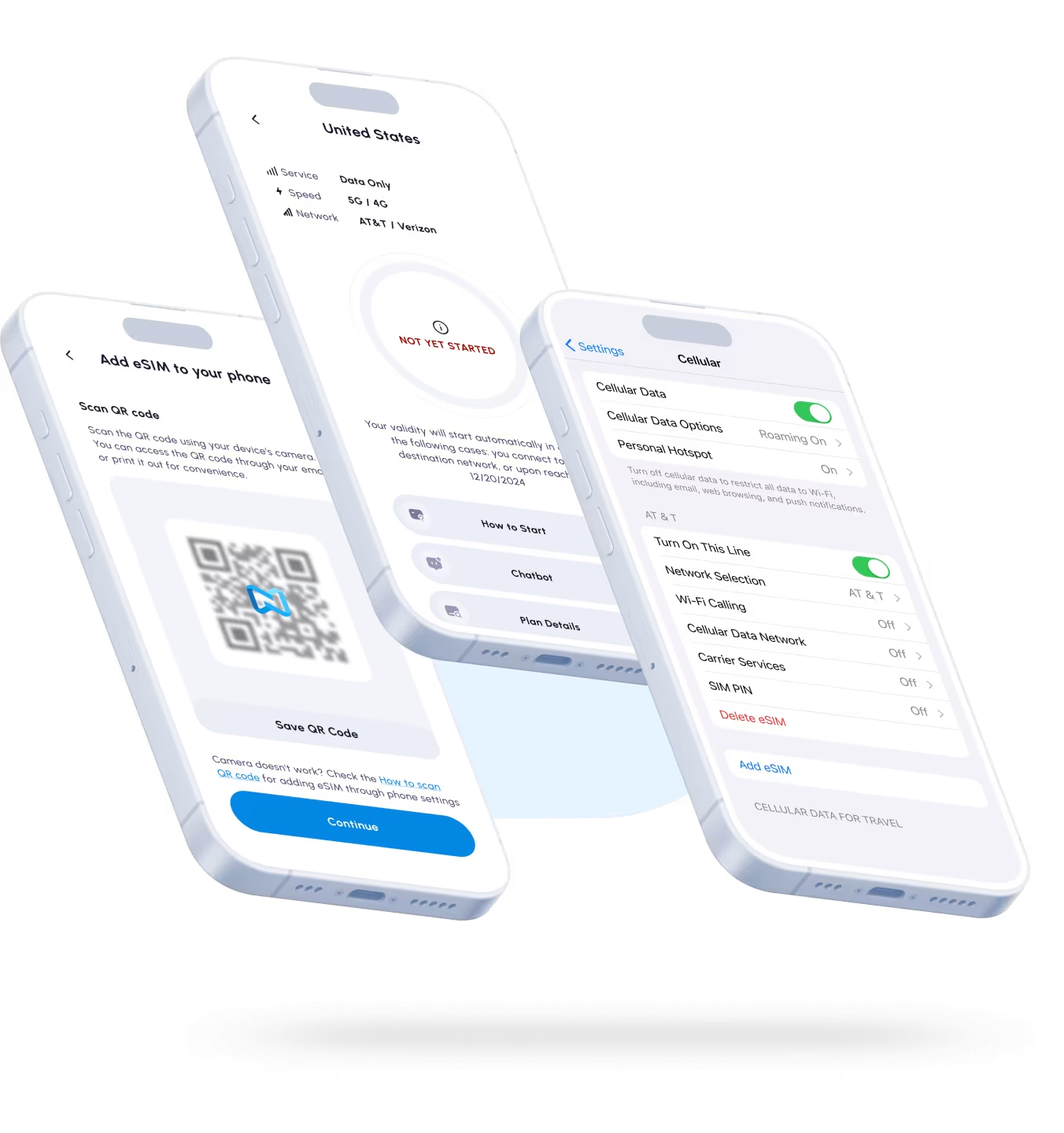
The biggest shift in the eSIM boom isn’t technical. It’s commercial.
The companies winning right now aren’t necessarily the ones with the best product. They’re the ones who control access to the customer.
Think about where people actually discover eSIMs:
- Travel booking platforms
- Airline apps
- Banking apps
- Affiliate comparison sites
- Influencers and content creators
That’s where decisions happen.
And that’s why you’re seeing a surge in:
- API-first eSIM platforms
- White-label solutions
- Embedded connectivity partnerships
Because owning the product is no longer enough.
You need to be inside the journey.
The Rise of Embedded Connectivity
This is where things get interesting.
Some of the smartest players in the space aren’t even positioning themselves as eSIM providers anymore. They’re positioning as infrastructure.
Their pitch isn’t:
“Buy our eSIM.”
It’s:
“Let your users never think about connectivity again.”
Banks are starting to bundle connectivity into travel perks.
Airlines are experimenting with in-app data offers.
Travel apps are embedding eSIM activation directly into the booking flow.
This is a completely different game.
It turns eSIM from a product into a feature.
And once that happens, the standalone providers who rely only on direct sales start to feel pressure.
Your customers will buy connectivity. The question is: from you, or from someone else?
We help airlines, banks, and travel platforms turn that demand into a built-in product — not a missed opportunity.
Pricing Is Becoming a Race to the Bottom
Here’s another uncomfortable reality: pricing power is collapsing.
As more providers enter the market and as supply becomes commoditized, prices are dropping fast.
You’ve probably seen it:
- 1GB plans going from €10 to €5
- Aggressive “unlimited” daily pricing
- Constant promo codes and discounts
At first glance, this looks like great news for consumers.
But for providers, it creates a dangerous dynamic:
- Lower margins
- Higher acquisition costs
- Shorter customer lifecycles
And because most users buy eSIMs for a single trip, retention is weak.
So what happens?
Providers are forced into a cycle of:
Acquire → sell once → lose customer → repeat
That’s not a growth model. That’s a treadmill.
“Unlimited” Is the Most Contested Battleground
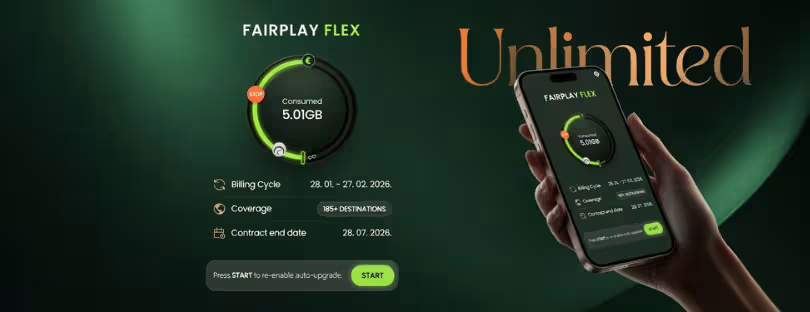
If there’s one word defining the current phase of the eSIM boom, it’s “unlimited.”
Everyone is selling it.
But not everyone means the same thing.
Some providers offer:
- True high-speed unlimited
- Fair usage policies with throttling
- Daily caps disguised as unlimited
And this is where trust starts to break.
Users don’t read the fine print. They experience it.
And when “unlimited” suddenly becomes slow or restricted, they remember.
That’s why a few providers are trying to reposition around transparency and predictability instead of just price.
It’s a subtle shift, but an important one.
Because in a commoditized market, trust becomes a differentiator.

Brand Is Finally Starting to Matter
For a long time, brand didn’t matter in eSIM.
Users searched “eSIM for Italy,” clicked the cheapest option, and moved on.
That’s changing.
Why?
Because the market is getting crowded.
When every provider looks the same, people start asking:
- Who can I trust?
- Who will actually work when I land?
- Who won’t leave me without data in the middle of a trip?
This is where recognizable brands start pulling ahead.
Not because their product is radically different.
But because they’re remembered.
And this is exactly where most providers are still underinvesting.
They focus on:
- Adding more destinations
- Tweaking pricing
- Launching new bundles
But they ignore:
- Messaging
- Positioning
- Emotional connection
In a $10B market, that’s a huge miss.
The Real Winners Are Building Systems, Not Products
If you zoom out, a pattern starts to emerge.
The providers gaining real traction are doing at least one of these things:
- They own the distribution
- They embed into other platforms
- They build a strong brand recall
- They create repeatable revenue models
And most importantly, they think beyond the one-time sale.
Because that’s the biggest structural weakness in the entire eSIM market.
It’s built around trips.
Not users.
The Retention Problem Nobody Talks About
Here’s a simple question:
How many eSIM users come back to the same provider for their next trip?
Not many.
And that’s a problem.
Because it means most companies are constantly rebuilding revenue from zero.
Some are trying to fix this with:
- App ecosystems
- Loyalty programs
- Multi-country plans
- Long-validity packages
Others are going further and rethinking the model entirely:
- Subscription-based connectivity
- Persistent eSIM profiles
- Always-on global data
This is where the next phase of the market will be decided.
Not in who sells the cheapest 5GB plan.
But in who keeps the customer.
So… What Does “Winning” Actually Look Like?
Let’s cut through the noise.
Winning in the eSIM boom doesn’t mean:
- Having the most countries
- Offering the lowest price
- Launching the most plans
It means something much simpler, and much harder:
Being chosen without hesitation.
That happens when:
- Your brand is recognized
- Your value is instantly clear
- Your product actually delivers
- Your distribution puts you in front of the user at the right moment
Right now, only a handful of players are close to that.
Everyone else?
They’re competing in a crowded middle, hoping price or features will save them.
The Market Is Growing — But It’s Not Forgiving
Yes, the eSIM market is booming.
Yes, there’s more demand than ever.
But growth doesn’t guarantee success.
In fact, it often does the opposite.
It exposes:
- Weak positioning
- Fragile business models
- Lack of differentiation
The next 2–3 years will be brutal.
You’ll see consolidation.
You’ll see aggressive partnerships.
You’ll see brands disappear.
And you’ll see a few players pull far ahead.
The Bottom Line about eSIM market trends 2026
The $10B eSIM boom isn’t just about connectivity.
It’s about who understands that this is no longer a telecom product.
It’s a distribution game.
A branding game.
A retention game.
And most providers are still playing it like it’s 2018.
That gap?
That’s where the real opportunity is.


