There’s an unspoken agreement in the travel eSIM market: when a provider says “unlimited,” you mentally add an asterisk. You expect a throttle threshold buried somewhere — usually around 1–5 GB of high-speed data before the plan quietly drops you to speeds that technically still “work” but make streaming feel like 2009. It’s not illegal. It’s just the industry’s favorite misdirection.
If you’ve ever tried to load a video mid-trip and watched it buffer endlessly, you already know how this plays out.
Most providers have built their entire pricing logic around this sleight of hand. Offer a headline promise (unlimited), hide the throttle point in the fine print, and let the user discover it somewhere over the Atlantic. It works commercially. It doesn’t work for the customer.
Fairplay eSIM is doing something structurally different — and the mechanism that makes it work is, oddly, almost never discussed.
The Ladder, Explained
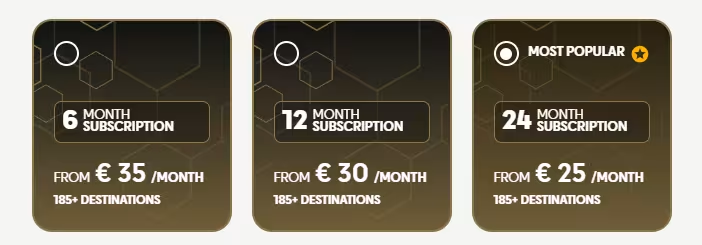
Fairplay Flex on the 6-month tier starts at €35/month. That’s the entry point. But the plan doesn’t operate on a flat fee model — it adapts to actual usage. The more data you consume in a given month, the more you pay, but the effective cost per GB drops as you climb.
It’s a progressive pricing ladder: your bill scales with behavior, not a fixed ceiling that punishes you for staying home one month and burning through 60 GB the next.
And then, at €95, the ladder stops. That’s the cost cap.
Above that threshold, the data is effectively unlimited at full speed — no throttle, no deprioritization theater, no fine print exceptions. You’ve paid the ceiling; the network is yours.
So the actual range isn’t “unlimited from €35.” It’s this:
Somewhere between €35 and €95, depending on how aggressively you use it — and genuinely unlimited if you hit that ceiling.
That’s a fundamentally different product promise than anything the market has standardized around.
Why This Is Harder to Copy Than It Looks
At face value, a usage-based pricing ladder sounds like something any eSIM provider could implement.
It’s not.
The model requires a few things that most providers aren’t built for.
First, it needs real-time usage visibility and a billing infrastructure that can track consumption and apply dynamic pricing mid-month. That’s not a feature. It’s a platform capability. Most resellers sitting on top of wholesale data pools don’t have the technical layer to do this cleanly.
Second, it requires network access at a level where you can actually guarantee full-speed delivery at the cap. The “5G with 4G/LTE fallback” framing matters here — not as marketing, but as a prerequisite. If you’re throttling at the infrastructure level to manage costs, the entire promise breaks.
Third — and this is the underappreciated part — it requires a business model that’s comfortable with variable revenue per user.
A flat-rate unlimited plan is predictable. A tiered ladder with a ceiling introduces variance. Some users hit €95 in week two. Others use 4 GB all month and stay at €35.
The unit economics have to hold across that spread. That means the pricing architecture has to be right from the start, not patched in later.
The Stop/Start Feature — What It Actually Does
One element that doesn’t get enough attention is the Stop/Start function — but it’s often misunderstood.
This isn’t about pausing your subscription cost entirely. You’re still paying your base monthly fee (€25–€35 depending on the plan), whether you use data or not. That’s intentional.
What the Stop/Start feature really controls is consumption, not cost.
You’re not accidentally triggering additional data steps when you don’t need them. You’re not climbing the pricing ladder without realizing it. You decide when usage begins — and when it doesn’t.
And that distinction matters.
Because this product isn’t built for occasional users trying to minimize every euro. It’s built for heavy users — people who, when they travel, consume serious amounts of data and need performance without thinking twice.
For that kind of user, the value isn’t in avoiding the base fee.
It’s in controlling when you move beyond it.
Instead of a system that quietly charges you for unused capacity or surprises you with extra costs, Fairplay eSIM gives you a clear structure:
You pay the base to stay connected and ready.
You scale usage only when you actually need it.
And you always know where the ceiling is.
So no, it’s not a pause button in the traditional sense.
It’s something more aligned with how this entire product is designed:
Control, not avoidance.
What the Market Comparison Actually Shows
Most global eSIM players have converged on two models:
Pay-as-you-go data packages or flat “unlimited” plans.
The PAYG model is transparent but penalizes heavy users on longer trips.
The flat unlimited model is simple but almost universally throttled.
Some providers have introduced flexibility. Some have infrastructure advantages. But none have built a cost-capped progressive ladder as the core product architecture.
It’s not trying to be the cheapest per-GB option. It’s not trying to be the simplest one-click plan.
It’s targeting a very specific user:
The frequent traveler or digital nomad who uses a lot of data, hates bill shock, and has been burned enough times by “unlimited” to read the asterisk first.
For that user, €95/month as an absolute ceiling isn’t expensive.
It’s control.
The Real Product Philosophy
The cost cap is ultimately a transparency bet.
Most of the industry profits from the gap between what users expect and what they actually get. Fairplay’s architecture removes that gap — or at least shifts it to a place where the user is never the one paying for it.
You can’t be surprised by a €150 bill. You can’t be throttled off a cliff at 1 GB. The worst case is €95, and at €95, the data flows.
That’s not just a pricing feature. It’s a different relationship with the customer.
And it leads to a bigger question:
The real question isn’t whether this model works.
It’s why the rest of the industry hasn’t built it.
Driven by wanderlust and a passion for tech, Sandra is the creative force behind Alertify. Love for exploration and discovery is what sparked the idea for Alertify, a product that likely combines Sandra’s technological expertise with the desire to simplify or enhance travel experiences in some way.