Orange Poland Makes Prepaid eSIM Fully Self-Service
For years, eSIM has been positioned as the future of mobile connectivity. But in reality, most users still hit friction the moment they try to do anything beyond activation. Switching devices, recovering a lost line, or even converting from a physical SIM often still requires a store visit, a QR code, or customer support. Orange Poland prepaid eSIM app management
That’s exactly where Orange Poland is making a very deliberate move.
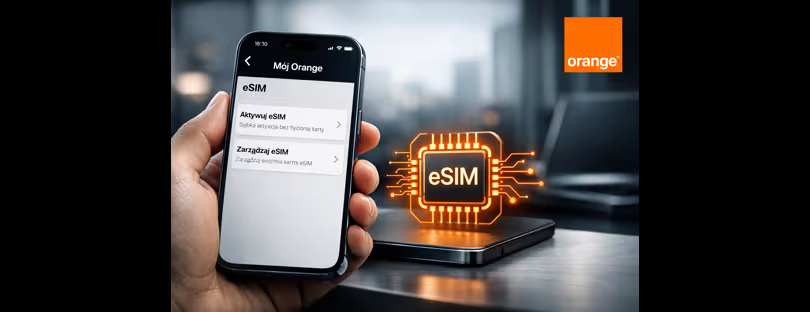
With the latest update to its “Mój Orange” app, the operator is pushing something the industry has been promising but rarely delivering: true, end-to-end eSIM self-management for prepaid users.
And that’s a much bigger deal than it sounds.
From “eSIM available” to “eSIM usable”
Most operators today technically “support eSIM.” But if you’ve ever used it, you know the gap between support and usability is massive.
What Orange Poland is doing here is closing that gap.
Inside the updated “Mój Orange” app, prepaid users can now:
- Convert a physical SIM into an eSIM directly in the app
- Transfer an active eSIM to a new device
- Block or unblock their eSIM instantly in case of loss or theft
No store visits. No waiting. No QR code emails. No friction.
This is a shift from eSIM as a product to eSIM as a system.
And importantly, it’s happening in prepaid.
Why prepaid is the real battleground
Postpaid users have always been the priority for telecom innovation. Higher ARPU, longer contracts, more predictable revenue.
Prepaid users? Historically underserved.
That’s why this move matters.
By bringing advanced eSIM controls to prepaid, Orange is effectively saying: digital self-service is no longer a premium feature. It’s the baseline.
This aligns with what we’ve already seen from Orange Flex, Orange’s fully digital sub-brand, where everything from onboarding to plan changes happens inside an app.
But now, that philosophy is being pushed into the core prepaid business.
That’s where scale is.
The real innovation: control, not technology
Let’s be clear. None of these features are technically groundbreaking.
eSIM transfer? Possible for years.
Remote blocking? Standard in telecom systems.
SIM-to-eSIM conversion? Also not new.
What is new is putting all of it in one place, directly in the hands of the user.
That’s the shift.
Instead of:
- Calling support
- Visiting a store
- Waiting for manual approval
You tap, confirm, done.
This is what telecom has been trying to achieve for over a decade: reducing dependency on physical infrastructure and human intervention.
And it’s finally starting to look real.
The theft scenario finally solved
One of the most overlooked pain points in mobile connectivity is what happens when you lose your phone.
With a physical SIM, the process is slow:
- Block the SIM via customer support
- Order a replacement
- Wait or visit a store
- Reactivate
With eSIM, it should be instant. But in most cases, it isn’t.
Orange’s update changes that.
Now, if your phone is stolen, you can immediately block your eSIM inside the app. And just as importantly, unblock it when needed.
This is not just convenience. It’s security infrastructure.
And in a world where your phone is your bank, your ID, and your authentication device, that matters more than ever.
Device switching without friction
Another major friction point in eSIM adoption has been device switching.
Anyone who’s tried moving an eSIM from one phone to another knows the process can be… unpredictable. Some operators require new QR codes. Others force full reactivation.
Orange is simplifying that.
By enabling direct eSIM transfer within the app, they’re removing one of the biggest psychological barriers to eSIM adoption: the fear of getting stuck.
Because if switching devices feels risky, users won’t commit to eSIM long-term.
This update removes that hesitation.

Quietly following a global trend
Orange Poland isn’t alone here. It’s part of a broader industry shift toward fully digital telecom experiences.
Operators like T-Mobile and Vodafone have been investing heavily in app-based account management and eSIM onboarding. Meanwhile, digital-first players like Airalo and Holafly have built their entire user experience around instant activation and minimal friction.
But there’s a key difference.
Travel eSIM providers started digital.
Traditional operators are transforming into digital.
And that transformation is much harder.
Legacy systems, retail dependencies, regulatory constraints, and internal processes all slow things down.
That’s why updates like this matter. They show real progress, not just marketing.
What this means for the market
This move puts pressure on other operators, especially in Europe.
Because once users experience true self-service, going back feels broken.
Expect three things to happen next:
- More operators will push eSIM management into apps
- Physical SIM replacement processes will become obsolete
- Customer support for basic SIM operations will decline
And importantly, prepaid users will no longer be treated as second-tier customers in digital innovation.
This also has implications for travel connectivity.
As local operators improve their digital experience, the gap between traditional telcos and travel eSIM providers starts to shrink.
Which raises a bigger question:
If your home operator offers seamless, app-based eSIM management, do you still need a separate travel eSIM?
That’s where things get interesting.
Where this leaves eSIM providers and the future of control
Orange Poland’s update is not just a feature release. It’s a signal.
The industry is moving toward a model where connectivity is:
- Fully digital
- Fully user-controlled
- Fully integrated into apps
This is exactly the direction the GSMA has been pushing with eSIM standardization and remote provisioning frameworks.
But the execution has been uneven.
What Orange is doing here is closing the last mile: user experience.
And that’s where the real competition will happen.
Because in the end, users don’t care about SM-DP+ platforms or provisioning standards.
They care about one thing:
Can I manage my connectivity instantly, without friction?
Orange Poland is getting closer to answering that with a yes.
And if others follow, this might be the moment eSIM finally becomes not just the future of connectivity, but the default.