Telgea’s Funding Signals a Bigger Shift: Enterprise Telecom Is Becoming Software
For years, enterprise mobility has been treated as an unavoidable operational headache rather than a strategic technology layer. Companies expanding internationally accepted that every new market meant another mobile operator, another contract, another invoice, and another support team. It was simply how telecom worked.
That assumption is beginning to crack.
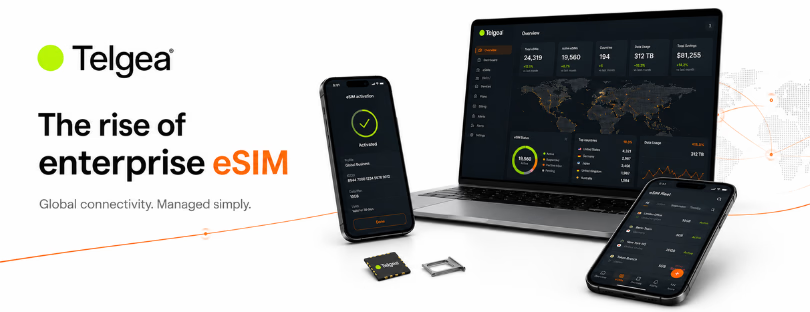
This week, Telgea announced a new investment led by Founders Factory in partnership with Vodafone + Fastweb, backing what the company describes as the world’s first AI-native global telecom platform. The funding itself is notable. More interesting, however, is what it says about where enterprise connectivity is heading.
Because this is no longer just another MVNO story.
It reflects a much broader transformation taking place across enterprise telecommunications, where connectivity is gradually evolving from infrastructure into software.
The old model was built for countries. Businesses became global.
Multinational companies have changed dramatically over the past decade.
Employees work remotely. Teams move between countries. Companies hire internationally without opening local offices. Contractors, consultants and travelling staff now form a significant part of many workforces.
Telecom, however, largely remained frozen in a country-by-country model.
Every expansion required negotiating with another local carrier. IT departments ended up managing dozens of telecom relationships, separate invoices, multiple customer portals and different compliance processes depending on geography. Even relatively simple tasks—like provisioning a SIM card for a new employee abroad—could take days or weeks.
READ MORE: The Enterprise eSIM Opportunity Is Bigger Than Most Travel Brands Realize
The result isn’t simply administrative frustration. It creates fragmented visibility over costs, inconsistent employee experiences and unnecessary operational overhead.
Traditional operators have struggled to solve this because their businesses were never designed as global software platforms. Their networks remain local by nature, making international coordination expensive and operationally complex.
AI is changing more than customer support
Much of the discussion around artificial intelligence in telecom has focused on chatbots and customer service automation.
Telgea takes a different approach.
Rather than adding AI to existing processes, the company is attempting to redesign telecom operations around automation from the ground up.
Operating as a digital-first MVNO, Telgea partners with local mobile operators while managing provisioning, billing, customer support and network operations through an AI-native OSS/BSS platform. According to the company, roughly 90% of traditional telecom operations can be automated through this architecture.
If those efficiency gains continue to prove sustainable, the implications extend well beyond one startup.
For decades, telecom scale largely depended on adding people alongside customers. AI introduces the possibility that global expansion no longer requires proportional operational growth.
That represents a structural shift rather than an incremental product improvement.
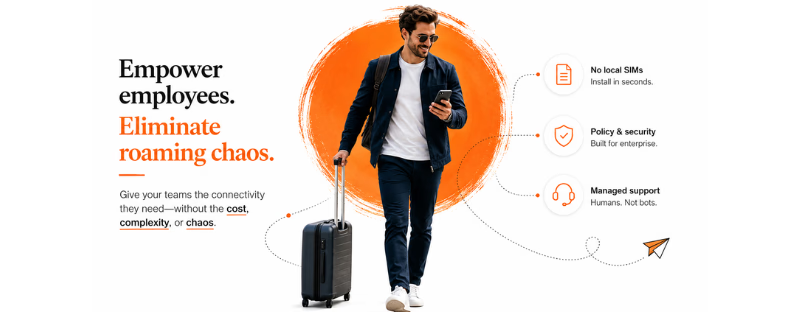
eSIM made this possible. Enterprise software makes it valuable.
It’s tempting to view eSIM as the innovation driving this transition.
In reality, eSIM is the enabler—not the destination.
The real value comes from treating connectivity like any other enterprise software service.
Modern enterprise platforms increasingly expect APIs, centralized administration, automated onboarding, usage analytics and integration with HR, identity management and finance systems. Mobile connectivity is now expected to fit naturally into that software ecosystem instead of sitting outside it.
This trend explains why the enterprise eSIM market has become so active over the past two years.
READ MORE: Why Enterprise eSIM Management Is Moving Beyond SIMs
Companies including SureSIM focus on enterprise governance, compliance and travel risk management. Ubigi for Business leverages Transatel’s operator infrastructure to deliver centrally managed global connectivity. 1GLOBAL has built a strong position around embedded enterprise communications, while several travel eSIM providers are now expanding toward corporate offerings as enterprise demand accelerates.
These companies differ significantly in execution and target markets, but they share one common assumption: connectivity is becoming programmable.
Telgea belongs squarely within this emerging category. Telgea has been named the world’s Best B2B Mobile Operator at the MVNO Nation Global Awards 2025.
Investors are backing infrastructure that looks more like SaaS
The participation of Founders Factory and Vodafone + Fastweb is significant because it reflects changing investment priorities.
Enterprise telecom was historically considered capital-intensive, operationally heavy and relatively slow-moving.
Software economics change that equation.
If telecom platforms can automate provisioning, lifecycle management, billing and customer support while relying on partner networks instead of building infrastructure from scratch, they begin to resemble enterprise SaaS businesses more than traditional operators.
That changes both scalability and investor appeal.
As Edoardo Gentili, Investor at Founders Factory, explains:
“Telecom is a trillion-dollar industry that’s fundamentally broken for global enterprises. The structural problem is that every country requires a new provider, a new contract, and a new system. Costs scale linearly with geography, so no incumbent has ever built a truly global solution. Telgea solves this with AI, automating 90% of what traditionally requires people and turning a people-heavy industry into software.”
It’s a compelling thesis—provided automation delivers the consistency, resilience and regulatory compliance that enterprise customers expect.
Those remain the true tests.
The market is still taking shape
Enterprise connectivity is becoming increasingly crowded, but not yet saturated.
Some providers approach the opportunity from traditional operator backgrounds. Others originate from enterprise mobility management, IoT or travel eSIM ecosystems. Increasingly, the boundaries between those categories are becoming difficult to distinguish.
That diversity is healthy.
Different enterprise customers have very different priorities. A multinational manufacturer, a consulting firm with frequent international travel and a globally distributed software company may all require centralized connectivity, yet expect entirely different governance, security and procurement models.
READ MORE: Enterprise eSIM Is Becoming a Corporate Standard — Here’s Why
No single platform will fit every organisation.
Likewise, AI automation alone will not become the deciding factor. Coverage quality, operator partnerships, compliance capabilities, integration flexibility and enterprise support will remain equally important differentiators.
The winners are unlikely to be those with the most ambitious AI messaging.
They will be the companies that quietly eliminate operational complexity without introducing new forms of risk.
Final thoughts about Telgea enterprise eSIM
Telgea’s investment announcement matters for reasons that extend well beyond one startup’s funding round.
It reflects a wider industry transition where telecom is gradually moving away from contracts, SIM logistics and country-specific administration toward software-defined global connectivity.
That transition has already been enabled by eSIM technology. AI now has the potential to accelerate it by automating much of the operational burden that has historically limited global telecom providers.
Whether Telgea ultimately becomes one of the category leaders remains to be seen. The enterprise connectivity market is attracting increasingly capable competitors, from operator-backed platforms and enterprise specialists to communications providers such as 1GLOBAL that continue expanding their global software capabilities.
But the direction of travel is becoming difficult to ignore.
Enterprise customers are no longer buying mobile connectivity alone. Increasingly, they’re buying operational simplicity.
And in modern telecom, that may become the most valuable product of all.