Spectrum Mobile Turns Dual eSIM Into a Second Line
Carrying two phones has always felt like a very clumsy solution to a very modern problem. One phone for work. One phone for personal life. One for clients. One for family. One number for the main job, another for the side business. It works, technically. But it also means more charging, more notifications, more devices to lose, and one more thing to think about before leaving the house.
Spectrum Mobile is now trying to make that setup simpler.
The company has launched Spectrum Mobile Second Line, a $10-per-month add-on that gives customers a second mobile number on the same compatible smartphone. The key detail is this: the service is built around Dual SIM Dual Standby smartphones, including devices that support dual eSIM. In other words, this is not just another mobile plan. It is a very practical example of how eSIM is slowly moving from “travel convenience” into everyday mobile identity management.
“Our customers want practical ways to keep their work and personal life organized on one device,” said David Owens, Senior Vice President, Mobile Products. “It’s a simple, integrated way to manage different numbers, whether for business or personal, without extra devices or toggling between apps.”
That sentence captures the real shift. eSIM is no longer only about landing in another country and avoiding roaming charges. It is becoming part of how people structure their digital lives.
Why second lines make sense now
Second numbers are not new. People have used prepaid SIM cards, business phones, call-forwarding apps and messaging platforms for years. But those solutions often feel like workarounds. Apps can be messy. Extra phones are annoying. Physical SIM cards are not exactly elegant.
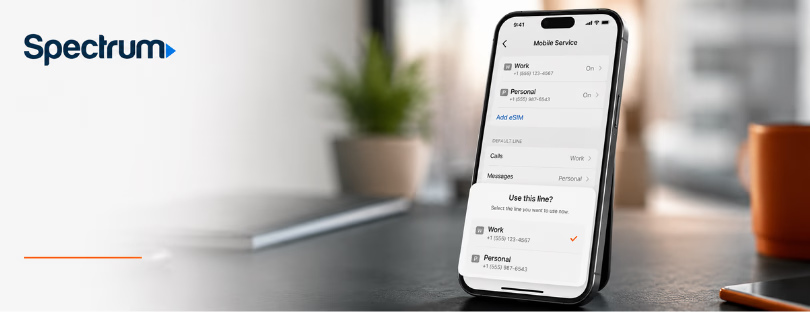
Dual eSIM changes the experience because the second number can live directly inside the phone’s native calling and messaging setup. Customers can label each line, then choose which number to use when calling or texting. Google describes this type of setup as Dual SIM Dual Standby, where users can choose which SIM to use for specific actions such as calls, messages or mobile data.
For Spectrum, the proposition is simple: add a second Spectrum Mobile number to an eligible phone, share the first line’s data plan, and get unlimited talk and text in the U.S., Mexico and Canada. The second line also includes voicemail, visual voicemail and Call Guard. Customers can add a new number or port in an existing one through Spectrum.net, the My Spectrum App or customer support.
That makes the offer especially relevant for entrepreneurs, freelancers, side-hustle workers, small business owners and anyone who wants cleaner separation between personal and professional communication.
The eSIM angle matters
The most interesting part of Spectrum’s launch is not the $10 price point, although that is clearly designed to feel accessible. The bigger story is that dual eSIM support is becoming normal enough for operators to package it as a mainstream feature.
Spectrum says it began offering dual eSIM phones in 2021 and that these devices have made up the majority of its device sales since. That matters because operators cannot build simple second-line products unless enough customers already have compatible phones. Hardware readiness is what turns eSIM from a technical feature into a sellable service.
This is also where Spectrum’s move fits into a wider industry direction. Apple, Google and other device makers have spent years pushing eSIM deeper into the smartphone experience. Apple’s own support documentation explains that users can have two active SIMs on supported iPhones, including eSIM-based setups depending on the model and carrier support. Google’s Pixel support also highlights dual SIM use cases, including one physical SIM plus one eSIM, and newer devices that support more advanced eSIM combinations.
The travel eSIM market talks a lot about cheaper data abroad. But the more strategic eSIM story is broader: multiple numbers, multiple profiles, different identities, business use cases, temporary plans, enterprise control and better device-level flexibility.
Spectrum’s Second Line is a small consumer product, but it points to that larger movement.

Not just for business users
It would be easy to frame this only as a small-business tool. That would be too narrow.
Yes, the obvious audience includes real estate agents, consultants, delivery workers, creators, tradespeople and people running a side business after hours. But the personal use cases are just as strong. Someone might want a separate number for online selling, dating apps, travel bookings, school communication, caregiving, privacy or temporary projects.
The value is not only separation. It is control.
READ MORE: Pixel 9 eSIM Simplified: Your Guide to eSIM and Dual SIM
A second line lets users decide which number belongs to which part of their life without fully moving into app-based calling. That is important because many people still trust native phone numbers more than third-party apps, especially for banks, verification codes, client calls and professional communication.
There is also a subtle convenience factor. No extra phone means no second battery, no duplicate device insurance, no additional accessories and no awkward switching between handsets. For many users, that is enough.
Where Spectrum fits in the market
Spectrum Mobile is not trying to reinvent mobile here. It is taking a feature already available in modern phones and turning it into a simple add-on. That is smart.
Compared with app-based second-number services, Spectrum’s approach feels more integrated because the number sits at the carrier level and works through the phone’s native calling and texting experience. Compared with carrying a second device, it is obviously cleaner. Compared with a full second mobile line, the shared-data model keeps the proposition easy to understand.
This is also where cable mobile operators have an opportunity. Spectrum already sells broadband, Wi-Fi and mobile as part of a converged connectivity bundle. A second-line product gives it another way to increase stickiness without asking customers to change their main device or rethink their entire mobile setup.
For the wider eSIM industry, the lesson is clear. The next wave of eSIM value will not only come from cheaper gigabytes. It will come from use cases that make the phone more flexible.
The real conclusion
Spectrum Mobile Second Line is not a flashy launch, and that is exactly why it is interesting. It shows eSIM becoming boring in the best possible way.
For years, eSIM was marketed as something futuristic, mostly useful for frequent travellers or early adopters. Now it is quietly turning into infrastructure for everyday life: one phone, two numbers, cleaner boundaries, fewer devices.
That is where the market is going. Airalo, Ubigi, Nomad eSIM and other travel eSIM brands have educated consumers around digital connectivity abroad. But operators like Spectrum are showing another side of the same technology: eSIM as a practical identity layer inside the phone.
The companies that understand this will stop treating eSIM as just a data plan format. They will use it to solve real problems people already have. Work versus personal. Local versus international. Primary versus temporary. Consumer versus business.
Spectrum’s product is simple. But the signal behind it is bigger: eSIM is moving from travel hack to mobile life management.