Why eSIM Adoption Is Stuck: Distribution Over Tech
Here’s the uncomfortable truth the industry doesn’t like to admit: eSIM isn’t struggling because the tech isn’t ready. It’s struggling because people don’t understand it and because it still doesn’t show up where decisions actually happen.
The gap is no longer technical. It’s commercial. Behavioral. And above all, distribution.
And the numbers make that obvious.
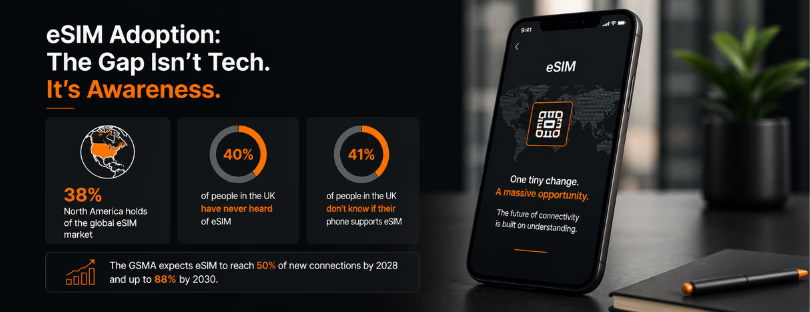
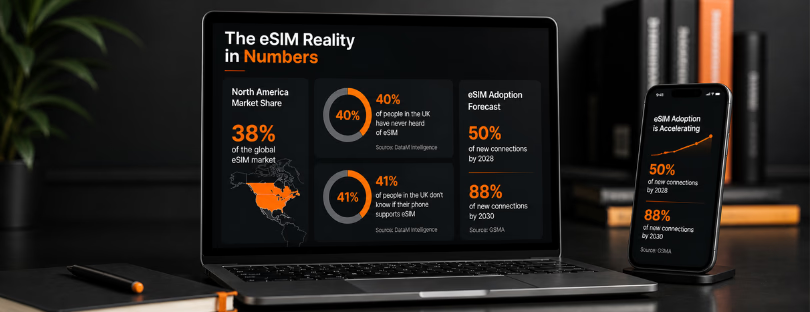
North America holds around 38% of the globaI eSIM market. A UK survey by DataM Intelligence found that 40% of people have never heard of eSIM. Another 41% don’t even know if their phone supports it.
That’s the real barrier.
And yet, the GSMA expects eSIM to reach 50% of new connections by 2028 and up to 88% by 2030.
So the growth will come.
But not because the tech improves.
It will come when people actually understand it and when it shows up at the right moment.
Let’s unpack that.
The tech problem is basically solved
From a pure technology standpoint, eSIM is already where it needs to be.
Standards are mature. Remote provisioning works. Devices support it at scale. Apple pushed it. Samsung followed. Android normalized it. The GSMA ecosystem is aligned.
And yet adoption is… underwhelming.
By the end of 2025, eSIM penetration in smartphones was still only around 5 percent globally, with projections to reach about 10 percent in 2026.
That’s not a technology curve. That’s friction somewhere else.
Even more telling, more than 260 operators have launched eSIM services, but consumer awareness remains below 30 percent in key markets.
So the industry did the hard part. It built the infrastructure.
Users just didn’t follow.
Awareness is the real bottleneck
If you zoom out, this starts to look less like a telecom problem and more like a classic adoption failure.
People don’t switch to something they don’t understand.
And right now, eSIM suffers from a weird positioning issue. It’s marketed as a feature, not a benefit.
Ask a typical traveler what eSIM is, and you’ll often get hesitation. Ask someone who has used it, and you’ll hear something very different. Once people try eSIM, they rarely go back to physical SIMs.
That’s the paradox.
Low awareness, high satisfaction.
Which tells you everything: this is not a product issue. It’s an onboarding and education issue.
And the industry has underestimated how big that gap actually is.
Distribution is still stuck in the old world
Now let’s talk about the bigger problem. Distribution.
Telecom still thinks in telco terms. Stores, operators, SIM swaps, QR codes buried in settings menus.
But eSIM is not a telco-native product anymore. It’s a digital product. And it behaves like one.
People discover travel insurance on Booking.com. They discover flights on Skyscanner. They discover hotels on Airbnb.
But where do they discover connectivity?
That’s the gap.
Right now, most users only discover eSIM in one of three moments:
- When they are already traveling and hit roaming shock
- When someone recommends it
- When they actively search for it
That’s too late in the journey.
By the time a user is searching “eSIM for Italy”, the decision window is already narrow and highly price-driven. The real opportunity sits earlier, when the trip is being planned.
And the industry has largely ignored that.
The onboarding experience still feels “telco.”
Even when users do find eSIM, the experience is not always helpful.
Activation flows can still feel unnecessarily complex. Transferring profiles between devices is often confusing.
For something that is supposed to be “simpler than a SIM card”, that’s a problem.
Compare this with how people expect digital services to work today:
- One click
- Clear pricing
- Immediate value
eSIM often delivers the value, but not always the clarity.
And in consumer tech, clarity is everything.
Why travel became the entry point
There’s a reason travel eSIM exploded first.
It solves a very specific, very painful problem: roaming costs.
That’s why adoption in travel is disproportionately high compared to domestic use. Even in markets like the UK, a significant share of consumers have already used eSIM specifically for travel.
Travel creates urgency. Urgency forces behavior change.
But that also limits perception.
If eSIM is only understood as a “travel hack”, it never becomes infrastructure.
And that’s where the industry is stuck right now.
Your customers will buy connectivity. The question is: from you, or from someone else?
We help airlines, banks, and travel platforms turn that demand into a built-in product — not a missed opportunity.
The shift from product to infrastructure
What’s quietly happening beneath the surface is more interesting.
eSIM is moving from being a consumer product to becoming an invisible layer inside other products.
This is where distribution changes completely.
Because the winning players won’t be the ones with the best plans. They’ll be the ones closest to the user moment.
And that’s not telecom anymore.
That’s platforms.
The missing layer
This is where things get interesting.
If the problem is awareness and distribution, the solution is not another eSIM provider.
It’s a layer that sits between the ecosystem and the user.
A translator.
A filter.
A decision engine.
Right now, the market is fragmented and noisy. Dozens of providers. Similar pricing. Subtle differences most users never fully understand.
That’s the friction.
Users don’t need more choice. They need context.
- What actually matters?
- Which differences are real?
- When should you even use eSIM in the first place?
Those questions are still largely unanswered.
And that’s the gap.
Not another product. Not another plan.
But a way to make sense of it all, at the moment, a decision is being made.
Because in a market where the product is already good enough, the advantage shifts.
Not to the provider.
But to whoever helps users decide.
That’s not traditional media.
It’s distribution through understanding.
And that’s where the real leverage is.

The missed opportunity most players ignore
Here’s what most eSIM providers still underestimate:
They are competing on the wrong battlefield.
Pricing, data packages, coverage. These things matter, but they are not the real differentiator anymore.
The real differentiator is:
- Who controls discovery
- Who controls trust
- Who shows up first
Right now, that’s still fragmented.
But it won’t stay that way.
We’ve seen this pattern before in other industries. Aggregators and platforms eventually capture the decision layer. Providers become an interchangeable infrastructure.
eSIM is heading in the same direction.
Where growth will actually come from
If you look at projections, eSIM adoption will scale massively over time. Up to 76 percent of smartphone connections by 2030.
But the growth won’t come from better technology.
It will come from:
- Better placement inside digital ecosystems
- Simpler explanations of value
- Integration into everyday products
In other words, distribution and education.
Exactly the two areas the industry has underinvested in.
Conclusion: The real battle is not technical
The eSIM industry solved the hard engineering problems years ago.
What it hasn’t solved is how people discover, understand, and trust the product.
And until that changes, adoption will continue to lag behind its potential.
The winners in this space won’t necessarily be the providers with the best networks or the cheapest plans.
They’ll be the ones who:
- Control the narrative
- Own the entry points
- Translate complexity into decisions
This is why platforms matter more than ever.
Because in a market where the product is already good enough, the real advantage comes from helping people understand why it matters and when to use it.
And right now, that layer is still wide open.