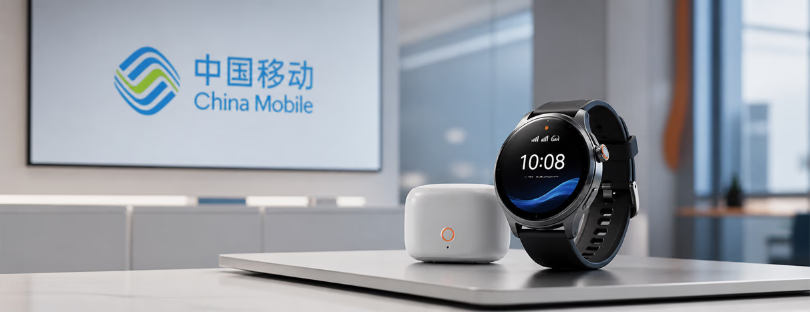
China Mobile is preparing to launch an AI-eSIM product at its “2026 Mobile Cloud Conference,” taking place from May 7 to 9 at the Suzhou Jinji Lake International Conference Center. According to the short announcement, the product can “dispatch cloud-based models in real time,” allowing devices to “think autonomously and respond instantly.” The reported target use cases include AI toys, smart wearables, and other connected terminals.
That sounds futuristic, but the real story is more practical. China Mobile is not just presenting eSIM as a digital replacement for a plastic SIM card. It is positioning eSIM as part of a wider device intelligence layer: connectivity, identity, cloud access and AI response working together.
For the travel eSIM market, this may look distant at first. AI toys and wearables are not the same as a tourist buying 10GB for Japan or Italy. But the direction matters. eSIM is moving beyond “download a plan and get online.” It is becoming part of how intelligent devices are activated, authenticated and connected to cloud services.
Why AI changes the eSIM conversation
Traditional eSIM is easy to understand. A phone, tablet or smartwatch needs mobile connectivity, so an eSIM profile is downloaded remotely. That model has worked well for travel, consumer devices and basic IoT.
AI devices create a more demanding use case. An AI toy may need voice recognition, cloud processing, content filtering, and fast responses. A wearable may need location awareness, translation, health prompts, or assistant-style interaction. In those scenarios, connectivity is not a background utility. It becomes part of the product experience.
This is why China Mobile’s wording matters. The company is not simply saying: Here is an eSIM for a device. It suggests that mobile connectivity can be bundled with access to cloud-based AI models. That fits a broader telecom trend. Operators do not want to be invisible pipes for AI products. They want to sit closer to the intelligence stack.
And honestly, that is where telecom companies still have a strong argument. They control networks, authentication, mobile identity, cloud infrastructure and enterprise relationships. For small AI devices, especially those without screens or complex user interfaces, that combination can be valuable.
Wearables are the obvious test ground
Smart wearables are probably the right starting point. They are personal, mobile and increasingly expected to do more than track steps or show notifications. But many wearables are too small, too power-constrained or too lightweight to run advanced AI locally.
That makes cloud-assisted intelligence attractive. The device can stay simple, while heavier processing happens elsewhere. In that model, the eSIM is not the star of the show, but it is essential. Without reliable mobile identity and connectivity, the experience falls apart.
This is also where China Mobile’s scale matters. A travel eSIM brand can simplify roaming for consumers. China Mobile can potentially work with device makers, cloud platforms, enterprise customers, and network partners at the same time. That gives it a different role in the ecosystem.
Airalo, Holafly, Nomad eSIM, and similar players are primarily addressing the traveller’s data problem. China Mobile’s AI-eSIM concept points to another category: embedded connectivity for intelligent devices.
The risk of another telecom buzzword
There is, of course, a danger here. “AI-eSIM” could become one more shiny telecom label attached to something quite ordinary. The industry has a long history of adding words like smart, cloud, intelligent or AI to products before the user benefit is fully clear.
If it only provides an eSIM profile plus access to cloud AI services, the name may be more marketing than architecture. But if it combines eSIM identity, real-time model dispatch, remote device management, network optimisation and cloud integration, then it becomes much more interesting.
That would make AI-eSIM less of a consumer product and more of an enablement layer for device manufacturers. In other words, the customer may not be the person wearing the smartwatch. The customer may be the company building the smartwatch, toy, tracker or connected terminal.
Conclusion
China Mobile’s AI-eSIM announcement should not be read as a direct threat to travel eSIM providers. It is not trying to replace the simple travel data plan. It is pointing to a different layer of the market, where eSIM becomes part of connected intelligence.
That is the important distinction. Travel eSIM brands have won attention by making roaming easier, cheaper and more app-friendly. Operators like China Mobile are trying to move higher in the stack, closer to AI devices, cloud infrastructure and managed connectivity.
The winners will not be the companies that simply put “AI” in front of eSIM. The winners will be the ones that make intelligent devices work reliably in the real world: fast activation, secure identity, low latency, cloud access, remote control and predictable commercial models.
So yes, the term AI-eSIM needs skepticism. But the direction is real. The next eSIM battleground may not be only the smartphone. It may be every small intelligent device that needs to stay connected without feeling connected.
Driven by wanderlust and a passion for tech, Sandra is the creative force behind Alertify. Love for exploration and discovery is what sparked the idea for Alertify, a product that likely combines Sandra’s technological expertise with the desire to simplify or enhance travel experiences in some way.