Free eSIM on Landing: Transavia’s New Play
There’s a small but telling shift happening in how airlines think about connectivity. It’s no longer just about in-flight Wi-Fi or selling add-ons mid-journey. Increasingly, the focus is on what happens the moment you land.
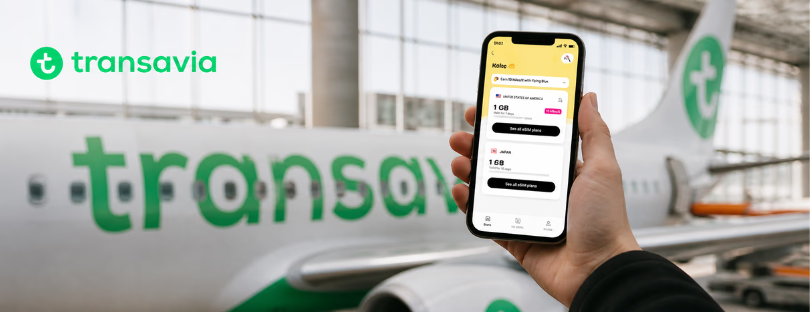
Transavia France is the latest to lean into that idea, announcing a partnership with Kolet that gives passengers two days of mobile data on arrival. It’s a simple proposition on the surface: up to 1GB of free data, valid for 48 hours, automatically available once you reach your destination. After that, users can top up through the Kolet app.
But behind that simplicity sits a much bigger strategic play.
Connectivity starts at touchdown
For years, airlines have treated connectivity as something that happens in the air. But that’s not how passengers experience it. The real moment of need comes right after landing.
You switch off airplane mode and immediately need data. Maps. Ride-hailing. Hotel check-in. Messages to family. It’s not optional anymore.
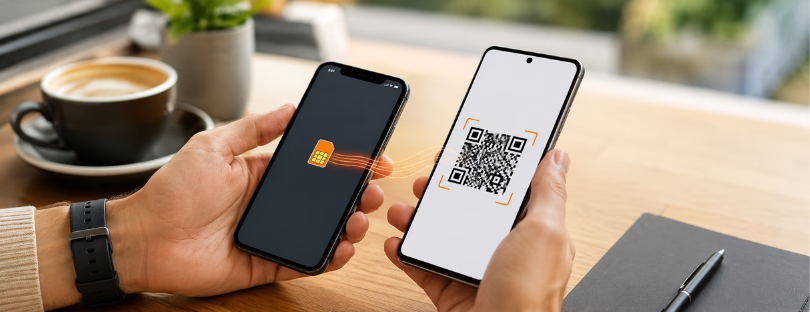
Transavia is clearly leaning into that reality. Instead of pushing passengers to hunt for Wi-Fi or figure out roaming, it removes the friction entirely. Install the eSIM before departure, land, and you’re connected within minutes. No SIM swaps, no queues, no confusion.
Passengers keep their primary number active, which matters more than it sounds. Losing access to your home line, even temporarily, is still one of the quiet frictions of international travel.
The offer itself is modest. 1GB over two days won’t cover heavy usage. But that’s not really the point. This is about bridging the “arrival gap” and then converting users into paying customers through top-ups.

From perk to distribution channel
This is where things get interesting.
For Transavia, the move fits into a broader push to embed useful services directly into the travel journey. As Julien Mallard, deputy managing director, commercial, at Transavia France, puts it:
“We are constantly looking to enhance our passengers’ experience with simple, useful services. Mobile connectivity is now part and parcel of travel, and this partnership with Kolet allows us to meet that need smoothly and immediately.”
It’s not just about improving the passenger experience. It’s about owning another layer of it.
Airlines have already monetised seats, baggage, meals, and increasingly ancillaries like insurance and car rentals. Connectivity is one of the last major untapped layers.
READ MORE: Airlines & eSIMs: The Next Ancillary Revenue Play
For Kolet, the logic is even clearer. This is a textbook B2B2C move. Instead of fighting for attention in a crowded eSIM marketplace, it integrates directly into a high-intent moment, when the need for connectivity is immediate and unavoidable.
Eduardo Ronzano, chief executive of Kolet, frames it like this:
“Data has become an essential part of travel. This is no longer just about comfort but an immediate need on arrival. With Transavia, we want to make this connectivity visible and accessible at the right moment in the journey.”
That “right moment” is everything. Distribution beats product in this space more often than not.
Loyalty, upsell, and subtle lock-in
There’s another layer here that shouldn’t be overlooked: loyalty integration.
Passengers can top up using Flying Blue Miles or earn 10 miles per euro spent. That ties connectivity directly into the airline’s loyalty ecosystem.
It’s a smart move. It nudges users toward repeat usage while framing connectivity as part of the broader travel experience rather than a standalone purchase.
We’ve seen similar experiments before, but they’re becoming more structured now. Connectivity is slowly being repositioned from a utility to a monetisable, loyalty-linked product.
And because the initial data is free, the barrier to entry disappears. Users don’t need to make a decision up front. They’re already inside the ecosystem by the time they realise they need more data.
The bigger push to normalise eSIM
This partnership also reflects a broader industry trend: normalising eSIM as the default for international travel.
Kolet already covers more than 190 destinations and positions itself as a fully digital solution. Activation takes minutes, no physical SIM required. That’s not unique anymore, but what matters is where and how that experience is delivered.
By embedding eSIM into the airline journey, Kolet is effectively bypassing one of the biggest adoption barriers: awareness.
READ MORE: Why Airlines Quietly Love When You Forget to Buy an eSIM Before Your Flight
Most travellers still don’t actively search for eSIMs before a trip. They either rely on roaming or figure things out on arrival. Integrations like this shortcut that behaviour.
The timing also aligns with broader industry signals. GSMA data has consistently shown steady growth in eSIM-compatible devices, while players like Airalo, Nomad eSIM, and Holafly have scaled globally by simplifying onboarding and distribution. What’s changing now is the shift from direct-to-consumer acquisition to embedded partnerships.
Kolet has already tested this model with Philippine Airlines and Axa. Transavia is a more visible European deployment, and likely a sign of what’s coming next.

Where this fits in the wider market
If you zoom out, this move sits at the intersection of two bigger trends.
First, the unbundling and rebundling of travel services. Airlines are no longer just transport providers. They’re becoming platforms that orchestrate multiple parts of the journey.
Second, the shift in telecom from retail products to embedded services. Connectivity is moving closer to infrastructure. It’s something that gets integrated into other experiences rather than sold on its own.
READ MORE: When Airlines Sell eSIMs: Smart Upsell or Just Another Fee?
We’re seeing this across the board. Fintech apps are embedding connectivity. Travel platforms are experimenting with eSIM offers. Even hotels are starting to explore it as part of their digital guest experience.
What Transavia and Kolet are doing is not radically new. But the timing and execution matter. It’s simple, visible, and tied to a real user need.
And that’s often what wins.
What this actually signals
This isn’t just another airline perk. It’s a signal of where the market is heading.
The real competition in eSIM is no longer just about pricing or coverage. It’s about distribution and timing. Who gets to the user first, and in what context?
Airlines, with their direct relationship and high-intent touchpoints, are in a uniquely strong position. They control the journey, the communication channels, and increasingly the ecosystem around it.
Compared to standalone eSIM providers still relying heavily on search traffic and app downloads, embedded models like this have a structural advantage.
But there’s also a limitation. Offers like 1GB for two days are designed as entry points, not full solutions. Heavy users or longer stays will still need alternatives, whether that’s larger plans or subscription-based models from players like Airalo or newer entrants focusing on high-usage segments.
According to Amadeus, around 90% of travellers report some level of stress during their journey. Connectivity is one of the simplest ways to reduce that friction. The companies that remove it earliest in the journey will likely capture the most value.
So the question isn’t whether more airlines will follow. It’s how fast they’ll move, and which partners they’ll choose.
Because once connectivity becomes expected at touchdown, not optional, this stops being a differentiator and becomes a baseline.