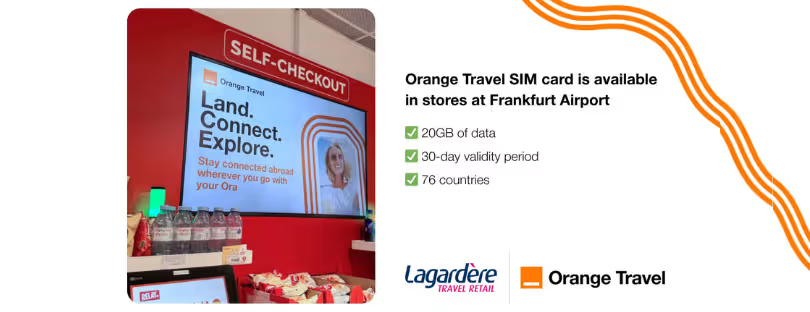
Orange Travel Expands to Frankfurt Airport SIM Stores
There’s something very deliberate about Orange Travel expanding its physical retail presence through Lagardère Travel Retail. On paper, it’s just another distribution deal. In reality, launching at Frankfurt Airport is a calculated play for one of Europe’s busiest international transit hubs, where connectivity decisions are often made in a rush, under pressure, and with very little patience.
And that’s exactly where Orange wants to win.
Instead of fighting purely in the crowded eSIM marketplace online, this move brings the product back into a physical, high-intent environment. You’re already traveling. You already need data. You’re standing in a store. Decision made.
The product itself is simple on purpose
There’s no overcomplication here. The Orange Travel World SIM being offered at Frankfurt Airport is built around a very clear use case: short-term international travel without friction.
What you get
- 20GB of data
- 30-day validity
- Coverage across 76 countries
That positioning matters. It avoids the common trap of trying to be everything at once. This is not a long-term subscription product, not an enterprise solution, and not an “unlimited” marketing exercise. It’s a straightforward travel SIM designed for predictability.
The onboarding is equally stripped back. Insert the SIM after landing, and it connects automatically to a local partner network. No activation gymnastics, no QR codes, no app dependency. For a certain segment of travelers, that simplicity still wins.

Why physical retail still matters
It’s easy to assume eSIM has made airport SIM cards obsolete. It hasn’t. Not even close.
A large share of travelers still fall into one of three categories:
- They don’t know what eSIM is
- They don’t trust it yet
- Or their device doesn’t support it
For these users, airport retail remains the most intuitive moment to solve connectivity. And Lagardère Travel Retail understands that flow better than most. They operate in the exact spaces where decisions happen fast: convenience stores, travel essentials, impulse zones.
What Orange is doing here is embedding itself into that decision moment instead of trying to intercept it earlier online.
There’s also a psychological layer. Buying connectivity at the airport feels “complete.” Passport, boarding pass, SIM card. You’re ready. That still matters more than the industry likes to admit.
A different play from the eSIM-first crowd
If you look at where most competitors are heading, the contrast is clear.
Players like Airalo or Holafly have gone almost entirely digital. Discovery happens through search, comparison sites, or apps. The product is instant, but the journey requires a bit more awareness and confidence from the user.
Orange is taking a hybrid route.
It already has an eSIM offering, but this expansion shows it’s not abandoning physical distribution. Instead, it’s layering it on top of digital channels.
That’s actually closer to how traditional telecom operators think. Multi-channel, not single-channel.
And there’s a subtle advantage here. Airport retail captures last-minute buyers. That’s a segment many digital-first providers miss entirely.
The role of partnerships in scaling globally
The Lagardère partnership is not just about Frankfurt. It’s about a scalable model.
Lagardère Travel Retail operates thousands of outlets across airports and transport hubs worldwide. Once a product like Orange Travel is integrated into that ecosystem, expansion becomes operational rather than strategic. You replicate the same model across locations.
This is how distribution networks quietly become competitive advantages.
Instead of spending heavily on digital acquisition in every market, Orange can leverage physical presence in high-traffic nodes. Airports become both retail points and brand touchpoints.
It’s a slower burn than pure digital growth, but arguably more durable.
Where does this fit in the broader connectivity shift?
The timing is interesting. The travel connectivity market is in a transitional phase.
eSIM adoption is accelerating, driven by device compatibility and better user education. At the same time, traditional roaming is still widely used, especially among less price-sensitive travelers.
According to recent insights from organizations like the GSMA and market analysts such as Counterpoint Research, the next phase is not about one model replacing another. It’s about coexistence.
Physical SIM, eSIM, roaming bundles, and enterprise connectivity platforms. They all serve different moments and user profiles.
Orange’s move fits neatly into that reality. It doesn’t try to force behavior change. It meets travelers where they are.
What travelers actually experience
From a user perspective, this kind of offer solves a very specific pain point.
You land in a new country, turn on your phone, and expect it to work. No searching for Wi-Fi, no dealing with captive portals, no worrying about roaming charges.
That expectation has become standard.
The difference is how you get there. For some, it’s downloading an eSIM before departure. For others, it’s picking up a SIM at the airport.
Orange is betting that the second group is still large enough to matter.
Not just distribution, but positioning
This expansion is less about selling SIM cards at an airport and more about how Orange positions itself in a fragmented market.
While many competitors are racing toward fully digital, app-based models, Orange is reinforcing a hybrid approach that blends physical presence with global coverage. It’s not as flashy, but it’s pragmatic.
Compared to pure eSIM players, this strategy captures a different slice of demand. Less tech-savvy users, last-minute buyers, and travelers who simply prefer something tangible. Compared to traditional roaming, it offers a clearer, more predictable alternative.
The broader trend is clear. Connectivity is becoming part of the travel infrastructure itself, not an afterthought. Airports, airlines, and travel retailers are increasingly involved in how that connectivity is delivered.
Orange’s partnership with Lagardère is a step in that direction. It brings connectivity closer to the starting point of the journey, where decisions are made quickly, and expectations are high.
It may not redefine the market overnight. But it quietly strengthens Orange’s position in a space where distribution, trust, and timing matter just as much as price or technology.