Albania Tourism Boom: Can Growth Last Beyond Summer?
Albania’s tourism boom has moved from surprise story to stress test.
A new intelligence report, The State of Albania Travel 2026 by Dental Tourism Albania, puts hard numbers behind what many travellers already noticed on TikTok, in airport queues and across the Albanian Riviera: the country is no longer “emerging” in the gentle sense of the word. It is busy. Very busy.
According to INSTAT-based figures cited in the report, Albania reached 12.47 million foreign visitors in 2025, up from 3.67 million in 2014. That is a 3.4 times expansion in eleven years. Tirana International Airport has become the clearest physical symbol of that shift, handling around 11.6 million passengers in 2025, compared with roughly 1 million in the disrupted year of 2020.
From hidden coast to crowded calendar
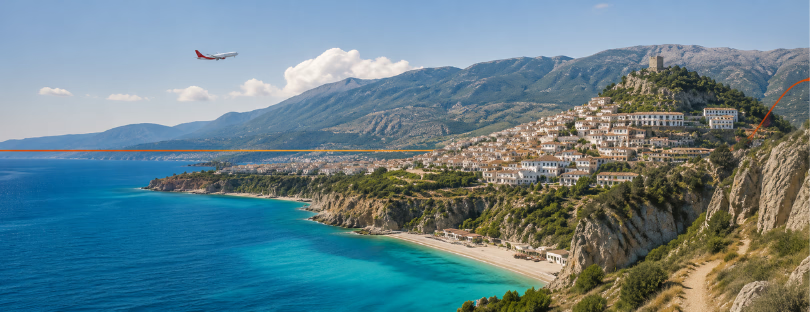
Albania’s appeal is easy to understand. The beaches are still cheaper than much of Croatia, Greece or Italy. The landscape jumps from the Ionian coastline to Ottoman towns to mountain valleys in a few hours. And, crucially, low-cost airlines have made the country dramatically easier to reach.
Wizz Air, Ryanair, easyJet, Lufthansa and ITA Airways have all helped pull Albania into Europe’s short-break map. Once that happens, discovery accelerates quickly. One Instagram reel becomes a flight search. One cheap fare becomes a long weekend. One “underrated Europe” list becomes 500,000 extra visitors.
But the report makes a sharper point than “Albania is growing.” Albania may have already solved the demand problem. The next issue is whether the destination can absorb that demand without flattening the character that made it attractive.
The seasonality problem
The most important number in the report may not be 12.47 million. It may be 75 to 80 percent.
That is the estimated share of tourist stays concentrated between June and September, with July and August alone absorbing a huge slice of annual demand. This is where Albania starts to look less like a tourism miracle and more like a Mediterranean case study.
Croatia has spent years trying to push visitors beyond Dubrovnik and the summer coast. Greece is leaning into shoulder-season city breaks, islands outside peak months and cultural tourism. Montenegro has faced similar pressure, where coastal growth is strong but inland tourism still has to work harder for attention. Albania is now entering the same club, only faster.
The quote from the report captures it well:
“Albania has solved the demand problem. The next decade is about solving the calendar – turning a four-month beach season into a twelve-month destination that still feels undiscovered when you arrive in October.”
That sentence matters because it shifts the tourism conversation from volume to management.
Growth is not the whole story
The old tourism playbook was simple: more flights, more hotels, more arrivals. Albania followed it well. International hotel brands including Marriott, Hilton, Melia, Radisson and Hyatt have moved into or around the market. Airport capacity is expanding. The Riviera has become a serious investment story.
But 2030 will not be won by counting arrivals alone.
READ MORE: RosCar.al – the best car rental service in Albania
WTTC has already highlighted the growing weight of travel and tourism in Albania’s economy, with the sector contributing more than a fifth of GDP when wider effects are included. The national strategy points toward €6 to €7 billion in annual tourism revenue, more than 70,000 new direct jobs and a tourism share of GDP around 25 to 26 percent by 2030.
Those are ambitious targets. They are also a warning. When tourism becomes that important to the economy, weak planning becomes expensive. Overcrowded beaches, seasonal jobs, strained infrastructure and price inflation can turn a hot destination into a fragile one.
The bigger opportunity
The good news is that Albania has more than beaches.
Berat and Gjirokaster give the country a cultural depth that many first-time visitors still miss. Butrint connects Albania to ancient Mediterranean history. Theth and Valbona can support a stronger adventure travel story. Tirana itself is becoming a genuine city-break destination, not just an airport stop before the coast.
READ MORE: Albania Goes Roam Like at Home With EU in 2026
Then there is the diaspora. With large Albanian communities across Italy, Greece, Germany, Switzerland and the UK, Albania has a natural year-round audience if it can package family visits, business travel, medical tourism, cultural events and short breaks more intelligently.
This is where Albania could separate itself from destinations that simply became crowded and expensive. The country still has room to design the next phase rather than just react to it.
Conclusion
Albania is not the Mediterranean’s secret anymore, and pretending otherwise is lazy travel marketing. The smarter story is that Albania has reached the point every successful destination eventually faces: growth is no longer the trophy, it is the pressure test.
Compared with Croatia, Greece or Montenegro, Albania’s advantage is speed. Its risk is also speed. If the country keeps treating summer arrivals as the main scoreboard, it could burn through its “undiscovered” appeal quickly. But if it uses this moment to build a stronger October, a better March, a real inland itinerary and a more balanced aviation calendar, Albania could become something more durable than Europe’s latest beach crush.
The next chapter is not about whether travellers will come. They already are. The real question is whether Albania can make tourism feel less like a seasonal rush and more like a national system that works all year.