Truecaller launches travel eSIM across 29 countries
Truecaller is moving into travel eSIMs, and the interesting part is not simply that another brand has entered the crowded eSIM market. The interesting part is who is entering.
The Stockholm-based company, best known for caller ID, spam protection and contact verification, has launched a travel eSIM product across 29 purchase markets. It is the company’s first move into mobile data services, and in many ways, a logical extension of what Truecaller already sells: trust, convenience and control over the mobile experience.
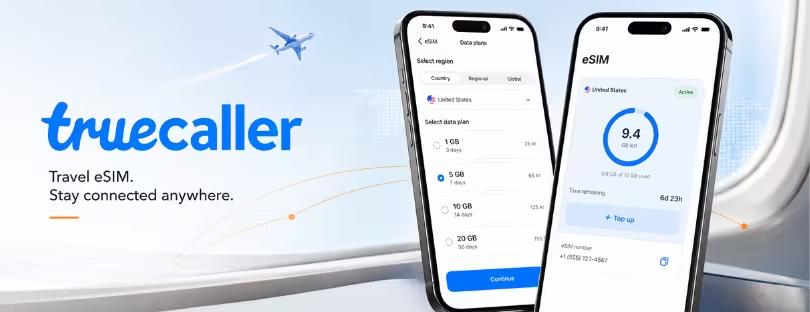
At launch, Travel eSIM is available through the Truecaller iPhone app and on the web at Truecaller.com, with web access opening the product to compatible Android devices from day one. The plans range from 1 GB over 7 days to 20 GB over 30 days, and Truecaller says coverage works globally, allowing users to buy before departure and stay connected while travelling. The company also says the product is available to purchase in 29 markets, including the US, UK, Germany, France, Italy, Spain, Sweden, Australia, Canada, Malaysia, South Africa and Nigeria.
That makes this more than a travel add-on. Truecaller is testing whether its huge communications audience can also become a buyer base for digital connectivity.
Why Truecaller matters here
Truecaller recently passed 500 million monthly active users, with more than 150 million outside India, according to the company’s own announcement. That kind of scale changes the eSIM conversation.
Most travel eSIM brands still need to acquire customers trip by trip. They fight on Google search, app store rankings, influencer campaigns, affiliate pages and price comparison tables. Truecaller already sits on millions of phones as a trusted utility. It does not need to explain what mobile convenience means. Its users already open the app because something about their phone experience feels uncertain, noisy or risky.
There is another important layer here: Truecaller is not building the entire telecom stack alone. TechCrunch reports that the company is working with global cellular connectivity provider Telna and telecom software provider Telness Tech to operate the eSIM platform. That makes the move feel less like Truecaller suddenly becoming a telecom operator, and more like a classic embedded-connectivity play: Truecaller brings the brand, user relationship and distribution, while specialist partners support the connectivity and platform layer underneath.
Travel connectivity fits neatly into that emotional space. Nobody wants to land abroad and wonder whether roaming is active, whether the hotel Wi-Fi is safe, or whether a taxi app will load before the airport queue disappears. Truecaller bets that a trusted mobile identity app can also become a trusted mobile data seller.
Fredrik Kjell, COO at Truecaller, framed the launch exactly in that direction:
“I am delighted that Truecaller is launching an eSIM travel data product for our users. Truecaller is a trusted communications brand worldwide, and with our scale, we can offer a great product at a competitive price. We are rolling this out on our iPhone app and the web channel, and look forward to expanding on our Android app and adding support for additional markets. Today marks the first step in offering adjacent communication products to our massive user base.”
The last sentence is the one to watch. “Adjacent communication products” suggests this is not necessarily a one-off travel experiment. It may be the start of Truecaller treating connectivity as part of a broader communications stack.
The market is ready, but crowded
Travel eSIM is one of the fastest-moving parts of consumer telecom. Juniper Research estimated global travel eSIM revenue at $1.8 billion in 2025, with forecasts reaching $8.7 billion by 2030. The same research points to strong growth as travellers look for alternatives to traditional roaming charges.
GSMA Intelligence has also highlighted the acceleration of consumer eSIM adoption, with global eSIM smartphone penetration expected to double in 2026 and continue growing strongly into 2027. In plain English: more phones support eSIM, more users understand it, and travel remains one of the easiest reasons to try it.
But this is no longer an empty field. Airalo built early brand recognition around simple travel eSIM discovery. Holafly pushed the unlimited-data angle. Ubigi leans on Transatel’s telecom infrastructure and has strong credibility in connected cars and business travel. Yesim has expanded into both consumer packages and B2B API distribution. Saily entered with the Nord Security trust halo. Even mobile operators are preparing or expanding their own travel eSIM plays to defend roaming revenue.
So Truecaller is not entering a niche. It is entering a market where distribution, trust and timing matter as much as coverage.
Distribution is the real product
The strongest part of Truecaller’s move is not the plan range. A 1 GB to 20 GB portfolio is useful, but not unusual. The stronger asset is placement.
Truecaller can meet users inside an app they already understand. That matters because travel eSIM adoption still has friction: device compatibility, installation steps, QR codes, data-only confusion, plan validity, country coverage and the classic “will this actually work when I land?” question.
Brands that already own mobile trust have an advantage. This is why banks, airlines, booking platforms, security apps and fintechs are increasingly interested in the eSIM market. They do not need to become telecom operators in the traditional sense. They need to package connectivity at the right moment, with enough credibility that the user does not hesitate.
Truecaller’s launch fits that exact shift. Connectivity is moving from a standalone product to an embedded digital consumable. The user may not search for “best travel eSIM.” They may simply buy data from the app they already trust before boarding.
Conclusion about Truecaller travel eSIM
Truecaller’s travel eSIM launch is not a revolution by itself, but it is a very clear signal of where the market is going.
The next phase of travel eSIM will not only be won by providers with the cheapest gigabytes. It will be won by brands that already control user attention before the trip, during the trip, or at the moment of mobile anxiety. Airalo and Holafly proved there was demand. Ubigi and Yesim show that infrastructure and distribution depth matter. Saily shows how trust from another digital category can be transferred into connectivity. Truecaller now brings the same idea from communications.
That is what makes this launch worth watching. Truecaller is not just selling data. It is testing whether mobile trust can become a gateway into global connectivity. And if it works, expect many more non-telecom brands to ask the same question: why let roaming be the operator’s business only?