Telna and the eSIM Infrastructure Behind Travel Apps
Most travellers do not wake up thinking about wholesale eSIM infrastructure. They think about one thing: “Will my phone work when I land?”
That small expectation is now reshaping a surprisingly big part of the telecom market. And Telna sits right in the middle of it.
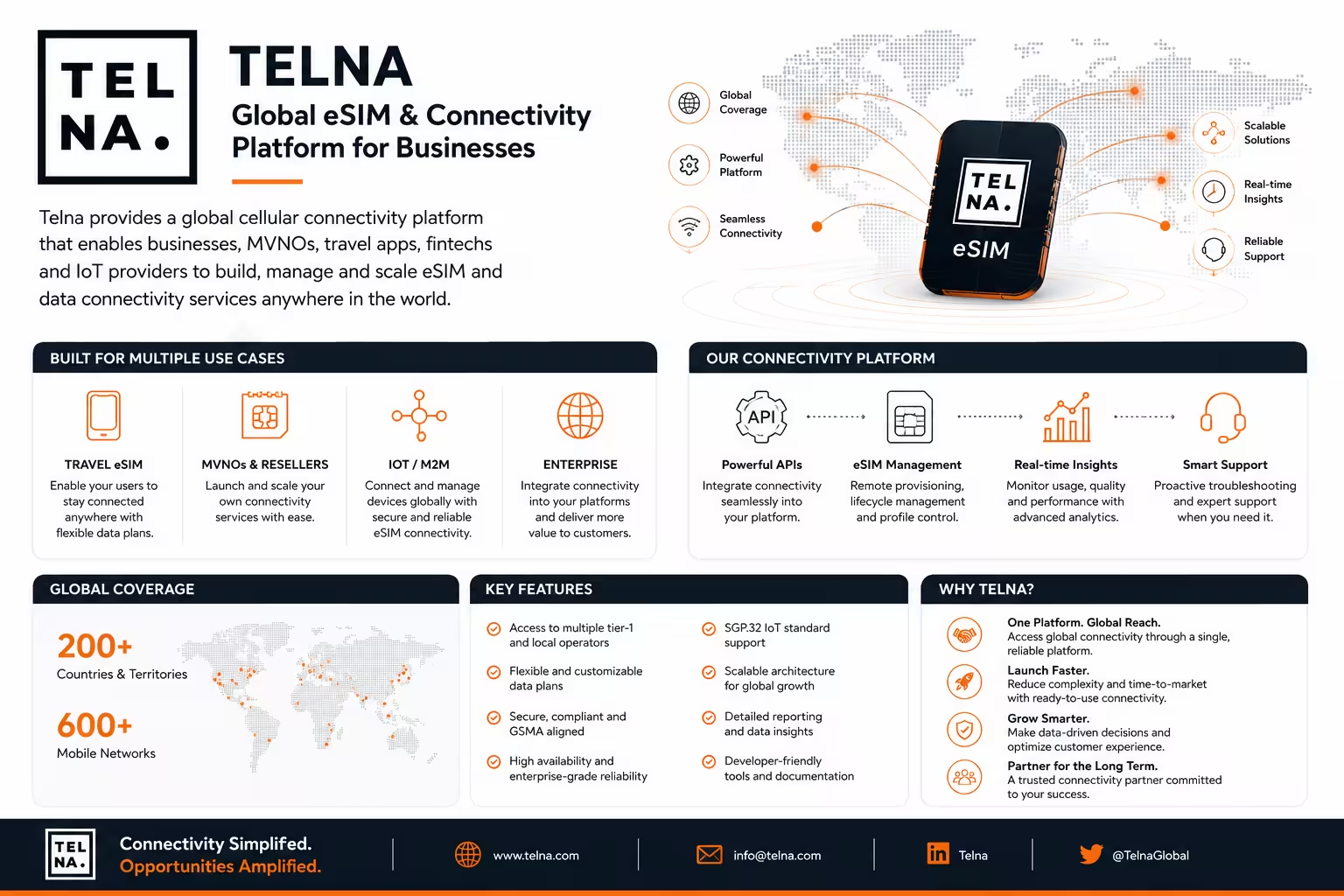
Telna is not a classic consumer eSIM brand trying to win Instagram ads with “Japan 5GB from €X” or “Europe unlimited data.” It is closer to the machinery behind those experiences. The company positions itself as a global cellular connectivity provider for businesses that want to build, distribute, manage, and monetize eSIM and data connectivity without stitching together dozens of operator deals by themselves. Its website talks openly about APIs, custom data packages, eSIM distribution, real-time troubleshooting, usage insights, and network analytics. That tells you a lot about where Telna wants to play: not only in selling connectivity, but in making connectivity programmable.
And that is exactly where the eSIM market is heading.
The eSIM story is moving upstream
For years, most travel eSIM coverage focused on consumer brands. Airalo, Holafly, Nomad, Ubigi, Yesim, GigSky, Saily and others became the visible layer. The user picked a country, paid a few euros, scanned a QR code, and avoided a nasty roaming bill.
Simple story. Easy to understand.
But underneath that story, the market has become much more complicated. Someone has to source coverage. Someone has to manage profiles. Someone has to handle activation failures, routing, network quality, roaming agreements, data package design, troubleshooting, billing, API integration, and usage visibility. When an eSIM does not activate in Mexico City or a traveller gets poor speeds in Dubai, the consumer usually blames the brand they bought from. But the problem may be buried much deeper in the connectivity stack.
READ MORE: eSIM Users Are Switching Providers Twice as Fast
This is why companies like Telna matter. They are part of the less glamorous but increasingly strategic wholesale and enablement layer. Telna describes its Connectivity Hub Platform as an end-to-end connectivity service for IoT/M2M, MVNOs, and eSIM. In one case study, the company says its platform integrates with multiple tier-one carriers across geographies, allowing clients to offer global coverage without managing individual network relationships themselves.
That is not a small detail. It is the difference between “we sell eSIMs” and “we can run a scalable connectivity business.”
APIs are becoming the new storefront
The interesting thing about Telna is not simply that it supports eSIM. Many companies do. The stronger point is that Telna seems built for businesses that want to embed eSIM into another product.
That could be an MVNO. A travel app. A fintech. A mobility platform. An IoT company. Even a brand that does not want to “become telecom,” but wants connectivity to sit naturally inside its customer experience.
This is where APIs become more than a technical feature. They become a distribution strategy. If a company can use Telna’s API to design packages, distribute eSIMs, check usage, troubleshoot in real time, and manage analytics, then connectivity becomes something that can be added to other services. Not as a clunky add-on, but as part of the product flow.
READ MORE: eSIM Go Investment Signals B2B eSIM Shift
That is the shift Alertify readers should watch carefully. Travel eSIM is no longer only about standalone apps fighting for Google rankings. It is also about who can put connectivity inside banking apps, airline apps, booking platforms, business travel tools, car rental flows, and enterprise mobility dashboards.
Telna itself has publicly framed travel eSIM as something being embedded by MVNOs, travel apps and fintech platforms, which fits the broader market direction we are seeing across the sector.
Not just travel, but IoT too
Telna’s eSIM story also overlaps heavily with IoT, and that gives it a different profile from many consumer-first eSIM providers.
In travel eSIM, the device is usually a smartphone, the usage window is short, and the customer expects an instant experience. In IoT, the stakes are different. Devices may be deployed across countries for years. They may sit inside vehicles, payment terminals, industrial equipment, logistics assets, or remote monitoring systems. Nobody wants to physically swap SIMs in thousands of devices because a network contract has changed.
READ MORE: Why Two eSIMs on One Network Feel Different?
That is where eSIM and remote SIM provisioning become genuinely powerful. Telna has written about SGP.32, the GSMA specification designed for IoT devices that may be constrained by network access or user interface limitations. Telna notes that the standard was published in May 2023 and is designed to make remote provisioning more suitable for IoT environments.
This matters because the eSIM conversation is often too consumer-heavy. Yes, travel eSIM is visible. Yes, the roaming alternative narrative is easy to sell. But some of the most durable value may come from enterprise and IoT use cases where eSIM reduces operational friction, not just roaming costs.
Where Telna fits in the market
Telna should not be compared only with consumer eSIM brands. That would miss the point.
A better comparison is with infrastructure and enablement players. Think 1GLOBAL, BICS, iBASIS, Transatel, Gigs, eSIM Go, Thales, Kigen, Valid, and other companies operating somewhere across connectivity, provisioning, orchestration, wholesale access, APIs, and embedded telecom. Each has a different center of gravity.
Gigs is strong in embedded mobile subscriptions and telecom-as-a-service for digital brands. 1GLOBAL combines global connectivity with a deeper core network and enterprise capabilities. BICS and iBASIS come from a carrier services and international connectivity background. Transatel has strong MVNO and IoT roots, with Ubigi as its visible consumer-facing eSIM brand. Kigen and Valid are more associated with eSIM enablement, secure provisioning and RSP infrastructure.
READ MORE: eSIM Orchestration Rankings 2026: Amdocs and Valid Lead
Telna appears to sit in a practical middle ground: global cellular connectivity, eSIM enablement, MVNO support, IoT connectivity, API-driven distribution, and management tools. That can be a useful position, especially for companies that want global eSIM capability without building a telecom stack from scratch.
But it also means Telna operates in a crowded and technically demanding market. The winners here will not be decided by who says “global coverage” the loudest. Almost everyone says that now. The real questions are more specific: How good is the routing? How reliable is activation? How much control does the customer have? Can usage be monitored properly? Are network issues visible fast enough? Can packages be customized commercially? Can the platform support both consumer-style speed and enterprise-style governance?
Those are the questions that separate serious infrastructure from nice-looking dashboards.
eSIM is becoming a product layer
The bigger trend is clear: eSIM is becoming a product layer, not just a telecom feature.
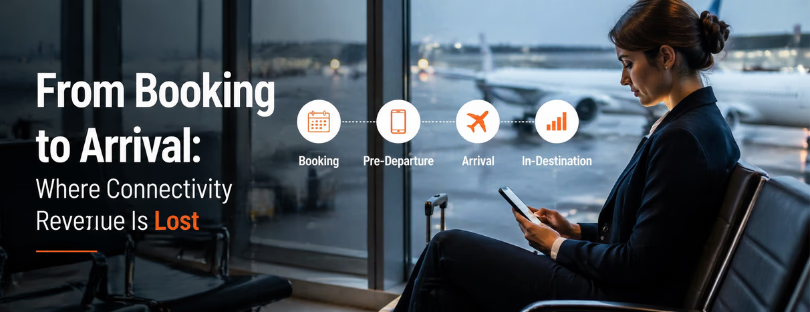
For travellers, that means connectivity will increasingly appear at the point of need. During booking. At airport check-in. Inside a banking app. In a business travel platform. In a hotel loyalty app. Maybe even preloaded into devices or bundled with premium services.
For businesses, it means connectivity can become a revenue stream, a retention tool, or an operational control layer. But only if the infrastructure underneath is solid.
That is why Telna’s role is worth watching. It is not trying to win the consumer conversation with a flashy eSIM storefront. It is working in the background where the harder commercial and technical decisions sit: network access, APIs, lifecycle management, analytics, troubleshooting, and scalable distribution.
The real takeaway
Telna represents where the eSIM market is quietly going next.
The first wave of travel eSIM was about visibility. Brands competed on destination pages, price tables, app design, and “avoid roaming fees” messaging. That market is still growing, but it is also becoming crowded and very easy to copy.
The next wave is about infrastructure, control, and embedded distribution. Who can help a fintech launch eSIM? Who can help an MVNO move faster? Who can support IoT deployments without creating a maintenance nightmare? Who can make eSIM feel invisible for the end user, while giving the business enough visibility behind the scenes?
Telna is one of the companies trying to answer that question from the platform side. And in many ways, that is where the more interesting eSIM story now lives. Not in another “best eSIM for Italy” comparison, but in the systems that decide whether global connectivity can actually scale.