Community Fibre Launches Unlimited UK Mobile eSIM
Community Fibre is moving beyond broadband with a new unlimited UK mobile eSIM, and the interesting part is not only the price. It is the model.
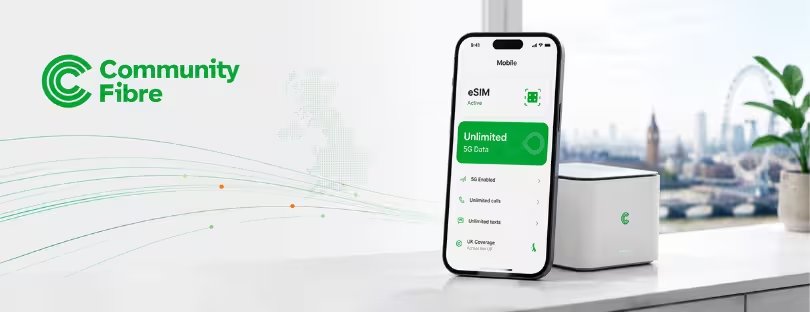
The London-based full fibre provider plans to launch the service in June, offering unlimited UK data, calls and SMS for £15 per month to existing broadband customers and £17 per month to non-broadband customers. The product has been developed with Gamma Communications and app developer Zappter, and will be available through the Community Fibre mobile app on iOS and Android. Customers will also be able to use the plan for hotspotting and tethering on compatible devices.
On paper, this is a mobile eSIM launch. In reality, it is another sign that the borders between broadband, mobile, travel connectivity and digital telecom services are getting thinner.
For Community Fibre, the pitch is simple: if it already owns the home broadband relationship, why stop there?
The price story
The UK mobile market has not exactly felt simple for consumers. SIM-only deals are everywhere, but so are confusing contract terms, roaming rules, “unlimited” conditions and mid-contract price increases. That is why Community Fibre’s price point stands out.
Unlimited mobile for £15 a month, when attached to broadband, is aggressive. It is not being positioned as a premium mobile lifestyle product. It is being positioned as practical connectivity, layered on top of an existing broadband relationship.
READ MORE: Nomad Launches UK eSIM with Unlimited 5G and Local Number
Graeme Oxby, chief executive officer of Community Fibre, framed it directly:
“The mobile market has become increasingly expensive and complicated for consumers, despite the technology becoming simpler and more digital. With our growth in mobile, we’re taking a different approach — delivering fast, unlimited 5G connectivity at a highly competitive price, with the flexibility customers increasingly expect.
“Because we build, own and operate our full fibre broadband network, we’ve created a model that allows us to offer better long-term value across both broadband and mobile. This launch is another step in delivering the highest-quality and most affordable services for our customers.”
That quote captures the bigger shift. Consumers are not asking for more telecom complexity. They want fewer moving parts. Broadband at home. Mobile outside. Travel data when needed. No long-term drama.
A leaner telecom model
Community Fibre’s advantage is not that it suddenly became a traditional mobile network operator. It did not. The advantage is that it already owns and operates its own full fibre broadband network, and that gives it a base from which to bundle more connectivity services.
The company says its network now passes 1.4 million homes and more than 185,000 businesses within 200 metres of its infrastructure. Its customer base has reached around 450,000, with continued year-on-year growth.
The financial backdrop is also strong. In 2025, Community Fibre increased revenue by 48 per cent to £113 million, while adjusted EBITDA rose 530 per cent to £50 million. The company also reached operational cash flow breakeven in Q1 2026 and is now planning an additional investment programme to expand its network beyond two million homes and businesses by 2028 to 2029.
READ MORE: Community Fibre launches international data roaming eSIM from as little as £2.29
That matters because a broadband provider adding mobile without the cost structure of a legacy mobile operator can move differently. It can use partners for mobile enablement, keep the experience app-based, and use broadband customers as the first distribution channel.
This is part of a wider market pattern. Fibre providers and alternative networks are looking at mobile because fixed connectivity alone is not always enough to defend customer relationships. Bundles increase stickiness. Mobile increases relevance. eSIM lowers the friction.
Olaf Swantee, Community Fibre chairman, said:
“This launch reflects the strength of the business we’ve built — combining infrastructure ownership, innovation and operational efficiency to deliver better value for customers in both broadband and mobile.”
That is the strategic message. Own the infrastructure where it counts, partner where it makes sense, and package the result more simply for customers.
Your customers will buy connectivity. The question is: from you, or from someone else?
We help airlines, banks, and travel platforms turn that demand into a built-in product — not a missed opportunity.
The competitive signal
Community Fibre’s move creates pressure on larger UK players. BT/EE, Virgin Media O2, VodafoneThree and Sky already understand the power of bundles. What is different here is that a smaller, infrastructure-led challenger is using eSIM and app-based delivery to compete on simplicity and price.
READ MORE: UK eSIM Adoption Surges as Travel eSIM Goes Mainstream
That does not mean Community Fibre will suddenly become a mobile giant. But it does show how telecom competition is changing. The old model was about owning every layer. The newer model is about controlling the customer relationship and assembling the right connectivity stack around it.
This is also relevant for the travel eSIM industry. As eSIM becomes a feature inside broadband apps, banking apps, airline apps, hotel journeys and enterprise tools, standalone providers will need stronger differentiation. Price and coverage alone will not be enough forever.
Travel eSIMs complete the picture
Community Fibre’s mobile offer also includes a travel eSIM with country-specific roaming bundles and prepaid roaming data plans for more than 160 countries. This part should not be treated as a footnote.
It shows how travel connectivity is being folded into mainstream telecom propositions. A customer can have fibre at home, unlimited UK mobile data, and international data when needed, all connected to the same brand relationship.
That is exactly where the market is moving.
Travel eSIM providers such as Airalo, Holafly, Nomad eSIM, Ubigi, Yesim and GigSky have already trained consumers to expect instant digital connectivity abroad. Meanwhile, broadband and mobile operators are trying to keep that value inside their own ecosystem.
Community Fibre’s approach sits somewhere in the middle. It is not trying to become a global travel eSIM marketplace. It is using travel eSIM as a useful extension of its connectivity offer.
That makes sense. The future is not “home broadband” versus “mobile” versus “roaming alternative.” For consumers, it is one practical question: can I stay connected without overpaying or overthinking it?
Conclusion
Community Fibre’s unlimited mobile eSIM is not revolutionary in isolation. Unlimited plans already exist. eSIM activation is no longer exotic. Travel eSIMs are now familiar to frequent travellers.
But the combination is what matters.
Community Fibre is showing how the next phase of telecom may be built around stitched-together connectivity: fibre at home, mobile in the UK, travel data abroad. Not as three separate purchases, but as one cleaner customer experience.
For established operators, this is a warning. Smaller challengers can use digital delivery, sharper pricing and focused partnerships to look far less complicated than legacy telecom brands. For travel eSIM providers, it is another sign that distribution is moving closer to the customer’s existing apps and services.
The winner will not always be the company with the loudest “unlimited” claim. It will be the one that makes connectivity feel boringly easy. That is what consumers actually want.
Sandra Dragosavac
Driven by wanderlust and a passion for tech, Sandra is the creative force behind Alertify. Love for exploration and discovery is what sparked the idea for Alertify, a product that likely combines Sandra’s technological expertise with the desire to simplify or enhance travel experiences in some way.