Best Cities for Museums and Galleries in 2026
Cultural city breaks are not getting quieter in 2026. They are becoming more deliberate. best cities for museums and galleries 2026
Travellers still book weekends around food, shopping, football, nightlife and cheap flights. But culture remains one of the strongest reasons to choose one city over another, especially in Europe, where museums and galleries are often the trip.
A new Time Out ranking, based on the views of more than 24,000 city residents worldwide, puts that into perspective. Paris has been named the world’s best city for museums, while London leads for art galleries. The result is not shocking, but it is useful. The cities winning in culture are not only the ones with the biggest collections. They are the ones where culture feels visible, accessible and alive outside the museum door too.
For travellers planning 2026 city breaks, the ranking confirms something many already sense: Europe still dominates the cultural travel map.
Museums still move travellers
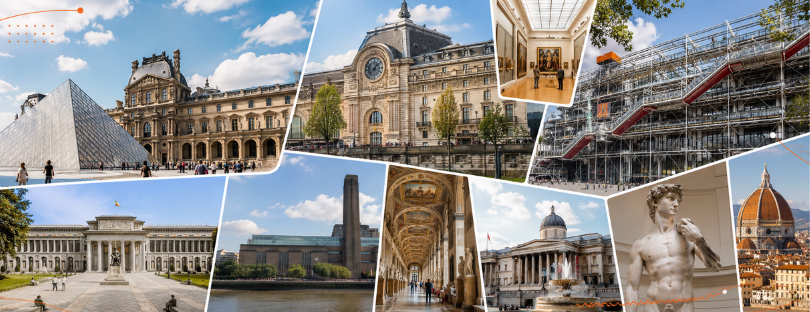
Paris takes first place for museums, with a 97% approval rating from residents surveyed by Time Out. The Louvre remains the obvious global magnet, but the city’s strength is broader than one institution. The Musée d’Orsay, Centre Pompidou and smaller specialist museums reward repeat visits.
Madrid follows in second place with 90%, helped by the Prado, Reina Sofía and Thyssen-Bornemisza. London comes third on 88%, while New York and Chicago complete the top five.
READ MORE:
The full top 10 for museums in 2026 is Paris, Madrid, London, New York, Chicago, Florence, Prague, Budapest, Vienna and Lisbon.
What stands out is how practical these cities are. You can build a three-day itinerary around major museums without making every visit feel like a once-in-a-lifetime event.
Galleries tell a different story
The art gallery ranking has a slightly different energy. London takes first place with 81%, ahead of Paris and New York, both on 68%. Florence ranks fourth with 63%, followed by Madrid and Edinburgh on 61%. Rome and Melbourne share seventh place on 60%, with Prague and Washington DC completing the top 10.
READ MORE: The Art Lover’s Guide for French Museums and Galleries
London’s lead makes sense. Tate Modern and the National Gallery give the city global weight, but its real advantage is range. Blue-chip galleries, independent spaces, temporary shows and neighbourhood art scenes all sit within the same ecosystem. London is not only a place to see famous art. It is a place to follow what is happening now.
Florence’s position is interesting. It shows that a city associated with Renaissance art can still compete in a ranking shaped by contemporary cultural habits.
Italy’s cultural advantage
Italy performs strongly because it offers something many cultural travellers still want: density. Rome and Florence are not cities where art is isolated inside institutions. It is built into streets, churches, courtyards and public squares.
Florence’s sixth place for museums and fourth place for galleries underlines its unusual position. The Uffizi and Galleria dell’Accademia remain central, but the city’s 2026 calendar also gives travellers a fresh reason to look again. Palazzo Strozzi is hosting Rothko in Florence from 14 March to 23 August 2026, a major exhibition that reminds visitors that Florence is not frozen in the Renaissance.
READ MORE: 10 Must-Visit Museums in Italy | The Ultimate Guide
Rome’s gallery ranking also feels timely. The city has always had the historic advantage, but its contemporary scene is becoming easier for visitors to read. MACRO’s 2026 programme includes Hito Steyerl. Mechanical Kurds, while the Galleria d’Arte Moderna is marking its centenary with GAM 100. Chiostro del Bramante is also extending its nature-focused exhibition language with Flowers. Wonderful Nature in 2026.
Rome is not trying to compete with London as a contemporary art machine. Its appeal is different: old city, living programme, layered experience.
Choose by travel style
The ranking is useful, but travellers should not treat it like a universal answer. Paris is the strongest choice if museums are the centre of the trip. London is better for gallery-hopping and cultural variety. Madrid is excellent for major museums without the same level of tourist theatre. Florence works for a compact, art-heavy itinerary. Rome suits travellers who want culture mixed with walking, architecture, food and atmosphere.
These trips are not for everyone. If your ideal city break is beaches, wellness hotels or nightlife-first travel, a museum-led itinerary can start to feel like homework. And even for culture lovers, the ranking could be improved with more detail on affordability, crowding, accessibility and how easy it is to book tickets.
For alternatives, Berlin, Vienna, Lisbon, Copenhagen and Prague deserve attention because they offer strong cultural value without always feeling as obvious as Paris or London.
Culture is becoming the real city premium
The bigger story is that cultural travel in 2026 is less about ticking off famous museums and more about choosing cities with a strong creative rhythm. Time Out’s ranking captures part of that, but the market trend is wider. Travellers want exhibitions worth planning around, neighbourhoods worth walking through and cultural experiences connected to the city rather than packaged for tourists.
That is why Paris and London still lead, but also why Florence, Rome, Madrid and Edinburgh matter. They show that the future of cultural tourism is not only in mega-museums. It is in cities that can turn heritage into a living reason to visit now.
For Alertify readers, the takeaway is simple: the best cultural trips in 2026 will not be the ones with the longest museum list. They will be the ones where the city itself becomes part of the exhibition.