Transatel’s Quiet Power in Global eSIM Connectivity
Transatel is one of those companies that makes much more sense once you stop looking at the eSIM market only through consumer apps.
Yes, travellers may know its consumer-facing brand Ubigi. And yes, Ubigi is visible in travel eSIM, connected car data plans and international mobile connectivity. But Transatel itself is playing a deeper game. It is not simply trying to sell a few gigabytes to someone landing in Tokyo or New York. It is building and managing cellular connectivity for IoT devices, MVNOs, enterprises, car manufacturers and global digital services.
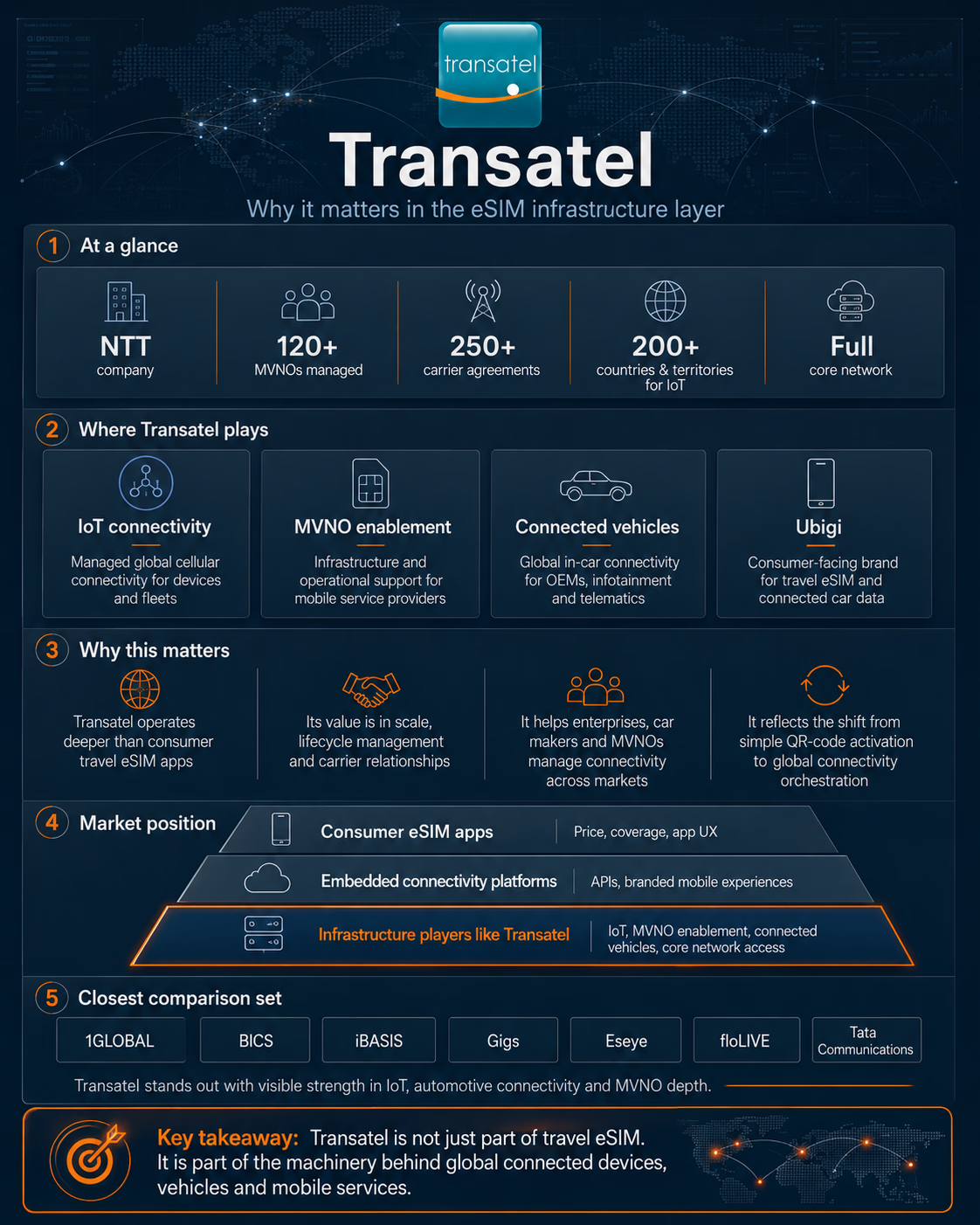
On its own site, Transatel describes itself as an NTT company focused on global cellular IoT connectivity and MVNO enablement, with its own full core network, more than 120 MVNOs managed, and network access agreements with 250+ international mobile carriers and regional infrastructures. That is not a small claim. It puts Transatel in the infrastructure layer of the eSIM economy, not only the retail layer.
And that matters because the eSIM market is moving beyond “scan this QR code.” The next phase is about who can manage connectivity at scale, across countries, networks, devices, compliance requirements and customer journeys.
The NTT factor
Transatel became part of NTT Communications in 2019, when NTT completed its acquisition of a majority stake in the company. At the time, the strategic logic was clear: Transatel brought global IoT cellular connectivity and MVNE capability, while NTT added global network infrastructure, cloud, data center and enterprise reach.
That combination gives Transatel a different weight compared with many newer eSIM companies. It has the agility of a specialized connectivity provider, but it sits inside one of the world’s largest telecom and technology groups.
READ MORE: Transatel Expands Global 4G/5G Connectivity Solution ‘Ubigi for Business’ Worldwide
For enterprise buyers, that matters. A company deploying connected vehicles, industrial devices, payment terminals or global employee connectivity does not only ask: “Is the data cheap?” It asks: “Will this still work when we scale to multiple markets? Who manages the networks? What happens when regulations change? Can this support 5G, LTE-M, eSIM and lifecycle management from one place?”
Transatel’s pitch is built for that kind of buyer.
IoT is a serious story
The consumer eSIM market gets more attention because it is easier to understand. A traveller needs data. A provider sells data. Simple.
But Transatel’s more serious story is IoT.
The company says its IoT platform connects devices across 200+ countries and territories using 2G, 3G, 4G, 5G and LTE-M, with global coverage, managed connectivity services, SIM management, API access and private LTE or 5G network options.
That is the kind of infrastructure needed for devices that do not behave like people. A person can open an app, top up a plan or contact support. A fleet tracker, EV charger, smart meter, medical device or industrial sensor cannot politely troubleshoot a roaming issue at the airport.
READ MORE: Transatel Brings Zero-Touch eSIM to IoT Hardware
This is why IoT eSIM is a different market from travel eSIM. It is less glamorous but more operationally demanding. The connectivity has to be persistent, remotely manageable and commercially predictable. It also has to survive real-world mess: borders, weak networks, local restrictions, changing carrier agreements and long device lifecycles.
Transatel’s Global IoT eSIM messaging now also references the latest GSMA SGP.31/32 standards, positioning the solution as scalable for IoT fleets across 200+ countries and multiple network generations. That is important because the IoT market needs eSIM standards designed for constrained devices and massive deployments, not just smartphones.
Your customers will buy connectivity. The question is: from you, or from someone else?
We help airlines, banks, and travel platforms turn that demand into a built-in product — not a missed opportunity.
Connected cars are becoming mobile products
Transatel is also very relevant in connected vehicles.
Its Internet of Vehicles platform is aimed at car manufacturers that want global 4G and 5G connectivity, secure eSIM support and more independence from individual mobile carriers. Transatel says its profile provides access to 230+ network operators in more than 200 destinations, while allowing car OEMs to keep control of the network setup and onboard preferred carriers when needed.
That is a big deal. Cars are becoming software environments. Navigation, diagnostics, infotainment, emergency services, over-the-air updates, passenger Wi-Fi and in-car productivity all depend on connectivity. But carmakers do not want to negotiate separately in every country or rebuild connectivity logic market by market.
READ MORE: Transatel Launches Its Global 5G IoT Connectivity Solution In Japan With NTT DOCOMO
This is where Transatel’s role becomes quite practical: it gives automakers one connectivity architecture that can travel with the vehicle.
Ubigi, Transatel’s consumer eSIM brand, also gives the company a visible front end for car connectivity and travel data. That dual position is interesting. Transatel can serve OEM infrastructure needs, while Ubigi helps expose the service to real end users in a branded way.
MVNO experience still counts
One underrated part of Transatel’s story is its MVNO and MVNE background.
A lot of new embedded connectivity companies speak in software language, which is smart because buyers in fintech, travel and devices understand APIs. But telecom is not just software. There are commercial agreements, numbering issues, regulatory obligations, roaming rules, billing flows, support processes and network behavior that can become painful very quickly.
READ MORE: Transatel Unveils Global Private LTE/5G Solution
Transatel has spent years in the MVNO world, which gives it a practical understanding of how mobile services actually operate. That makes it a different kind of competitor from pure API-first platforms. It may not always sound as sleek as newer embedded-connectivity brands, but it has deep operational credibility.
Where Transatel competes
The closest comparisons are not consumer-only eSIM brands. Transatel belongs in the same broader conversation as 1GLOBAL, iBASIS, BICS, floLIVE, Eseye, Kigen, Workz, Gigs and Tata Communications, depending on the use case.
Compared with 1GLOBAL, Transatel feels especially strong in IoT, automotive and MVNO enablement, while 1GLOBAL has built a sharper public story around fintech, travel platforms and embedded eSIM distribution.
Compared with Gigs, Transatel is more telecom-infrastructure heavy. Gigs speaks like modern developer infrastructure for branded mobile plans. Transatel speaks more like a global cellular connectivity operator with real MVNO and IoT depth.
Compared with iBASIS and BICS, Transatel overlaps in global connectivity and carrier-grade services, but it has a more visible eSIM and IoT deployment narrative, especially through connected vehicles and Ubigi.
Compared with Airalo, Holafly or Nomad, the difference is even clearer. Those brands are closer to the traveller and stronger in consumer marketing. Transatel is closer to the infrastructure and device layer.
Conclusion
Transatel matters because it shows where eSIM is becoming bigger than travel.
The market is splitting into layers. At the top, consumer eSIM apps compete on price, coverage, app experience and affiliate visibility. In the middle, embedded connectivity platforms help fintechs, travel brands and digital products add mobile service into their own customer journeys. Deeper down, companies like Transatel manage the hard part: global network access, MVNO enablement, IoT connectivity, car OEM integration, eSIM lifecycle management and carrier relationships.
That deeper layer is less noisy, but it may be more defensible.
The next phase of eSIM will not be won only by whoever has the prettiest app or the cheapest 10 GB plan. It will be shaped by companies that can make connectivity work quietly across devices, vehicles, platforms and markets. Transatel is one of those companies.
For Alertify readers, the takeaway is simple: if you want to understand where eSIM is going, do not look only at travel checkout pages. Look at connected cars, IoT fleets, MVNO infrastructure and the platforms sitting behind the brands. Transatel is not always the loudest name in the room, but it is very much in the machinery that keeps the room connected.