Transatel Brings Zero-Touch eSIM to IoT Hardware
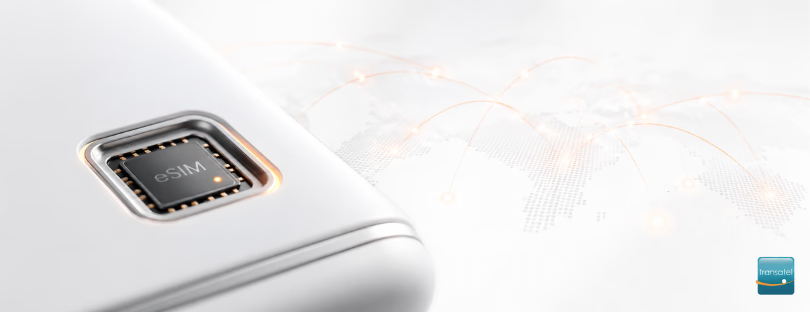
NTT’s Transatel is moving eSIM away from the travel checkout page and into a much less visible, but more important place: the hardware itself.
Its latest work with Furukawa Network Solution Corp., part of the Furukawa Electric Group, points to where eSIM is heading in IoT. The companies announced a proof of concept for router connectivity using Bootstrap eSIM technology, combining Furukawa network equipment with Transatel’s multi-carrier connectivity across NTT DOCOMO and KDDI networks in Japan. The practical idea is simple: a router should wake up, connect, receive the right operator profile and start working without somebody opening a box, inserting a SIM card, scanning a QR code or calling a technician.
That is the promise of zero-touch eSIM provisioning.
Why SGP.32 matters
For consumer travel eSIMs, “easy activation” usually still means the user does something. You buy a plan, scan a QR code, install an app or tap through device settings. That works when the device is a phone in a traveler’s hand. It does not work when the device is a utility meter in a basement, a router inside industrial equipment, or a tracker inside a shipping container.
This is where GSMA’s SGP.32 standard matters. Unlike the consumer eSIM model, which was built around smartphones and user interaction, SGP.32 was designed for IoT devices that may have no screen, no keypad, no app environment and no person nearby. It introduces a more automated architecture built around the eSIM IoT Remote Manager, known as eIM, and the IoT Profile Assistant, or IPA. In plain English, the eIM acts like the control layer for managing profiles remotely, while the IPA helps the device receive and execute those profile instructions.

The hardware logic
For manufacturers, this changes the economics of deployment.
A hardware maker can ship one global device instead of producing different SIM versions for different countries. A logistics company can send trackers across borders without depending on expensive permanent roaming. A utility provider can update smart meters without sending technicians to locked rooms or underground installations. A factory can keep routers online by pushing a fallback profile if the main carrier connection becomes unreliable.
The bigger shift is that connectivity becomes part of the device lifecycle, not a separate operational chore. It can be planned at manufacturing, activated at first power-on, adjusted by region, updated for regulation and changed later if commercial conditions move.
That last point matters. IoT devices are often expected to stay in the field for five, ten or even fifteen years. Networks change during that time. Operators sunset technologies. Local rules evolve. Pricing agreements get renegotiated. A physical SIM locked into the wrong device can become expensive.
Not the same as travel eSIM
Transatel has a useful position here because it sits in both worlds. On one side, it supports enterprise IoT connectivity through its global cellular platform and operator relationships. On the other, it powers Ubigi, the consumer-facing eSIM brand used by travelers, laptop users and connected car customers. The network DNA may overlap, but the product logic is completely different.
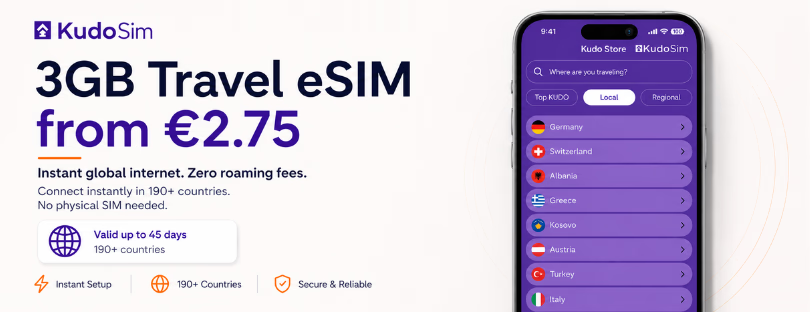
Ubigi is built for people. A traveler chooses a destination, buys a prepaid data plan and activates it through a QR code, device setting or app-led flow. The value is convenience, price transparency and avoiding roaming shock. Transatel IoT is built for fleets. The buyer is not a tourist landing in Tokyo, but an enterprise, manufacturer, utility company or fleet manager trying to keep thousands of devices connected without touching them individually.
A travel eSIM is about personal control. An IoT eSIM is about operational control. The enterprise wants standardization, automation, fallback, compliance and predictable management across many devices. In consumer eSIM, the friction is checkout and activation. In IoT eSIM, the friction is logistics, field service, roaming dependency and lifecycle risk.
This also explains why the billing models look different. Consumer travel eSIMs are mostly prepaid packages, monthly plans or regional bundles. IoT deployments usually require custom enterprise contracts, pooled usage, APIs, dashboards, service-level expectations and sometimes local profile strategies for regulatory reasons. A €10 travel eSIM and a multi-country IoT router fleet may use the same broad eSIM concept, but they are not the same business.
What still needs proving
There are limits, of course. SGP.32 is still young compared with consumer eSIM, and real-world interoperability matters more than brochure language. Enterprises will need to test device compatibility, bootstrap reliability, fallback behavior and profile switching before treating zero-touch as finished. For small, static deployments in one country, a traditional SIM or a simpler M2M arrangement may still be enough.
But for mobile, distributed or long-life hardware, the direction is hard to ignore. Competitors such as 1GLOBAL, emnify, Kigen and Wireless Logic are also framing SGP.32 as the next step in programmable IoT connectivity. That tells us this is not just a Transatel story. It is a market shift.
Conclusion
Transatel’s Furukawa PoC is interesting because it brings the conversation back to hardware reality. The future of eSIM will not only be travelers comparing data bundles before a trip. It will also be routers, meters, vehicles and industrial devices quietly negotiating their own connectivity in the background.
And that may be the more valuable version of eSIM: not the one you notice because it saves you from airport Wi-Fi, but the one you never notice because the device simply works.