Why eSIM Providers Are Becoming Connectivity Platforms
For the last few years, the travel eSIM market has looked deceptively simple. Open a website, choose France, Turkey, Japan or “Global”, pay, scan a QR code, and hope the plan works when the plane lands.
That model still matters. For casual travelers, it is often enough. A student going to Barcelona for four days does not need a connectivity workflow. They need 5GB, a clear price and no roaming shock.
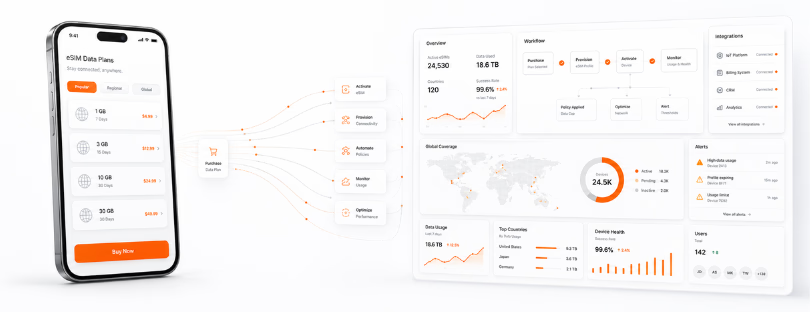
But the market is moving somewhere else. The next layer is not just selling a data plan. It is running the operations behind that plan: provisioning, plan assignment, user management, wallet balances, policy control, usage monitoring and partner reporting.
In other words, eSIM is starting to look less like a digital shop and more like an operating system.
Data is becoming the easy part
The irony is that eSIM storefronts became popular because they removed friction. No airport kiosk. No plastic SIM. No waiting. No guessing what roaming will cost.
Now that same simplicity has created a problem: too many providers look almost identical on the surface. Everyone has destinations. Everyone has “instant activation”. Everyone says they are global.
So the question shifts. Who controls the experience when things get messy?
A traveler may only see a QR code. A business partner sees something much bigger. Can they assign plans to employees? Can the platform show which users are burning data fastest? Can a travel agency sell eSIM vouchers without touching telecom complexity? Can a fintech or airline embed connectivity without becoming a mini telco?
The winners are not only the brands with the nicest country pages. They are the companies building dashboards and APIs that let other businesses run connectivity as a product.
 Workflow connectivity
 Workflow connectivity
The clearest signal is the language changing around the industry. eSIM Go talks about API access and eSIM enabling infrastructure. Gigs calls itself an operating system for mobile services. Kigen talks about profile management and orchestration. GSMA’s SGP.32 specification for IoT eSIM management points in the same direction: remote provisioning is becoming a foundation for connected devices and managed fleets.
This does not mean every travel eSIM brand needs to become an enterprise platform. Some should not. A clean B2C store with good pricing, honest coverage and fast support can still be a strong business.
READ MORE: Best eSIM for Europe 2026 — Tested for Latency, Throttling & Multi-Network Resilience
But the ceiling is different. A storefront sells one transaction. An operating layer can support repeat usage, embedded distribution, partner sales, corporate travel, device connectivity and multi-market control.
Think about an airline. It does not want to manually sell 50 destination plans. It wants a post-booking connectivity flow that fits the route, language, currency and trip length. A bank wants a benefit assigned to premium customers, tracked by campaign and supported without damaging trust. A company with traveling staff does not want random expense-card purchases. It wants visibility.
That is the difference between selling data and managing connectivity.
What changes for travelers
For everyday travelers, the operating-system shift will be mostly invisible.
Better infrastructure should mean fewer failed installations, clearer plan status, smarter top-ups, more persistent eSIM profiles and less “delete and buy again” behavior. It should also make support less painful, because the provider should know what happened instead of asking the customer to send screenshots at midnight.
There is a catch, though. More platform control can also mean more bundled offers that look convenient but are not always the cheapest. A hotel, airline or bank may promote an eSIM inside its own journey, but that does not automatically make it the best plan. Travelers still need comparison, especially when unlimited claims, throttling rules and expiry windows are not obvious.
What changes for providers
For eSIM providers, the question is becoming uncomfortable: are you a shop, a brand, a platform, or infrastructure?
Airalo and Holafly have shown how powerful consumer branding can be. Ubigi and Transatel show how embedded connectivity can move into cars and device ecosystems. eSIM Go, Gigs and similar players show the B2B side: APIs, automation, white-label flows and programmable telecom. Meanwhile, specialist enterprise players are pushing visibility, risk control and managed connectivity instead of cheap gigabytes.
None of these models is automatically better. They serve different buyers.
READ MORE: eSIM Revenue Models for Airlines, Banks and OTAs
A leisure traveler may still prefer the simplest checkout. A bank or OTA needs integration. A corporate mobility team needs governance. An IoT project needs lifecycle control. The danger is when providers pretend one model fits all of them.
The market could improve here. Too many companies still describe technical capabilities with vague phrases such as “seamless global connectivity”. That may sound polished, but it hides the real question: what can the platform do when thousands of users, plans, profiles and support cases are running at once?
Final thoughts about the eSIM operating system
The eSIM market is not leaving retail behind. It is growing out of retail.
Storefronts made eSIM understandable. Operating systems will make it scalable. The next competitive edge will not only be who has the lowest 10GB plan for Spain. It will be who can turn connectivity into a managed, measurable and repeatable workflow for travelers, partners and businesses.
That is why the most interesting eSIM companies in 2026 will not be judged only by destination coverage. Coverage is expected now. The stronger test is whether they can make connectivity behave like software: configurable, trackable, supportable and embedded wherever the customer journey actually starts.