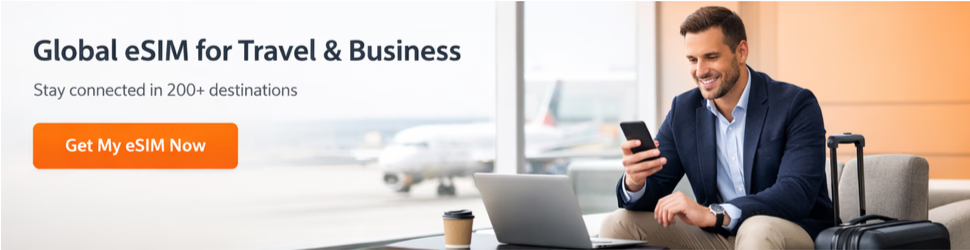
Why eSIM Is the Cleanest Revenue Stream in Travel Tech Right Now
There is a reason eSIM keeps appearing in airline apps, banking propositions, travel marketplaces and loyalty discussions. Not because every travel brand wants to become a telecom company. Most do not. It is because connectivity can be sold digitally, delivered instantly and used at the exact moment the customer needs it. eSIM revenue stream for travel brands
eSIM removes the old mess around travel connectivity. No warehouse. No delivery window. No kiosk. No plastic. A traveller buys a plan, receives a QR code or in-app installation flow, and connects when they land.
The missing add-on
The interesting part is not that eSIM is new. It is that many companies already own the perfect moment to sell it.
Airlines know where the customer is flying. Hotels know when the guest will arrive. OTAs know the itinerary. Banks know who pays abroad. Fintech apps understand cross-border behaviour better than most telcos. Yet too many brands still leave connectivity to airport Wi-Fi, roaming shock or a last-minute Google search.
READ MORE: Yesim B2B Strategy: API vs Enterprise Play
That is the missed opportunity. Travel companies spend heavily to acquire a customer, then allow another provider to capture the connectivity revenue at the most valuable point of the trip. eSIM sits inside the journey itself. It solves a small but real anxiety: “Will I be online when I arrive?”
This is where B2B eSIM platforms become relevant. Yesim’s Partner API lets companies integrate eSIM sales into their own website, app or e-commerce flow, with coverage in 200+ destinations, 1000+ network operators, flexible pricing configuration and technical support. The brand does not need telecom infrastructure. It can own the customer relationship while Yesim handles the connectivity layer.
Why the margin feels different
The cleanest revenue streams in travel usually share three traits: easy to attach, low-friction to deliver and linked to customer intent. eSIM fits all three.
A traveller booking Tokyo, Dubai or New York is already thinking about maps, messaging, payments and ride-hailing. Connectivity is not a random upsell. It is part of making the trip work.
READ MORE: 3 Million Travelers Choose Yesim for Global eSIM Connectivity
The margin structure is attractive because the cost base is not shaped like physical retail. There is no shelf space, no manual fulfilment, no unsold stock. There are still wholesale costs, support expectations, refunds and customer education. But compared with many travel add-ons, eSIM is simpler to scale.
GSMA Intelligence has described travel eSIM as one area pushing eSIM into mainstream consumer behaviour, even while smartphone eSIM adoption has been slower than early forecasts expected. eSIM is not universal yet, but travel is one of the clearest use cases because the pain is immediate.

Where Yesim fits
Yesim is useful here because it shows how eSIM is moving from consumer storefronts into embedded B2B infrastructure. The consumer sees a simple data product. The partner sees APIs, pricing control, fulfilment, destination coverage and support.
For an airline, that could mean offering destination data after checkout. For a hotel group, it could be a premium guest benefit for international arrivals. For a bank or fintech, it could become part of a travel card proposition. For travel agencies and OTAs, it can be bundled into higher-value itineraries.
This does not have to be loud. A small “Stay connected when you land” module at the right point in the journey can be more effective than a telecom-style campaign. That is why Yesim’s API approach is more interesting than reselling plans on a separate landing page. The value is in placement.
Not for everyone
The model is not equally attractive for every travel business. If a company has very low digital traffic, weak checkout control or no recurring traveller relationship, eSIM may not move the needle quickly. It also requires trust in the partner platform. If the customer has a poor activation experience, they will blame the brand that sold it.
There is room for improvement, too. Plan naming is still confusing. Coverage claims can sound broader than the actual network experience. Refund policies are not always easy to understand. Some providers still sell eSIMs like commodity data bundles, when the better opportunity is to explain use cases clearly.
Alternatives exist. Gigs is pushing embedded telecom for travel and fintech use cases. eSIM Go focuses on reseller and white-label infrastructure. Most travel eSIM providers are better known on the consumer side, while 1GLOBAL and Transatel sit closer to enterprise, operator or embedded connectivity models. The market is not empty, so travel brands should choose carefully.
Final thoughts
eSIM looks like the cleanest revenue stream in travel tech not only because it is digital. Plenty of digital products fail. It works because timing, need and delivery line up unusually well.
A travel brand does not need to become a telco. But it does need to stop treating connectivity as someone else’s problem. The companies that already own booking, payment, loyalty or arrival moments are sitting on a revenue layer that feels natural to the customer and light for the business.
Yesim’s B2B services, especially its Partner API, fit that direction because they turn eSIM from a standalone product into an embedded capability. Still, the winners will not be the brands that simply add “buy eSIM” to a menu. They will be the ones that place connectivity at the exact moment when the traveller quietly thinks: I hope my phone works when I land. Contact Yesim here.