iBASIS: The Carrier-Grade Layer Behind eSIM Growth
There is a funny thing happening in the eSIM market. The loudest brands are often the simplest to understand: buy data, scan a QR code, and land connected. That is the retail story. Useful, visible, easy to market.
iBASIS sits somewhere else.
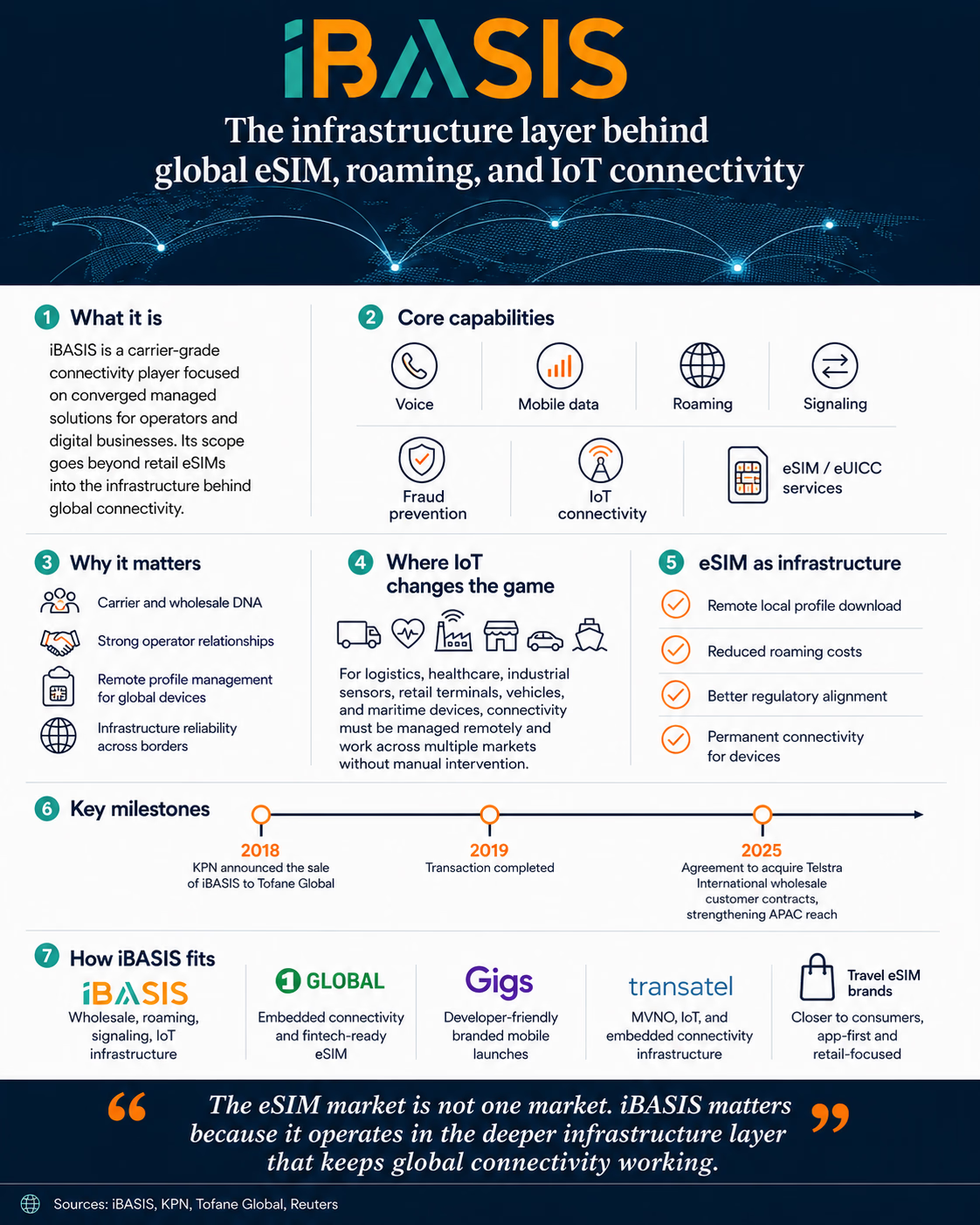
The company is not trying to be the most familiar name on a traveller’s phone screen. It is playing in the infrastructure layer behind global connectivity: voice, mobile data, roaming, signaling, fraud prevention, IoT connectivity, and eSIM/eUICC services. Its own positioning is built around “converged managed solutions” for operators and digital players, covering voice, mobile, IoT connectivity, infrastructure, fraud prevention, and value-added services. That already tells you this is not a lightweight eSIM reseller story. It is a carrier-grade connectivity story.
And for Alertify readers, that distinction matters. Because the future of eSIM is not only about who has the cheapest 10 GB plan for Turkey. It is also about who controls the network relationships, the roaming architecture, the permanent connectivity layer, and the eUICC logic that keeps devices connected across markets.
The wholesale DNA
iBASIS has old-school telecom DNA, and that is not an insult. In this market, it can be an advantage.
The company has long been associated with international carrier services, voice traffic, mobile data, and roaming infrastructure. KPN announced the sale of iBASIS to Tofane Global in 2018, describing iBASIS as its US-based wholesale carrier subsidiary. The transaction was completed in 2019, with Tofane Global positioning the acquisition around international communications and expansion into IoT, mobile data, and global access services.
READ MORE: iBASIS x Tampnet: Offshore connectivity just got serious
That background explains why iBASIS sounds different from newer embedded connectivity players. It does not lead with flashy consumer language. It leads with network reach, operator relationships, managed services, and infrastructure reliability.
For a consumer eSIM buyer, that may feel invisible. For an operator, enterprise, IoT manufacturer, or platform that needs connectivity to work across borders without becoming a regulatory mess, it is exactly the point.
The IoT angle is where it gets serious
The most interesting iBASIS story today is probably IoT.
Its Global Access for Things service is designed to provide global mobile connectivity for connected devices through one contract. iBASIS says it uses next-generation eSIM/eUICC technology to provide a single global, remotely programmable SIM for mobile data connectivity across smart devices worldwide.
That sounds technical, but the practical use case is easy to picture. Think logistics trackers moving through multiple countries. Smart meters. Healthcare devices. Industrial sensors. Connected vehicles. Maritime equipment. Retail terminals. Devices that do not travel like people, but still need to behave well across networks.
This is where consumer eSIM logic breaks down. A human traveller can open an app, buy another plan, or contact support. A container tracker crossing borders cannot politely troubleshoot itself at 2 a.m. The connectivity has to be managed remotely, automatically, and with enough network intelligence to avoid expensive failures.
iBASIS is leaning into exactly that problem.
eSIM as a regulatory tool
One line from iBASIS’ eSIM technology material is especially important: eSIM allows a local profile to be added remotely over the air once a device is detected in a particular area, so it can operate as a local or regional SIM and reduce expensive roaming scenarios and regulatory issues.
That is a much bigger statement than “eSIM is convenient.”
In IoT, permanent roaming can become a real issue. Some markets restrict it. Some operators dislike it. Some use cases become too expensive if traffic always routes through the wrong architecture. Remote profile management gives enterprises and device makers a way to localize connectivity without physically replacing SIMs.
READ MORE: iBASIS Expands its Global Footprint with New Tokyo PoP, Strengthening Asia-Pacific Connectivity
This is where eUICC becomes infrastructure, not just activation convenience.
And honestly, this is one of the reasons the industrial eSIM market deserves more attention. Consumer eSIMs get the clicks. Industrial eSIMs solve uglier and often more valuable problems.
Roaming still matters
iBASIS also remains deeply tied to roaming and mobile data infrastructure. Its mobile data solutions are delivered across its global infrastructure, with products around signaling intelligence, LTE signaling exchange, IPX hub breakout, and roaming integrator services.
That sounds like backend telecom plumbing, because it is. But roaming performance is not magic. Someone has to manage signaling, routing, interconnects, data exchange, quality, fraud exposure, and operator relationships.
In October 2025, iBASIS published a roaming-focused piece about summer traffic, arguing that peak travel periods test the strength of IPX networks as mobile operators support surging roaming demand.
That is a useful reminder for the eSIM industry. A beautiful app is not enough. If the backend routing, signaling, and roaming relationships are weak, the user experience falls apart.
APAC expansion adds weight
One recent signal worth watching is iBASIS’ move involving Telstra International assets. Reuters reported in September 2025 that iBASIS agreed to acquire wholesale voice, mobile, and messaging customer contracts from Telstra Group’s international business, a deal expected to expand iBASIS into Australia and New Zealand and strengthen its Asia-Pacific footprint.
That matters because APAC is not a side market for global connectivity. It is one of the most complex and commercially important regions for travel, IoT, wholesale voice, messaging, enterprise mobility, and cross-border digital services.
For iBASIS, this kind of expansion fits the company’s identity: not a consumer land grab, but a deeper wholesale and infrastructure move.
Your customers will buy connectivity. The question is: from you, or from someone else?
We help airlines, banks, and travel platforms turn that demand into a built-in product — not a missed opportunity.
Where iBASIS fits
Compared with 1GLOBAL, iBASIS feels less consumer-facing and less fintech-branded, but very strong in carrier, roaming, mobile data, and IoT infrastructure. 1GLOBAL has a sharper embedded eSIM story for banks, travel platforms, and digital brands. Gigs speaks more like modern developer infrastructure, helping companies launch branded mobile plans quickly. Transatel, part of NTT, is another serious infrastructure player, especially around MVNO, IoT, and embedded connectivity.
READ MORE: iBASIS to Acquire Telstra International’s Wholesale Voice, Mobile & Messaging Contracts
Then you have travel-first eSIM companies such as Airalo, Holafly, Nomad, GigSky, and others. They are closer to the traveller. They win on brand, app experience, affiliate distribution, and price visibility. But many do not own the same depth of wholesale roaming, signaling, and IoT-grade infrastructure.
So iBASIS is not trying to win the same beauty contest. It is competing for a different kind of buyer: operators, enterprises, IoT players, platforms, and digital businesses that need global connectivity to behave like a managed infrastructure layer.
Conclusion
iBASIS matters because it reminds us that eSIM is not one market. It is several markets pretending to be one.
There is consumer travel eSIM, where the fight is about price, destinations, app experience, and trust. There is embedded connectivity, where companies like Gigs and 1GLOBAL help fintechs, apps, and platforms turn mobile service into a product feature. And then there is the deeper infrastructure layer, where iBASIS is much more relevant: roaming, signaling, IPX, IoT connectivity, eUICC management, wholesale relationships, and cross-border mobile operations.
That layer is less glamorous, but it may be harder to copy.
The real trend is clear: connectivity is becoming programmable, but programmable does not mean simple. Someone still has to manage the complexity underneath. iBASIS’ advantage is that it already lives in that complexity.
For Alertify readers, the takeaway is simple: do not judge the eSIM market only by the apps you see in search results. The companies shaping the next phase may be the ones travellers never notice. iBASIS is one of them.