iBASIS x Tampnet: Offshore connectivity just got serious
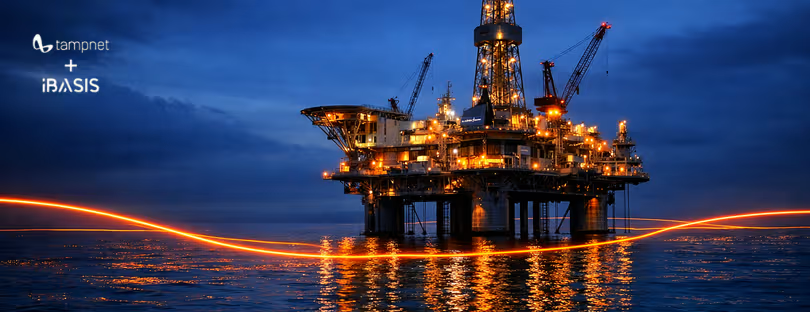
There’s a part of global connectivity that most travelers never think about until they’re in it: offshore networks. Oil rigs, wind farms, shipping lanes, cruise routes. Places where connectivity isn’t just about convenience, but safety, operations, and increasingly, everyday digital life.
This is exactly where the new partnership between iBASIS and Tampnet lands. And it matters more than it might look at first glance.
The two companies have teamed up to strengthen mobile connectivity across the Gulf of Mexico and the North Sea, two of the most critical offshore corridors globally. The goal is simple on paper: deliver reliable, high-quality roaming for maritime workers, offshore energy crews, and even cruise passengers.
In reality, it signals something bigger. Offshore connectivity is quietly becoming part of the mainstream telecom conversation.
From niche infrastructure to real user experience
Tampnet already operates what is widely considered the largest offshore high-capacity communications network in the world. Its infrastructure spans more than 450 offshore energy assets, combining fiber, LTE, and private 5G to deliver low-latency, high-bandwidth connectivity in places where traditional networks simply don’t reach.
But infrastructure alone doesn’t create a usable experience for roaming users. That’s where iBASIS comes in.
Under this partnership, Tampnet is using iBASIS’ full roaming suite. That includes 4G LTE and GRX transport, financial and data clearing, and professional services that support inbound roaming at scale. Beyond the technical stack, iBASIS also handled a core network migration, which is typically one of the most complex and risk-sensitive parts of telecom operations.
Øyvind Skjervik, CTO at Tampnet, put it clearly:
“We value the strong partnership with iBASIS. Their engineering support during our core migration and their comprehensive IPX and clearing services enable us to deliver an exceptional roaming experience to offshore users. Quality, interoperability and IPX reliability are critical for our inbound-roamers, mobile users operating or traveling across offshore industrial and maritime corridors.”
That last part is key. Offshore users are not casual data consumers. They are often operating in mission-critical environments where connectivity failures have real consequences.
The roaming shift offshore
For years, offshore connectivity had a reputation problem. It worked, but at a cost that discouraged usage.
Maritime workers and cruise passengers often avoided connecting altogether. Data was expensive, unpredictable, and in many cases not worth the risk of a shock bill. Sound familiar? It’s the same dynamic we saw with international roaming before eSIMs started reshaping expectations.
Now, that dynamic is changing.
With “Roam Like Home” policies extending into offshore scenarios, users can increasingly connect without thinking twice about cost. The expectation is that data usage offshore will rise significantly as adoption grows.
This is not just a pricing story. It is a behavioral shift.
Once users trust that connectivity is both reliable and predictable, they start using it differently. More video calls. More real-time monitoring. More cloud-based workflows. In offshore energy, that translates into operational efficiency. On cruise ships, it translates into passenger experience.
Non-terrestrial is no longer optional
Nicolas Barret, Chief Growth Officer at iBASIS, framed it in broader terms:
“Non terrestrial connectivity such as offshore connectivity is rapidly expanding, and Tampnet is at the forefront of this transformation. We are proud to support their growth in the coming years with robust, secure roaming services and a one-stop-shop IPX solution.”
Non-terrestrial connectivity is becoming one of the most important frontiers in telecom.
Between satellite networks, private 5G deployments, and offshore LTE, the traditional idea of “coverage” is expanding beyond land-based infrastructure. According to GSMA Intelligence and industry reports from organizations like the ITU, demand for connectivity in remote and industrial environments is growing fast, driven by energy, logistics, and maritime sectors.
Tampnet sits right in the middle of that shift. And partnerships like this one are what turn infrastructure into usable global connectivity.
How this compares with the wider market
This move also highlights a broader trend in the telecom ecosystem: specialization plus integration.
Players like BICS and Syniverse have long dominated the wholesale and IPX space, offering global interconnect and roaming services. Meanwhile, companies like Tampnet focus on specific environments where connectivity is difficult but valuable.
What’s changing is how tightly these layers are being integrated.
Instead of fragmented solutions, operators are increasingly looking for “one-stop-shop” roaming partners that can handle transport, clearing, interoperability, and support in a single package. iBASIS is positioning itself exactly in that space.
At the same time, offshore and remote connectivity providers are moving closer to the core telecom ecosystem. They are no longer isolated networks. They are becoming extensions of global mobile infrastructure.
This is similar to what we’re seeing with private 5G in enterprises and with satellite-to-device partnerships from players like SpaceX and AST SpaceMobile. Different technologies, same direction: connectivity everywhere, integrated into the same user experience.
What this actually means for users
For offshore workers, this partnership should translate into something very practical: fewer connectivity gaps, more stable roaming, and less friction when moving between networks.
For cruise passengers, it could mean a noticeable improvement in onboard connectivity, especially as expectations continue to rise. Streaming, messaging, and remote work are no longer optional features of travel. They are baseline expectations.
And for the industry, it reinforces a simple idea.
Connectivity is no longer defined by geography. It is defined by experience.
Final thoughts
The iBASIS and Tampnet partnership is not just another roaming agreement. It is a signal that offshore connectivity is moving into the same category as traditional mobile networks: expected, integrated, and increasingly invisible to the end user.
What makes this interesting is not the technology itself, but the convergence. Offshore networks, wholesale roaming platforms, and global IPX ecosystems are starting to operate as one layer. That is exactly how terrestrial mobile networks evolved over the past two decades.
Compared to other players in the market, this move positions iBASIS as more than just a wholesale provider. It becomes an enabler of new connectivity environments. For Tampnet, it bridges the gap between high-performance offshore infrastructure and global usability.
The bigger trend is clear. Whether it is offshore rigs, open seas, or remote industrial zones, the expectation is shifting toward seamless connectivity everywhere. Reports from GSMA Intelligence and ITU consistently point to growing demand in these “non-traditional” coverage areas, and partnerships like this are how the industry responds.
The real takeaway is simple.
The map of global connectivity is expanding. And offshore is no longer the edge.
Driven by wanderlust and a passion for tech, Sandra is the creative force behind Alertify. Love for exploration and discovery is what sparked the idea for Alertify, a product that likely combines Sandra’s technological expertise with the desire to simplify or enhance travel experiences in some way.