Vodafone Portugal Travel Plans Now Cover 109 Countries
Vodafone is making a subtle but important move in the travel connectivity space. Its latest update does not come with flashy headlines, but it signals something bigger: traditional telecom operators are still very much in the game.
Vodafone Portugal has expanded its travel mobile internet service to 109 destinations outside the European Economic Area, up from the 92 markets initially announced. That is not just a numbers update. It reflects a steady push to stay relevant in a market increasingly dominated by eSIM-first players.
The newly added destinations include a mix of high-friction and underserved markets such as Angola, Iran, Madagascar, Mongolia, and French Polynesia. In other words, not the usual “easy” tourist corridors, but places where connectivity is often unpredictable and expensive.
That choice alone tells you who this product is really for.
Built for simplicity, not disruption
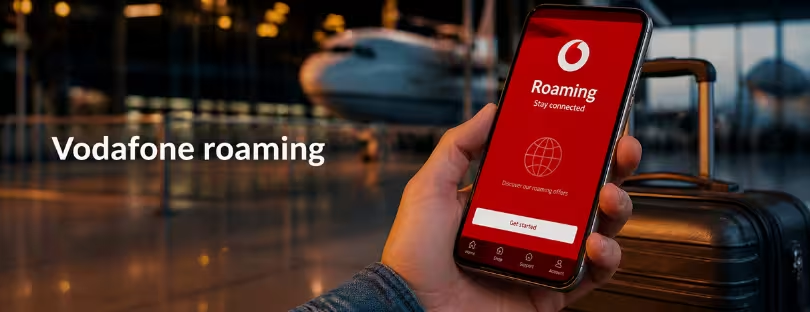
Vodafone’s offer is straightforward. You pick a data bundle, choose a duration of 7, 15, or 30 days, and keep your existing SIM and phone number. Prices start at around €6, with activation via SMS or the My Vodafone app. The plan only starts once you arrive at your destination, which removes the usual anxiety of wasting data before landing.
There is no app onboarding loop, no QR code scanning, no switching profiles.
And that is the point.
While the eSIM ecosystem has spent the last few years optimizing for frictionless digital experiences, Vodafone is doubling down on familiarity. For a large segment of travelers, especially those less comfortable with eSIM setup or device compatibility, this still matters more than we tend to admit.
From a user perspective, this is less about innovation and more about removing decision fatigue.
Why this expansion matters now
Timing is everything here.
The global travel rebound has stabilized, but the behavior of travelers has changed. People are moving more frequently across regions, often mixing business and leisure. At the same time, roaming costs outside the EU remain unpredictable, and that old “bill shock” fear has not disappeared.
Vodafone’s expansion feels like a response to that gap.
Instead of pushing users toward new technology, it offers a controlled extension of the existing roaming experience. Same SIM, same number, predictable pricing.
It is not trying to reinvent connectivity. It is trying to make it feel safe again.
And in a market where trust is still fragile, that is a powerful positioning.
The quiet competition with eSIM players
Let’s be clear. Vodafone is not competing head-on with players like Airalo, Holafly, or Yesim.
But it is competing indirectly.
eSIM providers have built their growth on three pillars: lower prices, global coverage, and ease of use. According to GSMA, eSIM adoption continues to accelerate, especially among frequent travelers and newer smartphone users.
However, there is still a large installed base that does not switch.
Device compatibility remains an issue. Corporate policies often restrict eSIM usage. And many users simply do not want to change how they connect.
This is where Vodafone’s model becomes interesting. It keeps users inside the traditional telecom ecosystem while borrowing some of the flexibility that made eSIM appealing in the first place.
In a way, it is a defensive strategy that also buys time.

Coverage is the real differentiator
What stands out in this update is not the pricing. It is the geography.
Expanding into markets like Chad, Congo, or Sierra Leone is not trivial. These are regions where partnerships, wholesale agreements, and network reliability become significantly more complex.
For travelers heading to these destinations, the choice is often between expensive roaming, inconsistent local SIM options, or limited eSIM coverage.
Vodafone is positioning itself as a safer default in exactly those edge cases.
That may not drive mass adoption overnight, but it strengthens its value proposition for high-friction travel scenarios, which is where loyalty is often built.
Where this fits in the bigger picture
There is a broader shift happening in travel connectivity.
On one side, you have eSIM-native companies pushing toward software-driven, API-enabled connectivity layers. On the other hand, traditional operators are slowly adapting their existing infrastructure to remain competitive.
Vodafone’s move sits somewhere in between.
It is not trying to become a tech platform. But it is also not standing still.
And that hybrid approach might be more relevant than it seems.
Conclusion about Vodafone Portugal travel data plans
The expansion of Vodafone’s travel data service is not a breakthrough moment, but it is a strategic one.
While eSIM players continue to define the future of global connectivity, traditional operators are quietly reshaping the present. Vodafone’s approach highlights a reality the industry sometimes overlooks: not every traveler is ready, or willing, to switch to eSIM.
Compared to players like Airalo or Holafly, Vodafone lacks the digital-first experience and often the pricing advantage. But it compensates with trust, simplicity, and seamless continuity. Against more flexible models like Yesim’s Pay & Fly, which challenge the logic of prepaid bundles altogether, Vodafone still operates within a more traditional framework.
And yet, that framework still works for millions of users.
The real trend here is not who wins between SIM and eSIM. It is the gradual blending of both models. Operators are becoming more flexible, while eSIM providers are working to build trust and consistency.
According to GSMA forecasts, eSIM-enabled devices will dominate new smartphone shipments in the coming years. But adoption is not just about availability. It is about behavior.
Vodafone understands that.
Instead of forcing change, it is adapting around it. And in a market defined by friction, that might be the smarter move for now.