BH Telecom quietly raises the bar for tourist SIMs in the Balkans
There’s a noticeable shift happening in the Balkan prepaid market, and BH Telecom just made one of the clearest moves yet.
As of April 27, 2026, the operator has significantly upgraded its tourist prepaid offers, pushing data allowances up to 100 GB. On paper, it looks like a simple refresh. In practice, it says a lot about how regional operators are starting to compete for high-usage travelers.
And not just tourists in the traditional sense, but the kind of users the industry has often ignored. Digital nomads, remote workers, and anyone treating the Balkans as more than a quick stop.
What actually changed in the 2026 tourist offers
The updated packages are straightforward but noticeably more aggressive than before.
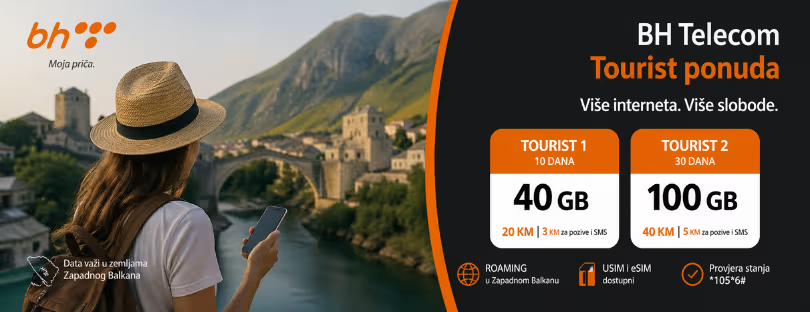
Tourist 1 now includes 40 GB of data for 20 KM, valid for 10 days, along with a small credit (3 KM) for calls and SMS.
Tourist 2 steps things up further with 100 GB for 40 KM, valid for 30 days, plus 5 KM for voice and messaging.
There is also an Unlimited Tourist option positioned as a premium tier for heavier users, although the exact fair usage conditions matter here and are always worth checking before purchase.
On top of that, these plans include data usage across the Western Balkans, not just Bosnia and Herzegovina. That’s a subtle but important detail.
Because once you remove borders from the connectivity experience, the product becomes much more relevant for real travel patterns in this region.
Regional roaming is no longer a “nice to have”
One of the most interesting parts of this update is not just the data volume, but where you can use it.
BH Telecom includes roaming within the Western Balkans, aligning with broader regional efforts to reduce roaming costs between countries like Serbia, Montenegro, North Macedonia, and Albania.
For travelers moving across multiple countries in a short period, which is extremely common in this part of Europe, this removes one of the biggest friction points.
It also puts pressure on other operators in the region to match that flexibility.
Because once users experience seamless regional data, going back to country-by-country SIM switching feels outdated very quickly.
Distribution still matters more than people think
Another practical strength here is availability.
These tourist SIMs are sold at BH Telecom retail locations, newsstands, and airports, and are also available as eSIMs. That hybrid approach still matters.
Despite all the momentum around eSIM, physical SIM cards remain relevant in markets like Bosnia and Herzegovina, especially for travelers who want a quick, no-friction setup on arrival.
The ability to choose between USIM and eSIM gives BH Telecom a broader reach than many digital-only players.
And yes, even small details like balance checks matter in real usage. The standard USSD code (1056#) is still part of the experience, which tells you this is a product designed for practical, everyday use, not just marketing.

Is 100 GB the new benchmark for “tourist” plans?
This is where things get more interesting.
A 100 GB tourist plan for roughly €20 is no longer niche. It’s a signal.
Across Europe and beyond, we’re seeing a clear divergence in the market:
- Global eSIM providers like Airalo or Holafly focus on convenience, instant activation, and broad coverage, but often at a higher price per GB
- Local operators like BH Telecom compete aggressively on volume and price, especially for longer stays
What BH Telecom is doing here is leaning hard into the second category. High data, low cost, regional usability.
And for a certain type of traveler, that’s exactly the right play.
Where does this put BH Telecom in the bigger picture
Compared to other regional operators, this move feels deliberate.
Tourist SIMs used to be an afterthought. Small bundles, short validity, designed for light usage.
Now they’re becoming serious connectivity products.
And BH Telecom is positioning itself accordingly.
READ MORE: Best eSIM for the Balkans 2026 — The Border-Hop & Partner Network Problem
By offering 100 GB with regional roaming, they’re not just targeting tourists. They’re quietly targeting long-stay visitors and mobile-first professionals who need reliable, high-volume data without paying Western European prices.
That’s a different segment. And a more valuable one.
What to watch next
The real question is whether this becomes the new baseline across the Balkans.
If operators in Croatia, Serbia, and beyond start matching these volumes and regional inclusions, we’re looking at a fundamentally different prepaid market in Southeast Europe.
One where local SIMs become a genuine alternative to global eSIM solutions, not just a cheaper backup.
And that’s where things get competitive.
A shift from convenience to capacity
This update from BH Telecom is not just about bigger data bundles.
It reflects a broader shift in how connectivity is being packaged and sold to travelers.
GlobaI eSIM players have already won on convenience. Instant activation, no physical cards, seamless onboarding. That’s not going away.
But local operators are starting to win on something else entirely. Capacity and price.
And for high-usage travelers, that trade-off is becoming harder to ignore.
If this trend continues, the market won’t converge. It will split.
Convenience vs. capacity.
And right now, BH Telecom is making a strong case for the second.