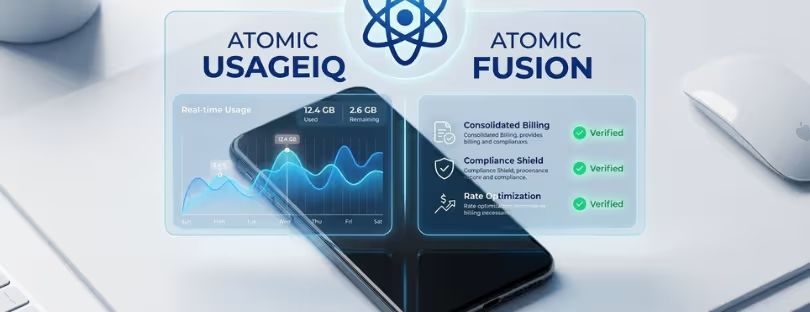
Atomic UsageIQ & Fusion: Real-Time MVNO Control
There’s a structural issue inside telecom that rarely gets talked about outside operator circles. Data usage is still, in many cases, not truly real-time. And that delay creates a chain reaction. Billing mismatches. Customer frustration. Revenue leakage. Compliance risks.
Atomic Mobile is trying to tackle that head-on with two new products: Atomic UsageIQ and Atomic Fusion. On paper, it sounds like another product launch. In reality, it’s a response to something much deeper. Telecom operations are becoming harder to manage just as expectations are rising.
Why Real-Time Still Isn’t Standard
Atomic UsageIQ is built around a simple idea. Operators should see data usage as it happens, not hours or days later.
That might sound obvious, but many MVNOs still rely on delayed or batch-based reporting. It works until it doesn’t. A heavy user burns through data faster than expected. A plan threshold is crossed too late. Costs spike before controls kick in.
UsageIQ introduces near real-time visibility into consumption, giving operators a chance to react while it still matters. That changes how plans can be structured.
Instead of static packages, you start seeing dynamic behavior:
- throttling triggered instantly, not retroactively
- alerts before a customer hits a limit
- automated controls tied directly to usage patterns
And more importantly, it opens the door to segmentation that actually reflects real usage, not assumptions.
Operators can:
- monitor usage in near real time
- reduce exposure to overages and delayed enforcement
- automate alerts and controls
- build targeted plans for specific customer types
It’s not just about visibility. It’s about control.

The Other Problem: Everything Behind the Scenes
If UsageIQ is about intelligence, Atomic Fusion is about removing operational drag.
Because the reality is this. Running an MVNO is no longer just about connectivity. It’s about navigating taxation across jurisdictions, staying compliant with constantly shifting regulations, managing billing accuracy, and handling support.
That’s where things break.
Atomic Fusion bundles several of those functions into a managed layer:
- customer billing
- tax calculation and remittance
- regulatory and compliance reporting
- customer support operations
For smaller or fast-scaling MVNOs, this is less about convenience and more about survival. Every one of these areas requires expertise, infrastructure, and ongoing maintenance. Getting it wrong is expensive.
So instead of building internally, Fusion offers a way to offload that complexity while maintaining operational confidence.
Two Products, One Direction
What Atomic is really doing here is splitting telecom into two layers.
One is intelligence. Knowing what’s happening in real time.
The other is execution. Handling everything that makes telecom operationally heavy.
“Our customers need two things: better intelligence and less friction,” said Amanda Herman, at Atomic Mobile. “Atomic UsageIQ helps operators make smarter decisions in real time, while Atomic Fusion removes operational barriers that often slow growth. Together, they help MVNOs scale faster and operate more efficiently.”
That framing is accurate. But it also reflects a broader shift happening across the industry.
The Bigger Trend: Telecom Is Becoming Modular
What Atomic is building sits somewhere between traditional MVNE platforms and newer API-first telecom players.
Companies like Gigs and 1GLOBAL are pushing telecom into a programmable layer. Infrastructure becomes something you plug into, not build.
Meanwhile, established players like BICS or Vodafone still offer deep infrastructure, but often with more complexity and longer integration cycles.
Atomic’s approach is slightly different. It’s not trying to replace infrastructure. It’s trying to make the messy middle layer cleaner.
And that middle layer is where most MVNOs struggle.
According to industry reports from organizations like GSMA, operational complexity is becoming one of the main barriers to MVNO growth, especially as regulatory requirements tighten and cross-border services expand.
At the same time, user expectations are moving in the opposite direction. Instant visibility. Predictable costs. Seamless experience.
That gap is where products like UsageIQ and Fusion sit.
Availability and What Comes Next
Atomic Mobile plans to roll out both offerings this summer, with a beta already running among selected partners. The modular approach means operators can adopt them individually or together, depending on how much control or outsourcing they want.
Which is important. Because not every MVNO wants the same thing. Some want full control. Others want speed and simplicity.
Atomic is trying to serve both.
Takeaway
This launch isn’t about two new products. It’s about how telecom is being restructured.
The industry is quietly moving away from monolithic systems toward layered models. Intelligence on top. Infrastructure underneath. Operations handled somewhere in between.
The winners won’t necessarily be the ones with the biggest networks. They’ll be the ones who can turn complexity into something usable.
Atomic Mobile is betting that real-time visibility and operational simplification are where that transformation starts.
And looking at where the market is heading, that’s not a bad bet.