Zuma Enters eSIM Market with Telna Partnership
Zuma Resources Limited is making a sharp pivot into global connectivity. Through a new agreement with Telna North America Inc., the company is preparing to launch its own telecom brand and tap directly into the expanding eSIM market.
Here’s what’s interesting about this move: it doesn’t look like a telecom story at first glance. It looks like a manufacturing company quietly stepping into one of the most competitive, infrastructure-heavy markets out there. But once you unpack it, the Zuma–Telna deal is actually very on-trend for where global connectivity is heading.
From textiles to telecom
Zuma Resources Limited, previously known as Bilal Fibres, has officially signed a global connectivity agreement with Telna North America Inc.. On paper, it gives Zuma access to Telna’s multi-IMSI infrastructure. In reality, it gives them a fast track into the globaI eSIM and telecom services market without having to build the network layer from scratch.
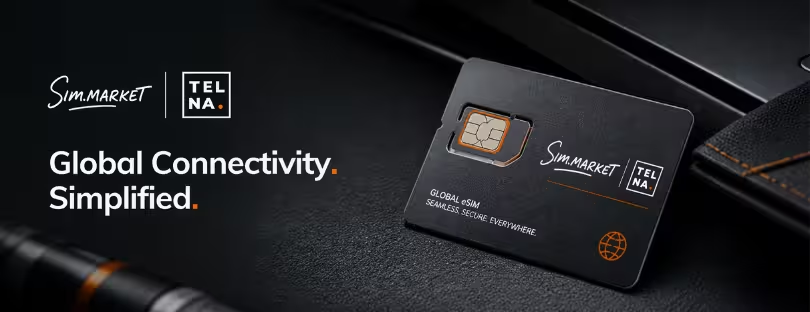
According to the company’s filing with the Pakistan Stock Exchange, Zuma will be able to launch its own global telecom brand, offering eSIM connectivity, mobile data, voice, SMS, and international roaming across multiple networks. You can find it here https://sim.market/
That’s not a small ambition. That’s essentially a full-stack telecom play, built on top of someone else’s infrastructure.
Why Telna matters here
Telna is not just another connectivity reseller. Over the past few years, it has positioned itself as a key enabler of embedded telecom, especially in travel and mobility use cases. Its multi-IMSI setup allows providers to dynamically connect users to different networks depending on location, performance, and cost.
More importantly, Telna has been actively pushing into the travel eSIM ecosystem. The company recently backed that strategy with a $100 million travel eSIM venture fund, aimed at accelerating partnerships and expanding distribution in the global connectivity space.
That context matters. Zuma isn’t just plugging into a network. It’s plugging into a broader push to scale eSIM adoption globally.
The classic “build vs. plug in” decision
What Zuma is doing reflects a wider shift we’re seeing across the industry.
Instead of investing years and capital into building telecom infrastructure, new entrants are increasingly choosing to “plug in” via platforms like Telna, 1GLOBAL, or Gigs. These players abstract away the complexity of roaming agreements, SIM provisioning, and network integrations.
The result is that launching a telecom brand today is less about spectrum and towers, and more about distribution, pricing models, and customer experience.
Zuma’s agreement reflects exactly that. It gives them:
- Access to global connectivity infrastructure
- The ability to operate as a reseller across jurisdictions
- Flexibility to integrate third-party partners
- A multi-supplier operating model
In other words, they get the backend without owning it.
A crowded but growing eSIM space
Of course, entering the eSIM market in 2026 is not like entering it in 2020.
Consumer-facing players such as Airalo, Holafly, and Nomad eSIM have already built strong distribution and brand recognition.
On the infrastructure side, companies like 1GLOBAL and Gigs are aggressively enabling fintechs, airlines, and digital platforms to embed connectivity directly into their products.
So where does Zuma fit?
At this stage, it’s not entirely clear. The company has stated that it intends to “develop, own, and operate its proprietary global telecom platform and brand,” but that positioning will depend heavily on execution.
Will they go direct-to-consumer?
Will they target enterprise or B2B2C partnerships?
Or will they position themselves as a regional connectivity layer with global reach?
Those are very different strategies, and the market is already competitive in each.

The MVNO angle
Zuma also mentioned it is evaluating applying for a Mobile Virtual Network Operator license from the Pakistan Telecommunication Authority.
That’s a logical next step, but it’s also where things get more complex.
MVNO licensing introduces regulatory overhead, local compliance requirements, and operational challenges that go beyond simply reselling connectivity. It can strengthen local positioning, especially in Pakistan, but it doesn’t automatically translate into global competitiveness.
In fact, many newer players are skipping the traditional MVNO route altogether and focusing instead on cross-border, API-driven connectivity models.
What this says about the industry
If you zoom out, this deal fits into a much bigger pattern.
We’re seeing telecom slowly transform from a vertically integrated industry into a layered ecosystem:
- Infrastructure providers (networks, roaming agreements)
- Enablement platforms (Telna, 1GLOBAL, Gigs)
- Distribution players (travel eSIM brands, fintechs, airlines)
Zuma is entering the distribution layer, but with ambitions to control more of the stack over time.
That’s ambitious, but not unrealistic, especially with the right partnerships.
At the same time, the barrier to entry has never been lower. And that creates a different kind of problem: differentiation.
Where this could actually work
The real opportunity for Zuma is not just launching “another eSIM brand.” That market is already saturated.
The opportunity lies in identifying a specific use case or vertical where connectivity is still broken or underserved.
Think:
- Regional travel corridors (Middle East to Europe, South Asia to the Gulf)
- SME or enterprise mobility solutions
- Bundled connectivity with financial or travel services
That’s where companies like Revolut (via 1GLOBAL) have succeeded. Not by selling data, but by embedding connectivity into an existing product ecosystem.
Conclusion
Zuma’s partnership with Telna is a smart shortcut into global telecom, but it’s not a guaranteed success.
The infrastructure is no longer the hard part. Telna, with its network and its $100 million push into travel eSIM, solves that. The real challenge is positioning.
If Zuma approaches this as a traditional telecom launch, it risks getting lost in a crowded, price-driven market dominated by established eSIM brands.
But if it treats connectivity as a feature, not a product, and builds around a specific audience or use case, the story changes completely.
That’s where the industry is heading. And that’s where new entrants still have a chance to win.
Because in 2026, telecom isn’t about who owns the network anymore. It’s about who owns the customer relationship.